The I-400, a marvel of naval engineering conceived in the twilight years of World War II, stands as a testament to Japan’s audacious ambition and innovative spirit. More than just a submarine, it was a floating airbase, a seaborne platform designed to project air power across vast oceanic distances. Its creation was born from desperation, a strategic gamble in a war that was increasingly tilting against the Axis powers. The Imperial Japanese Navy, facing dwindling resources and the relentless might of the Allied fleets, sought a weapon that could strike at the heart of the enemy homeland, a weapon that could deliver a psychological blow as potent as any physical damage. The I-400 class submarine was their answer.
## The Strategic Imperative: A Desperate Gamble
The genesis of the I-400 project can be traced back to the dire straits in which Japan found itself by 1943. The brutal island-hopping campaign by the United States had brought the war ever closer to the Japanese mainland, and Allied bombers were increasingly able to reach Japanese cities. The Japanese Navy, having suffered catastrophic losses in naval battles like Midway, understood that conventional naval warfare was no longer a viable option for projecting power offensively. They needed a way to circumvent the overwhelming Allied naval superiority and deliver a decisive blow. The concept of an aircraft-carrying submarine emerged as a radical, yet potentially game-changing, solution.
### The Vision of Airborne Assault
The core idea behind the I-400 was to create a submersible platform capable of launching aircraft to attack targets far beyond the reach of land-based airpower. The primary objective was the United States West Coast, specifically cities like San Francisco and Los Angeles, and potentially even the Panama Canal. Such an attack, it was reasoned, would not only cause significant destruction but also instill widespread panic and disrupt crucial supply lines. The aircraft themselves would be specially designed, compact, and capable of being launched from a catapult on the submarine’s deck. After their mission, they were intended to ditch at sea and be recovered by the submarine, a feat that, while challenging, was deemed achievable.
### Project Nihon: A Top-Secret Endeavor
The I-400 program was classified at the highest level. Known internally as “Project Nihon” or “K-Plan,” it involved a clandestine effort to develop and construct these unique vessels. The secrecy was paramount, as the Allies would undoubtedly view such a weapon as a grave threat and prioritize its destruction. The sheer scale of the undertaking, the specialized construction required, and the need for highly trained crews all contributed to the immense logistical and technical challenges faced by the Japanese. Despite these hurdles, the project moved forward with a determined urgency, reflecting the desperate measures being considered in the face of impending defeat.
The Japanese aircraft carrier submarine I-400 was a remarkable feat of engineering during World War II, designed to launch aircraft from beneath the surface of the ocean. This innovative vessel played a significant role in Japan’s naval strategy, showcasing the potential of combining submarine stealth with aerial capabilities. For more insights into the history and technology of the I-400 and its impact on naval warfare, you can read a related article at this link.
## Design and Engineering Prowess: A Submersible Airbase
The I-400 submarines were unlike anything seen before. They were the largest submarines ever built at the time, dwarfing their contemporaries in both size and capability. Their design was a complex integration of submarine and aircraft carrier functionalities, a fusion that pushed the boundaries of naval technology. The resulting vessels were truly remarkable feats of engineering, reflecting the ingenuity and resourcefulness of Japanese designers and shipbuilders.
### Immense Dimensions and Advanced Systems
The sheer size of the I-400 class submarines was staggering. They measured over 120 meters (approximately 400 feet) in length and displaced over 6,500 tons surfaced, making them considerably larger than even the largest Allied submarines. This immense size was necessary to accommodate the unique features of the design. They were equipped with powerful diesel engines for surface propulsion and electric motors for submerged operation, granting them a respectable range and speed for their era. Advanced features included a sophisticated ballast system for rapid diving and surfacing, along with a reinforced pressure hull designed to withstand considerable depth. The submarines were also equipped with powerful armament, including large-caliber deck guns and torpedo tubes, to provide self-defense.
### The Integrated Hangar and Catapult
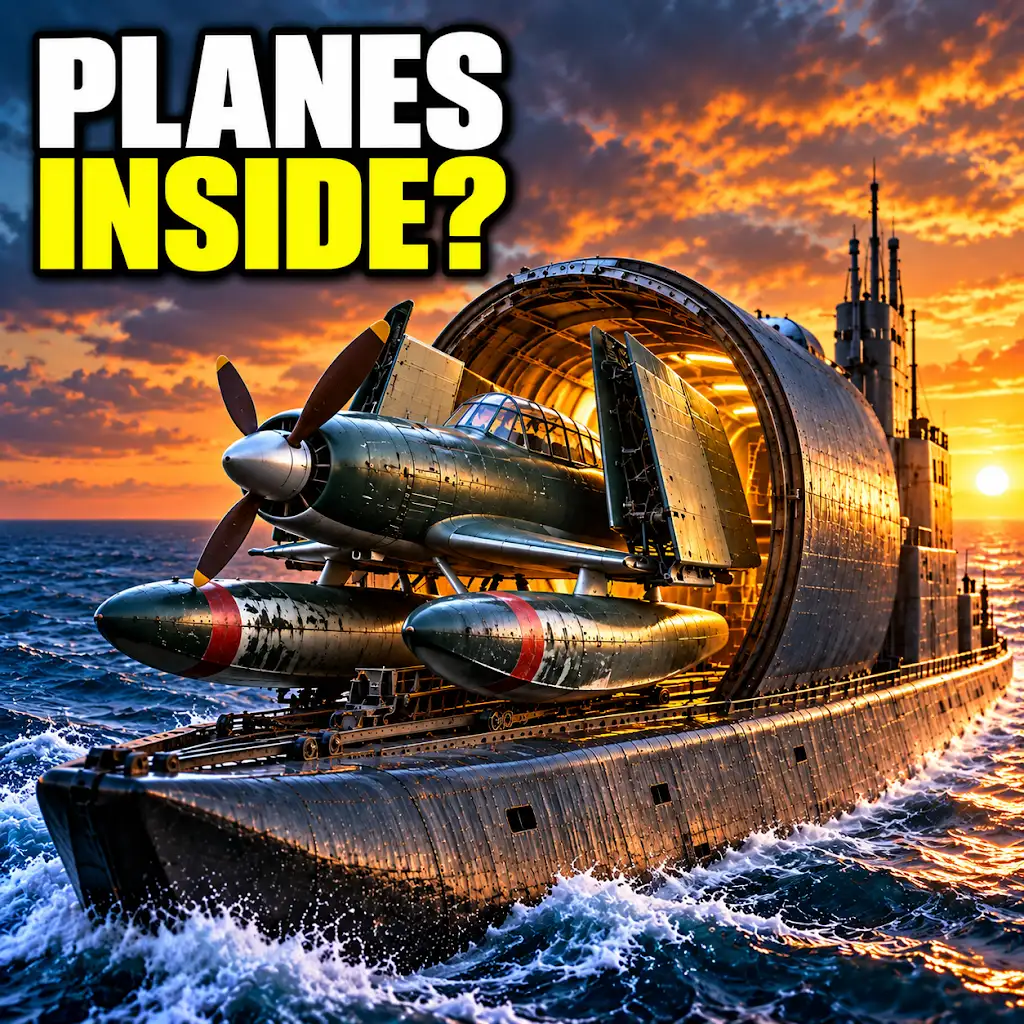
The most distinctive feature of the I-400 was its integrated aircraft hangar and launch system. A large, cylindrical hangar, capable of housing three Yokosuka MXY7 Ohka kamikaze planes or two Aichi M6A Seiran attack floatplanes, was built into the foredeck. The hangar was sealed and pressurized, allowing the submarines to launch their aircraft even while partially submerged or in rough seas. When an aircraft was to be launched, the submarine would surface, the hangar would be opened, and the aircraft would be moved onto a catapult mounted on the forward deck. This catapult, powered by gunpowder charges, could propel the aircraft into the air with sufficient speed for takeoff.
### Specialized Aircraft: The Seiran and Ohka
The success of the I-400 mission relied heavily on the specialized aircraft designed for its use. The primary aircraft was the Aichi M6A Seiran (“Mountain Storm”), a twin-engine floatplane designed specifically for carrier-based, or in this case, submarine-based, operations. The Seiran was capable of carrying a significant bomb load and was relatively fast for its time. Its float design allowed for water landings, theoretically enabling recovery by the submarine. Alongside the Seiran, the I-400 was also equipped to carry the Yokosuka MXY7 Ohka, a rocket-powered suicide attack aircraft. While the original intent of the I-400 was to launch conventional strike aircraft, the inclusion of the Ohka reflected the increasing desperation and the willingness to employ extreme measures.
## Operational Plans and Strategic Targets: Striking the Homeland
The strategic vision behind the I-400 class was audacious in its scope and chilling in its implications. The submarines were not intended for the usual submarine warfare of interdiction and reconnaissance. Their purpose was to deliver a direct, devastating blow to the enemy’s home front, a move designed to shatter morale and cripple war-making capacity.
### The Panama Canal as a Prime Objective
One of the most ambitious targets for the I-400 submarines was the Panama Canal. The strategic importance of the canal as a vital link for Allied shipping between the Atlantic and Pacific oceans cannot be overstated. A successful attack could have crippled this logistical artery, significantly delaying troop and supply movements. The plan was to launch aircraft equipped with bombs to attack the locks, potentially causing enough damage to render the canal impassable for an extended period. This would have forced the United States to divert significant resources to repair the damage and could have impacted the war effort in the Pacific.
### West Coast Cities Under Threat
Beyond the Panama Canal, the primary targets for the I-400 submarines were major cities on the West Coast of the United States. Cities like San Francisco, Los Angeles, and Seattle were envisioned as targets for aerial bombardment. The psychological impact of such an attack, delivered by submarines that could seemingly emerge from the ocean depths to strike at will, would have been profound. The Japanese hoped to sow fear and discord among the American population, potentially forcing the U.S. to divert military resources for homeland defense, resources that could otherwise be used in the Pacific theater.
### Challenges of Recovery and Logistics
The operational plans, while bold, were fraught with immense challenges. The recovery of the Seiran floatplanes after their missions was a critical and extremely difficult aspect. The submarines would have had to surface, locate the ditched aircraft, and then retrieve them with their onboard cranes. This process would have been time-consuming and exposed the submarine to enemy detection and attack. Furthermore, the logistics of supporting such long-range missions, including refueling and resupply, were complex and would have stretched Japanese naval capabilities to their limits. The limited number of aircraft and submarines also meant that the impact, while potentially significant, might not have been decisive enough to alter the course of the war.
## The I-400’s Legacy and Post-War Fate: A Ghost of What Might Have Been
The I-400 class submarines, despite their advanced design and ambitious plans, never achieved their intended strategic objectives. The war ended before they could be fully deployed on their most significant missions, leaving them as a fascinating “what if” in naval history. Their post-war fate is as dramatic as their conception, culminating in a clandestine investigation by the United States Navy.
### Limited Deployment and the War’s End
By the time the I-400 submarines were nearing completion and operational readiness, the tide of the war had irrevocably turned against Japan. The atomic bombings of Hiroshima and Nagasaki, followed by the Soviet Union’s declaration of war, brought about Japan’s surrender in August 1945. This effectively rendered the I-400’s strategic mission obsolete. While some of the submarines were pressed into limited service, their intended, highly destructive missions were never carried out. The war’s conclusion brought an abrupt end to their operational careers, leaving their potential for devastating impact unrealized.
### Post-War Investigation and Scuttling
Following Japan’s surrender, the United States Navy, aware of the existence of these unique vessels, expressed significant interest in their technology and design. A clandestine operation was launched to investigate the I-400 submarines and their capabilities. The submarines, designated for secret study, were taken to Hawaii. The U.S. Navy meticulously studied their construction, operational systems, and the aircraft they carried. Fearing that the advanced Japanese technology might fall into the hands of other nations, particularly the Soviet Union, the decision was made to scuttle the submarines. They were sunk in deep waters off the coast of Japan in 1946, ensuring that their secrets would remain with them.
### A Symbol of Ingenuity and Desperation
The I-400 class submarines stand as a poignant symbol of Japan’s technological prowess and the desperate measures it was willing to take in the face of overwhelming odds. They represent a fascinating intersection of submarine warfare and air power, a concept that would not be fully realized in naval strategy until decades later with the development of aircraft carriers. The I-400s, though never fully deployed for their intended purpose, remain a subject of historical fascination, a testament to human ingenuity and the complex, often tragic, narratives of wartime innovation. They are a reminder of the extraordinary measures conceived in the crucible of conflict, and the profound impact that even unfulfilled ambitions can have on our understanding of military history.
The Japanese aircraft carrier submarine I-400 represents a fascinating chapter in naval history, showcasing the innovative military strategies of World War II. This remarkable vessel was designed to carry and launch aircraft, allowing for unprecedented aerial strikes from underwater. For those interested in exploring more about the strategic implications and technological advancements of such submarines, you can read a detailed article on this topic at In the War Room. The I-400 not only highlights the ingenuity of its creators but also serves as a reminder of the evolving nature of warfare during that era.
## Lessons Learned and Lasting Impact: Echoes in Modern Naval Warfare
| Metric | Details |
|---|---|
| Type | Aircraft Carrying Submarine |
| Class | I-400 Class |
| Country | Japan |
| Displacement | 5,900 tons (surfaced), 6,500 tons (submerged) |
| Length | 122 meters (400 feet) |
| Beam | 12 meters (39 feet) |
| Draft | 7 meters (23 feet) |
| Speed | 18.7 knots (surfaced), 6.5 knots (submerged) |
| Range | 37,500 nautical miles at 14 knots (surfaced) |
| Test Depth | 100 meters (330 feet) |
| Armament | 3 x Aichi M6A Seiran aircraft, 8 x 533 mm torpedo tubes, 1 x 140 mm deck gun |
| Aircraft Capacity | 3 Seiran floatplane bombers |
| Crew | 144 officers and enlisted men |
| Commissioned | 1944 |
| Fate | Surrendered to US Navy in 1945, later scuttled |
The I-400 project, despite its ultimate lack of strategic success, offered valuable insights and foreshadowed future developments in naval warfare. The challenges and innovations associated with its design and intended operations left an indelible mark on naval thought, influencing concepts that would become commonplace in later decades. The integration of air power with submersible platforms, though not fully realized in the I-400’s era, laid conceptual groundwork.
### The Dawn of Submarine Aviation Integration
The I-400 was perhaps the most ambitious attempt in history to integrate aviation capabilities directly into a submarine platform. While early submarines had experimented with carrying small aircraft for reconnaissance, the I-400 was designed for offensive air operations. The concept of a submersible launching aircraft for strategic strikes was a radical departure from traditional submarine roles. Although the technical hurdles and operational complexities proved immense, the very attempt pushed the boundaries of what was considered possible. This pioneering effort, in its own way, contributed to the eventual understanding of the synergistic potential between submarines and aircraft, a concept that would evolve with advancements in technology.
### Foreshadowing Future Naval Concepts
The ambition behind the I-400 project, while born of wartime desperation, contained elements that resonate with modern naval thinking. The idea of a single platform capable of versatile operations, projecting power in multiple domains, is a cornerstone of contemporary naval strategy. While the I-400 was a submarine with aircraft, modern naval forces often employ multi-mission vessels and integrated systems that allow for a wide range of operational capabilities. The challenges faced in recovering aircraft and maintaining operational readiness also highlight the enduring complexities of combining disparate military technologies. The lessons learned, both in terms of success and failure, from such innovative but ultimately unfulfilled projects, continue to inform naval design and doctrine. The I-400 serves as a historical case study in the pursuit of strategic advantage through technological innovation, a reminder that even in defeat, great projects can leave behind valuable legacies.
Japan Built a Submarine That Could Launch Three Planes
FAQs
What is the Japanese aircraft carrying submarine I-400?
The Japanese aircraft carrying submarine I-400 was a large submarine built by the Imperial Japanese Navy during World War II. It was designed to carry three Aichi M6A Seiran aircraft for reconnaissance and bombing missions.
When was the Japanese aircraft carrying submarine I-400 built?
The I-400 submarine was built in the early 1940s and launched in 1943. It was one of the largest submarines ever built at the time, measuring over 400 feet in length.
How many aircraft could the Japanese submarine I-400 carry?
The I-400 submarine was designed to carry three Aichi M6A Seiran aircraft in a watertight hangar located on the deck of the submarine. These aircraft could be launched using a catapult system.
What was the purpose of the Japanese aircraft carrying submarine I-400?
The I-400 submarine was intended to be used for long-range reconnaissance and bombing missions against enemy targets, particularly in the Pacific Ocean during World War II. It was part of Japan’s strategy to extend its military reach beyond its naval bases.
What happened to the Japanese aircraft carrying submarine I-400 after World War II?
After Japan’s surrender in 1945, the I-400 submarine was captured by the United States Navy. It was taken to Hawaii for evaluation and eventually scuttled off the coast of Oahu in 1946 as part of a weapons test.