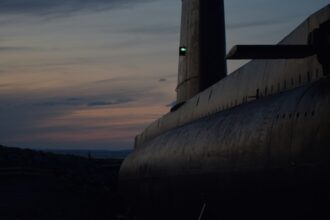
The frigid waters of the North Atlantic, a familiar theater for naval posturing, became the stage for a tense encounter between a United States Navy warship and a Soviet submarine. Reports from naval officials, shrouded in the typical reticence surrounding such incidents, described a close call that underscored the persistent undercurrent of Cold War rivalry simmering beneath the surface of détente. The alleged aggressive maneuver by the Soviet vessel, a presumed attack submarine, against the USS Gettysburg, a guided-missile cruiser, sent ripples of concern through defense circles and highlighted the ever-present risks of miscalculation in international waters.
The Shadowy Encounter Beneath the Waves
The incident, which reportedly occurred in international waters at a considerable distance from any territorial claims, involved a calculated risk by the Soviet submarine. While details remained scarce, official accounts suggested the submarine had positioned itself in a manner that strongly indicated hostile intent towards the American warship. The maneuver was described as an attempt to “charge” or close aggressively on the USS Gettysburg, a move that could have easily escalated into a dangerous confrontation. The U.S. Navy’s account painted a picture of a submarine operating with a degree of boldness, or perhaps recklessness, that belied the more nuanced diplomatic relations that were purportedly in place at the time.
Defining Aggression in the Maritime Domain
Understanding the implications of this alleged “charge” requires an appreciation for the unwritten rules and protocols that govern naval interactions, particularly between rival superpowers. In the confined and often invisible realm of submarine warfare, such aggressive maneuvers are rarely accidental. They are deliberate actions, meant to signal intent, test response times, or even provoke a reaction. For a submarine to “charge” a surface vessel is akin to a fighter jet performing a close pass or a tank advancing rapidly on an enemy position. It is a direct assertion of proximity and potential threat, designed to unnerve and to gauge the opponent’s composure.
The USS Gettysburg: A Capable Guardian
The USS Gettysburg (CG-60) is an Aegis-equipped guided-missile cruiser, a formidable platform in the U.S. Navy’s arsenal. These ships are designed for a multi-mission role, including anti-air warfare, anti-surface warfare, and anti-submarine warfare. Their advanced radar and weapon systems make them highly capable of detecting and engaging threats from all domains. The fact that a Soviet submarine felt compelled, or perhaps emboldened, to engage in such a close encounter with a vessel of the Gettysburg‘s caliber suggests a deliberate effort by the Soviet side to demonstrate capability or to assert dominance in the region. The crew of the Gettysburg, trained to the highest standards, would have been acutely aware of the potential danger and would have reacted with a calibrated response, prioritizing de-escalation while maintaining a defensive posture.
In recent news, a Soviet submarine was reported to have charged at a US warship, raising tensions in the region and sparking discussions about naval encounters during the Cold War. For a deeper understanding of the historical context and implications of such incidents, you can read a related article that explores similar maritime confrontations. For more information, visit this article.
The Submarine’s Alleged Motivation
The precise reasons behind the Soviet submarine’s aggressive actions remain a subject of speculation, but several plausible explanations emerge from the context of the Cold War naval environment. These include intelligence gathering, signaling strength, or even a misjudgment of intentions. Regardless of the underlying cause, the incident underscored the delicate balance of power and the constant potential for unintended escalation that characterized superpower naval interactions.
The Espionage Imperative
Submarine operations are inherently clandestine, and a primary mission for many submarines, especially during the Cold War, was intelligence gathering. A Soviet submarine closing aggressively on a U.S. warship could have been an attempt to gather electronic intelligence (ELINT) from the Gettysburg‘s radar and communication systems. By getting as close as safely possible, the submarine could maximize the signal strength and the quality of the intercepted data. This type of intelligence is invaluable, providing insights into the capabilities, operational procedures, and even the intentions of the opposing navy. The risk of detection and potential confrontation would have been weighed against the intelligence yield.
A Show of Force and Resolve
Beyond intelligence gathering, the incident may have been intended as a clear demonstration of Soviet naval power and resolve. In the competitive geopolitical landscape of the Cold War, neither side wished to appear weak or hesitant. A bold maneuver like charging a U.S. warship, while risky, could be seen as a way to project strength, to assert a presence in contested waters, and to remind the U.S. of the Soviet Union’s own formidable submarine capabilities. Such actions could be aimed at influencing strategic calculations and discouraging perceived encroachments by the opposing superpower. It was a form of “gunboat diplomacy” conducted beneath the waves, a silent but potent message delivered through action rather than words.
In recent news, a Soviet submarine was reported to have charged at a US warship, raising tensions in the region and prompting discussions about naval security. This incident echoes the historical confrontations during the Cold War, where submarine encounters often led to heightened military readiness on both sides. For a deeper understanding of the implications of such naval interactions, you can read a related article that explores the strategic significance of these underwater operations. Check it out here for more insights.
The Specter of Miscalculation
However, the possibility of a miscalculation cannot be entirely discounted. In the high-pressure environment of submarine operations, where visibility is limited and communication can be challenging, misunderstandings can arise. A Soviet captain might have misjudged the intentions of the Gettysburg, or perhaps misinterpreted a defensive maneuver as an offensive one. Alternatively, a junior officer might have acted rashly, driven by nationalist fervor or a desire to impress superiors, without fully considering the broader strategic implications. While less likely than deliberate action, the potential for a single, unauthorized act to spark a wider conflict was a constant concern for naval commanders on both sides.
The U.S. Navy’s Response and Protocols
The U.S. Navy’s response to such an aggressive maneuver would have been dictated by strict rules of engagement and a long-standing doctrine of measured but firm deterrence. The emphasis would have been on de-escalation while ensuring the safety of the Gettysburg and its crew. The incident, while reported, would have been handled through official diplomatic channels, with the U.S. lodging a protest with the Soviet Union.
De-escalation as a Primary Objective
The paramount objective in any close encounter with a potentially hostile vessel is to avoid escalation. The U.S. Navy has developed sophisticated protocols for dealing with such situations. This typically involves a series of escalating actions designed to signal displeasure and to warn the opposing vessel without resorting to immediate hostile force. These might include visual signals, audible warnings, or maneuvering the surface ship to create a greater separation. The Gettysburg‘s crew would have been trained to maintain calm under pressure, to assess the threat accurately, and to execute these protocols with precision. The goal is to diffuse the situation and prevent it from spiraling into a conflict.
Asserting Sovereignty in International Waters
While operating in international waters, all naval vessels are entitled to freedom of navigation. However, this freedom does not extend to actions that could be construed as hostile or that impede the legitimate operations of other nations’ ships. The U.S. Navy’s stance, in such cases, would be to assert its right to operate freely and to condemn any actions that infringe upon this right or that pose a danger to its personnel and equipment. The incident would have served as a reminder to the Soviet Union that the U.S. Navy would not tolerate aggressive or provocative behavior in international maritime spaces.
Diplomatic Channels and Formal Protests
Following an incident like this, the U.S. Department of State and the Department of Defense would have coordinated to convey their concerns to the Soviet government. This would typically involve a formal diplomatic protest, delivered through the embassy or other official channels. The protest would detail the nature of the incident, express the U.S. government’s dissatisfaction, and likely demand an explanation or assurance that such actions would not be repeated. The Soviet response, or lack thereof, would then inform future U.S. naval posture and diplomatic engagement.
The Broader Geopolitical Context
The incident involving the USS Gettysburg and the Soviet submarine did not occur in a vacuum. It was a manifestation of the enduring tensions and strategic competition that defined the Cold War, even during periods of supposed thawing relations. Such encounters served as stark reminders of the potential for conflict that lay beneath the surface of superpower diplomacy.
The Long Shadow of the Cold War
The Cold War, a decades-long ideological and geopolitical struggle between the United States and the Soviet Union, permeated all aspects of international relations, including naval operations. Despite periods of arms control negotiations and attempts at détente, the fundamental mistrust and strategic rivalry persisted. Submarines, with their stealth capabilities and potent offensive and defensive roles, were central to this competition. Both sides invested heavily in submarine technology and training, recognizing their crucial role in projecting power, deterring aggression, and gathering intelligence. Encounters like the one with the Gettysburg were an everyday reality for naval personnel on both sides, a constant dance on the precipice of confrontation.
Naval Posturing and Deterrence
Naval forces are often at the forefront of superpower competition, serving as visible symbols of national power and as instruments of deterrence. The presence of warships and submarines in strategically important regions, and the conduct of exercises and patrols, are all part of a complex signaling game. A Soviet submarine aggressively approaching a U.S. cruiser could be interpreted as a challenge to American naval dominance in a particular area, or as an attempt to test the resolve of the U.S. Navy. Conversely, the U.S. Navy’s ability to detect, track, and react to such maneuvers effectively demonstrated its own capabilities and commitment to maintaining freedom of the seas.
The Unseen Dangers of Close Encounters
The true danger of these close encounters lay in their potential for unintended escalation. A minor incident, a miscommunication, or an overzealous captain could, in theory, ignite a larger conflict, particularly if tensions were already high. The strategic doctrines of both sides were designed to prevent such an outcome, but the inherent risks remained. The incident with the Gettysburg served as a potent reminder of the human element in naval warfare and the critical importance of discipline, clear communication, and established protocols to
A Soviet Submarine Hit a U.S. Frigate. Was It the Wrong Ship?
FAQs
1. What happened when a Soviet submarine charged a US warship?
During the Cold War, in 1988, a Soviet submarine charged a US warship in the Barents Sea. The incident escalated tensions between the two superpowers.
2. How did the US warship respond to the Soviet submarine’s charge?
The US warship responded by taking evasive maneuvers to avoid a collision with the Soviet submarine. The crew of the US warship also prepared for a potential confrontation.
3. Were there any casualties during the incident between the Soviet submarine and the US warship?
Fortunately, there were no casualties reported during the incident between the Soviet submarine and the US warship. Both sides were able to avoid a direct confrontation.
4. What was the outcome of the confrontation between the Soviet submarine and the US warship?
After the tense standoff, the Soviet submarine eventually backed off and the situation de-escalated. The US warship continued its mission in the Barents Sea without further incident.
5. How did the incident between the Soviet submarine and the US warship impact US-Soviet relations?
The incident further strained US-Soviet relations during the Cold War. It highlighted the ongoing tensions and potential for conflict between the two superpowers at the time.