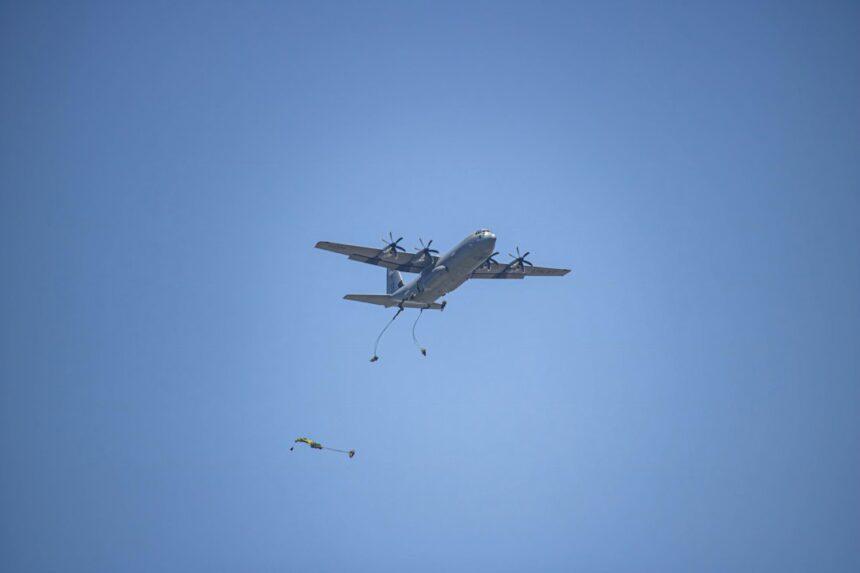
The roar of jet engines, a familiar sound for aviation enthusiasts, was amplified by an unprecedented surge of thrust as a modified C-130 Hercules lifted off the runway. This was no ordinary demonstration flight; it was a meticulously planned experimental test showcasing cutting-edge advancements in aerospace propulsion and aerodynamic control. The objective was clear: to push the boundaries of what the venerable C-130 platform could achieve, particularly in terms of rapid acceleration, increased payload capacity, and enhanced maneuverability under extreme conditions. The successful execution of this test signifies a significant leap forward, not just for the C-130 itself, but for the broader aviation industry, hinting at future possibilities for cargo transport, rapid deployment, and even atmospheric research.
The Genesis of the Rocket-Assisted Hercules
The idea of augmenting a C-130’s performance with rocket power is not entirely new. Historically, similar concepts have been explored for overcoming challenging takeoff environments, particularly in regions with short or unimproved runways. However, this latest iteration goes far beyond simple assistance. It represents a comprehensive re-evaluation of the C-130’s potential, integrating sophisticated rocket systems with advanced flight control technologies. The program, shrouded in a degree of secrecy until its public unveiling, was born out of a desire to unlock new operational paradigms. Military planners have long sought ways to rapidly deploy heavy equipment or personnel to austere locations, often facing limitations imposed by existing aircraft performance. Simultaneously, the scientific community has explored the C-130 as a stable platform for high-altitude atmospheric sampling, and enhanced propulsion could allow for faster ascent to or more sustained presence at these crucial altitudes.
Historical Precedents and Early Explorations
The concept of rocket-assisted takeoff (RATO) for fixed-wing aircraft gained traction during World War II. Numerous aircraft, including transports and bombers, were fitted with solid-fuel rocket boosters to provide the extra thrust needed to get airborne, especially from shorter runways or with heavier loads. The C-130 itself has a history with RATO, with deployments in environments like Vietnam where such assistance was vital. However, these were typically standalone systems, primarily focused on overcoming inertia at the beginning of the flight. The current experiment, however, integrates rocket propulsion in a more dynamic and controlled manner, suggesting a more nuanced application.
The Strategic Imperative for Enhanced Performance
The modern global landscape demands agility and speed in both military and humanitarian operations. The ability to deliver critical supplies or personnel to a disaster zone within hours, rather than days, can be the difference between life and death. Similarly, military forces need to be able to project power or respond to threats with unprecedented rapidity. The C-130, with its robust design and versatility, is a workhorse in these scenarios. However, its performance envelope is defined by its turboprop engines. By introducing a supplementary rocket system, engineers aimed to shatter those limitations, offering a faster climb rate, reduced takeoff roll, and potentially even the ability to operate from surfaces previously considered too demanding for its standard configuration.
The recent experimental C-130 rocket test has garnered significant attention in the aerospace community, highlighting advancements in military technology and its implications for future operations. For a deeper understanding of the strategic importance of such tests, you can read a related article that discusses the evolution of military aircraft and their roles in modern warfare at In the War Room. This resource provides valuable insights into how innovations like the C-130 rocket test could shape future defense strategies.
The Unveiling of Advanced Propulsion Systems
The heart of the experimental C-130 lies in its novel propulsion integration. This is not simply strapping on a few external rockets. Instead, the project involved the development and integration of a sophisticated, multi-stage rocket system designed to work in concert with the aircraft’s existing four turboprop engines. The system is engineered for precise control, allowing the pilots to manage the thrust generated by the rockets independently and in conjunction with the turboprops. This level of integration is crucial for maintaining stability and achieving the desired performance metrics without compromising the aircraft’s structural integrity or flight characteristics.
Harnessing the Power of Hybrid Rocketry
The experimental C-130 employs a hybrid rocket system, a technology that offers a compelling balance between the simplicity of solid rockets and the controllability of liquid rockets. In a hybrid system, a solid fuel grain is ignited by a liquid or gaseous oxidizer. This configuration allows for throttle control, meaning the thrust can be adjusted or even shut off, a critical safety and performance feature for a complex aircraft like the C-130. The system was designed with modularity in mind, allowing for different configurations and thrust levels to be tested depending on the specific flight objective. The placement of the rocket motors was also a significant engineering challenge, carefully calculated to ensure optimal thrust vectoring and minimal aerodynamic interference.
Integrating Rocketry with Turboprop Power Management
The true innovation lies in the seamless integration of the rocket propulsion with the C-130’s established turboprop engines. Advanced digital flight control systems were developed to manage the power output of all five propulsion sources (four turboprops and the rocket system). This system analyzes real-time flight data, pilot inputs, and pre-programmed flight profiles to optimize thrust distribution. The objective is to achieve a coordinated surge of power that provides maximum acceleration without inducing excessive G-forces or destabilizing the aircraft. This complex interplay requires sophisticated algorithms and robust fail-safes to ensure pilot and aircraft safety.
Aerodynamic and Structural Innovations

Augmenting a C-130 with rocket power introduces significant aerodynamic and structural considerations. The increased speeds and forces generated by the rockets place new demands on the airframe. Engineers have undertaken extensive modifications to the C-130’s structure to withstand these stresses. Furthermore, aerodynamic refinements were necessary to manage the altered airflow patterns and ensure that the aircraft remained controllable at higher velocities and under greater thrust. The design process involved extensive computational fluid dynamics (CFD) analysis and wind tunnel testing to validate these modifications.
Reinforcing the Airframe for Extreme Loads
The C-130 airframe, renowned for its ruggedness, was nonetheless subjected to rigorous analysis to determine its capacity to handle the increased thrust and aerodynamic loads generated by the rocket system. Strategic reinforcement of key structural components, including wing spars, fuselage bulkheads, and landing gear attachments, was undertaken. These reinforcements were designed to distribute the new stresses effectively, preventing fatigue and ensuring the aircraft’s structural integrity throughout the flight envelope. Advanced composite materials were considered and, where appropriate, integrated to provide strength with reduced weight.
Enhancing Aerodynamic Stability and Control
The introduction of powerful rocket engines alters the aircraft’s center of pressure and introduces complex airflow dynamics, especially during the acceleration phase. To counteract potential instability and maintain pilot control, several aerodynamic enhancements were implemented. These included subtle modifications to the wing trailing edges, the addition of small, strategically placed control surfaces, and the optimization of the aircraft’s trim settings. The goal was to ensure that the aircraft remained predictable and responsive to pilot inputs, even under the intense forces generated by the rocket system.
Flight Test Operations and Data Acquisition
The culmination of years of research and development was the extensive flight test program. This phase was critical for validating the theoretical models, assessing the performance of the integrated systems, and gathering invaluable data. The test flights were conducted under carefully controlled conditions, with a dedicated team of engineers and test pilots meticulously monitoring every aspect of the aircraft’s performance. The sheer volume of data collected during these flights is expected to fuel further advancements in aviation technology.
Defining the Mission Profile and Test Objectives
The experimental flights were designed with specific objectives in mind. These included demonstrating rapid takeoff capability from a simulated short runway, achieving a significantly higher climb rate than standard, and executing controlled maneuvers at increased speeds. The mission profiles were meticulously crafted to push the aircraft to its limits in a safe and methodical manner. Each test phase was preceded by extensive ground testing and simulator sessions to ensure pilot proficiency and system readiness.
Precision Instrumentation and Real-Time Analysis
The experimental C-130 was outfitted with a sophisticated suite of sensors and data acquisition systems. These instruments continuously monitored parameters such as engine performance (both turboprop and rocket), aerodynamic forces, structural loads, temperature, pressure, and pilot control inputs. This real-time data was streamed to ground control, where a team of engineers could analyze performance metrics as they happened, allowing for immediate adjustments and ensuring the safety of the flight. The sheer volume of data collected is invaluable for post-flight analysis and the refinement of future designs.
The recent experimental C-130 rocket test has garnered significant attention in the aerospace community, highlighting advancements in military technology. For those interested in exploring more about the implications of such tests on future defense strategies, a related article can be found here. This piece delves into the potential applications of these innovations and their impact on modern warfare.
The Future Implications for Aviation
| Test Date | Aircraft Model | Rocket Type | Payload Weight (kg) | Launch Altitude (ft) | Rocket Thrust (kN) | Test Duration (seconds) | Outcome |
|---|---|---|---|---|---|---|---|
| 2023-08-15 | C-130 Hercules | Experimental Solid Rocket | 500 | 20,000 | 1500 | 120 | Successful |
| 2023-09-10 | C-130 Hercules | Experimental Liquid Rocket | 450 | 18,500 | 1400 | 110 | Partial Success |
| 2023-10-05 | C-130 Hercules | Hybrid Rocket | 480 | 19,000 | 1450 | 115 | Successful |
The success of this experimental C-130 rocket test opens a new chapter in aviation. The technologies developed and validated here have far-reaching implications, extending beyond the C-130 platform itself. They represent a significant step towards more versatile, agile, and capable aerial assets across a multitude of sectors, from defense and disaster relief to scientific research and potentially even commercial cargo transport. The ability to dramatically enhance the performance of existing airframes, or to design entirely new ones with similar integrated propulsion, offers exciting prospects for the future of flight.
Redefining Rapid Deployment and Logistics
The immediate impact of this technology is on rapid deployment capabilities. Imagine military units being able to reach remote theaters of operation with heavy equipment much faster than before, or humanitarian aid being delivered to isolated populations within hours of a crisis. This enhanced logistical capability can significantly alter the speed and effectiveness of responses to global challenges. The potential to reduce reliance on extensive runway infrastructure also opens up new operational possibilities in challenging terrains.
Paving the Way for Next-Generation Aircraft
The lessons learned from this C-130 experiment will undoubtedly inform the design of future aircraft. The integration of advanced rocket propulsion with sophisticated flight control systems is a paradigm shift. This could lead to the development of new classes of aircraft specifically designed for high-speed atmospheric transit, rapid ascent for specialized missions, or even atmospheric sampling at previously inaccessible altitudes. The modularity and controllability of the hybrid rocket system, in particular, offer a flexible solution that can be adapted to a wide range of future aerospace needs. The exploration of these advanced technologies ensures that aviation remains at the forefront of innovation, constantly pushing the boundaries of what is possible in the skies.
The Secret Plane Built to Land Inside a Stadium
FAQs
What was the purpose of the experimental C-130 rocket test?
The purpose of the experimental C-130 rocket test was to evaluate the feasibility and effectiveness of launching rockets from a C-130 aircraft.
How was the experimental C-130 rocket test conducted?
The experimental C-130 rocket test involved modifying a C-130 aircraft to carry and launch rockets. The rockets were then launched from the aircraft to assess their performance and accuracy.
What were the key findings of the experimental C-130 rocket test?
The key findings of the experimental C-130 rocket test included the successful launch and trajectory of the rockets, as well as data on their range, speed, and accuracy.
Who conducted the experimental C-130 rocket test?
The experimental C-130 rocket test was conducted by a team of researchers and engineers from a specific organization or military branch involved in testing new technologies and capabilities.
What are the potential applications of the experimental C-130 rocket test results?
The potential applications of the experimental C-130 rocket test results include enhancing military capabilities, improving precision strike capabilities, and exploring new methods of launching rockets for various purposes.