The Aichi M6A Seiran, a name that whispers of audacious naval strategy and daring innovation, stands as a singular testament to a unique chapter in aviation history. Its very existence was born from a desire to strike at an enemy’s heart from an unexpected and potent platform – the submarine. This extraordinary aircraft, designed for launch from underwater vessels, represented a bold leap in military technology, blending the strategic reach of naval aviation with the stealth and surprise of submarine warfare. The Seiran, meaning “Clear Sky Storm” in Japanese, was envisioned as a potent offensive weapon, capable of delivering a telling blow to distant targets previously considered beyond the reach of submarine-borne aircraft. Its development and operational concept were as remarkable as the machine itself, embodying a spirit of ingenuity driven by the desperate circumstances of war.
The Genesis of a Submarine Aircraft Concept
The concept of launching aircraft from submarines was not entirely new, but it gained significant traction during the early years of World War II. For Japan, a nation with a vast maritime empire to defend and a growing need to project power far beyond its immediate shores, the idea held immense appeal. Submarines offered unparalleled stealth, allowing them to approach enemy territories undetected. Coupling this with the offensive capabilities of an aircraft could create a formidable strategic weapon, capable of reconnaissance, attack, and psychological impact. The potential targets were vast and tempting: distant enemy naval bases, vital industrial centers, and even major cities that lacked robust air defenses. The Japanese Imperial Navy, ever in pursuit of innovative solutions to gain an advantage, recognized the strategic implications of such a synergy.
Early Forerunners and Strategic Imperatives
Before the M6A Seiran, there had been earlier, albeit less integrated, attempts at combining submarines and aircraft. Primarily, these involved catapult-launched floatplanes carried aboard submarines for scouting purposes. While these provided valuable reconnaissance, they were limited in offensive capability and required significant surface time for launching and recovery. The Japanese Navy, however, envisioned something more ambitious: a dedicated attack aircraft that could be launched rapidly from a submerged submarine, deliver its payload, and potentially recover at a friendly base or even be ditched if necessary. This leap from reconnaissance to strike capability was a critical shift in thinking. The strategic imperative was to find ways to bypass conventional defenses and inflict damage where it was least expected. The vast Pacific Ocean presented both a challenge and an opportunity, and the submarine-launched aircraft offered a potential solution to extend Japan’s offensive reach significantly.
The Aichi Aircraft Company’s Mandate
The development of such a revolutionary aircraft fell to the Aichi Aircraft Company, a firm with a strong reputation for naval aircraft design. The Imperial Navy provided Aichi with a clear mandate: design a robust, carrier-capable (though in this case, submarine-capable) dive-bomber and torpedo bomber that could withstand the rigors of submarine deployment and launch. Key design considerations included a compact size for stowage within the submarine’s hangar, rapid assembly and launch procedures, and a sufficient combat radius to strike enemy targets. The aircraft needed to be able to be launched quickly after the submarine surfaced, minimizing its vulnerability. Furthermore, the design had to be relatively simple to maintain and operate, considering the limited resources available on a submarine. This demanding set of requirements spurred Aichi’s engineers to explore unconventional solutions.
The Aichi M6A Seiran was a remarkable submarine-launched aircraft developed during World War II, designed for long-range missions against enemy ships. For those interested in learning more about the innovative designs and strategic implications of such aircraft, a related article can be found at this link: here. This article delves into the technological advancements of the era and the impact of submarine warfare on aerial tactics.
The M6A Seiran: Design and Engineering Marvel

The Aichi M6A1 Seiran was the culmination of Aichi’s efforts, a striking machine that embodied the unique demands of its intended operational environment. It was a monoplane, featuring a low wing configuration and a distinctive retractable float system that allowed it to operate from water. The engineering challenges were substantial, requiring a balance between structural integrity for combat and the need for lightweight construction for efficient launch and transport.
Aerodynamic Efficiency and Compact Stowage
The Seiran was designed with aerodynamic efficiency in mind, ensuring it could perform effectively as a dive bomber. Its wings were relatively short and broad, contributing to its maneuverability. Crucially, the design incorporated a folding wing mechanism, a critical feature for its stowage aboard submarines. This allowed the aircraft to occupy a much smaller footprint within the submarine’s hangar, making it feasible to carry multiple aircraft. The main wings folded upwards and backwards, enabling the Seiran to fit snugly into the specialized cylindrical hangars of the I-400 class submarines. This ingenious folding mechanism was a testament to the meticulous engineering required to integrate an aircraft into a submarine’s operational profile.
The Unique Floatation System
Perhaps the most distinctive feature of the M6A Seiran was its innovative retractable floatation system. Instead of the typical fixed landing gear of land-based aircraft, the Seiran was equipped with two large floats beneath the fuselage and a smaller tail float. These floats were essential for water landings and takeoffs, but their design also contributed to the aircraft’s operational flexibility. The main floats were designed to retract upwards into the aircraft’s fuselage, reducing drag during flight. This retraction system was a complex piece of engineering, requiring robust mechanisms to ensure reliability. The ability to retract the floats was vital for efficient flight and for preparing the aircraft for stowage.
Powerplant and Performance
The Seiran was powered by a single Mitsubishi Kinsei 43 radial engine, a reliable and potent powerplant for its time. This engine provided the necessary thrust for the aircraft’s dive bombing missions and for achieving a reasonable combat radius. The engine’s output was carefully matched to the aircraft’s weight and aerodynamic profile to ensure acceptable performance characteristics. While not the fastest aircraft of its era, the Seiran was designed for a specific role, emphasizing dive bombing capabilities over sheer speed. Its performance envelope was tailored for the mission: rapid ascent, steep dives, and sufficient endurance to reach its targets and return to its submarine recovery point.
Operational Concept: The I-400 Class Submarines
The Aichi M6A Seiran was inextricably linked to the development of the Imperial Japanese Navy’s I-400 class submarines. These were not ordinary submarines; they were colossal vessels, the largest submarines ever built at the time, and were specifically designed to serve as aircraft carriers. Their immense size was dictated by the need to house and launch the Seiran aircraft. The synergy between the submarines and the aircraft was the cornerstone of this audacious strategic concept.
The Submarine Carrier Role
The I-400 class submarines were revolutionary in their design, incorporating a large, hangar-like structure atop their decks, capable of holding three Aichi M6A Seiran aircraft. This hangar was a sealed cylinder, designed to protect the aircraft from the elements and to maintain a level of readiness. The submarines were also equipped with a catapult system that allowed for the rapid launch of the Seiran. The entire operational doctrine revolved around the submarine surfacing, launching its aircraft, and then submerging to avoid detection while the aircraft conducted its mission. The submarine would then attempt to rendezvous with the aircraft for recovery or, in dire circumstances, the aircraft could be ditched.
Launch and Recovery Procedures
The process of launching a Seiran from an I-400 class submarine was a carefully orchestrated and time-sensitive operation. Once the submarine surfaced and the aircraft were readied, the hangar was opened, and the aircraft were brought onto the deck. The wings were unfolded, and the aircraft were positioned on the catapult. With a powerful surge of steam or compressed air, the catapult would propel the Seiran into the air. Recovery was a more complex affair. Ideally, the submarine would be waiting at a pre-arranged rendezvous point. The pilot would ditch the aircraft in the water near the submarine, and the crew would attempt to recover the pilot and salvage what they could of the aircraft. Given the operational realities and the strategic risks, recovery was often not successful, and many Seiran aircraft were likely lost after their missions.
Strategic Targets and Ambitions
The intended targets for the Seiran and its carrier submarines were ambitious, reflecting Japan’s desperate strategic situation. The most well-known proposed mission was an attack on the Panama Canal. The rationale was to cripple vital Allied supply lines and to sow widespread panic and disruption. The idea was that a submarine-launched aerial attack on such a critical piece of infrastructure would be utterly unexpected and potentially devastating. Other potential targets included naval bases on the West Coast of the United States, such as San Francisco and San Diego, and industrial centers. The psychological impact of such an attack, bringing the war directly to the enemy’s homeland from an unconventional source, was also a significant consideration.
Combat and Operational History
Despite its impressive design and revolutionary concept, the Aichi M6A Seiran saw very limited combat. The circumstances of the war, the immense logistical challenges, and the eventual Allied dominance of the Pacific theater all contributed to the Seiran’s operational obscurity. The aircraft and its carrier submarines were largely kept under wraps, intended for surprise attacks when the opportunity arose.
The Late War Realities
By the time the I-400 class submarines and their Seiran aircraft were nearing operational readiness, the strategic landscape of the Pacific had shifted dramatically. Allied forces had gained the upper hand, and Japan was increasingly on the defensive. The immense resources required to build and operate these unique vessels and aircraft were becoming difficult to sustain. Furthermore, the need for reconnaissance and the potential for limited attacks had been superseded by the overwhelming need to defend Japanese home islands and prevent further Allied advances.
The Final Mission and Its Aftermath
The only significant operational deployment of the I-400 class submarines and the Seiran aircraft was in the closing stages of the war. The submarines were tasked with a mission to attack Allied naval forces operating off the coast of Ulithi Atoll, a vital Allied forward base. However, by the time they reached their operational area, the battle was already winding down, and the element of surprise was lost. The aircraft were launched, but their impact was negligible. Some accounts suggest they were used against shore installations or shipping, while others indicate they were largely ineffective against well-defended targets. Following their missions, the submarines were scuttled or captured by Allied forces. The surviving Seiran aircraft were studied by the Allies, recognizing the unique technological achievement they represented.
The Aichi M6A Seiran, a remarkable submarine-launched aircraft used by the Imperial Japanese Navy during World War II, showcases the innovative military strategies of its time. For those interested in exploring more about the technological advancements and operational history of such aircraft, a related article can be found at In the War Room, which delves into various aspects of military aviation and its impact on naval warfare.
Legacy and Significance
| Attribute | Details |
|---|---|
| Type | Submarine-launched aircraft |
| Manufacturer | Aichi |
| Role | Reconnaissance and attack |
| First Flight | 1943 |
| Length | 10.12 meters (33 ft 2 in) |
| Wingspan | 12.00 meters (39 ft 4 in) |
| Height | 3.75 meters (12 ft 4 in) |
| Empty Weight | 3,700 kg (8,157 lbs) |
| Max Takeoff Weight | 4,900 kg (10,802 lbs) |
| Engine | Mitsubishi MK4C Kasei 13 radial engine, 1,130 hp |
| Maximum Speed | 475 km/h (295 mph) |
| Range | 1,200 km (746 miles) |
| Armament | 1 × 250 kg bomb or torpedo |
| Crew | 1 pilot |
| Launch Platform | I-400 class submarine |
The Aichi M6A Seiran, despite its limited operational impact, holds a significant place in aviation and naval history. It represents a bold, albeit ultimately unsuccessful, attempt to revolutionize naval warfare by combining the stealth of submarines with the offensive power of aircraft. The Seiran serves as a fascinating case study in wartime innovation and the pursuit of unconventional strategic advantage.
A Symbol of Audacious Ingenuity
The Seiran stands as a powerful symbol of the ingenuity and daring spirit that can emerge from wartime pressures. The concept of launching a sophisticated attack aircraft from a submerged submarine was a visionary idea that pushed the boundaries of what was considered technologically feasible. It showcased the Imperial Japanese Navy’s willingness to explore radical solutions to overcome perceived disadvantages in the face of a more powerful enemy. The engineering achievements required to make such a concept a reality, from the folding wings to the retractable floats, are a testament to the skill and dedication of the engineers involved.
Lessons in Innovation and Limitations
The story of the Seiran also offers valuable lessons about the limitations of even the most innovative technologies. The operational concept, while brilliant in theory, was ultimately hampered by the realities of war. The immense cost, the logistical complexities, and the strategic shifts meant that the Seiran never had the opportunity to truly fulfill its potential. Its brief and largely ineffective combat history underscores the fact that technological superiority alone does not guarantee victory. The Seiran’s fate serves as a reminder that strategic success depends on a multitude of factors, including timing, resources, and the broader geopolitical context.
A Unique Niche in Aviation History
The Aichi M6A Seiran occupies a unique and fascinating niche in the annals of aviation history. It remains the only aircraft specifically designed and built for widespread deployment from submarine carriers. While other nations experimented with aircraft carried on submarines, none pursued the integrated attack aircraft concept with the same ambition as Japan. The Seiran’s legacy lies not in its battlefield successes, but in its pioneering nature and the sheer audacity of its conception. It is a testament to human ingenuity and the relentless pursuit of military advantage, even in the face of overwhelming odds. The whisper of its existence continues to intrigue historians and aviation enthusiasts alike, a reminder of a time when the skies and the depths of the ocean were envisioned as a combined battlefield, ripe for surprise and devastation.
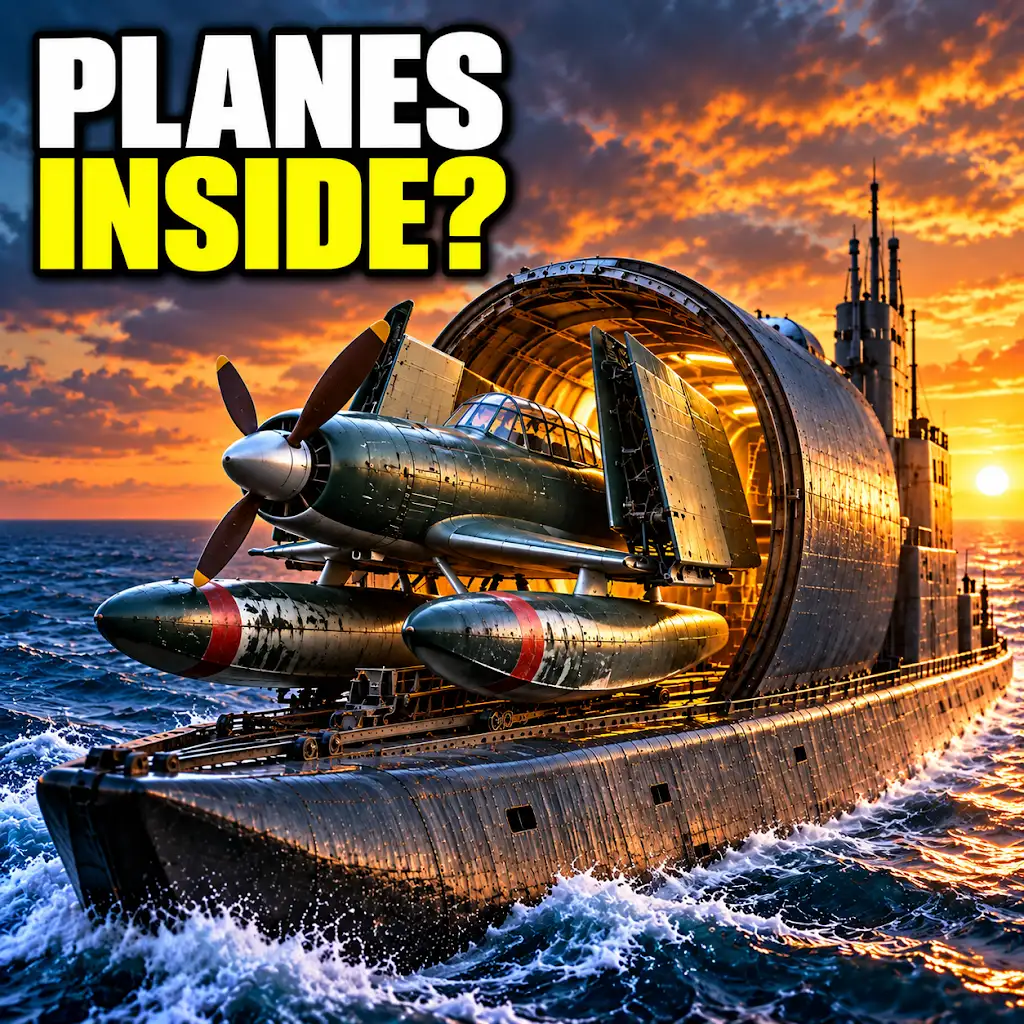
Japan Built a Submarine That Could Launch Three Planes
FAQs
What is the Aichi M6A Seiran submarine launched aircraft?
The Aichi M6A Seiran was a Japanese submarine-launched attack floatplane used during World War II. It was designed to be carried by submarines and launched from a catapult for reconnaissance and bombing missions.
When was the Aichi M6A Seiran developed?
The Aichi M6A Seiran was developed in 1943 by the Aichi Aircraft Company in Japan. It was specifically designed for the Imperial Japanese Navy’s submarine fleet to provide them with a covert attack capability.
How many crew members could the Aichi M6A Seiran accommodate?
The Aichi M6A Seiran could accommodate a crew of two: a pilot and an observer/gunner. The aircraft was equipped with defensive armament to protect itself during missions.
What was the range and payload capacity of the Aichi M6A Seiran?
The Aichi M6A Seiran had a range of approximately 1,200 miles and could carry a payload of up to 1,764 pounds. This allowed it to conduct reconnaissance missions and carry out bombing raids on enemy targets.
How many Aichi M6A Seiran aircraft were produced?
A total of 28 Aichi M6A Seiran aircraft were produced during World War II. However, they were never used in combat as intended, as Japan surrendered before they could be deployed in significant numbers.