
The silent giants of the deep, submarines, have long captivated the human imagination. Their ability to traverse the vast, unexplored oceans, shrouded in secrecy and mystery, has fueled countless tales and inspired technological marvels. Among the many impressive feats attributed to these underwater vessels, one stands out as particularly extraordinary: the unveiling of a submarine with an astonishing range, capable of covering an almost incomprehensible 37,500 miles on a single mission. This achievement redefines the boundaries of underwater exploration and military projection, pushing the envelope of what was previously thought possible for a submersible craft.
The sheer magnitude of 37,500 miles is difficult to fully grasp. To put it into perspective, this distance is equivalent to circumnavigating the Earth nearly one and a half times at the equator. It surpasses the longest non-stop flights ever undertaken and dwarfs the typical operational deployment distances for most conventional naval vessels. For a submarine, operating under the immense pressures of the deep, maintaining stealth, and sustaining its crew for such an extended period, this range signifies a monumental leap in engineering, propulsion, and life support systems.
This article will delve into the multifaceted aspects of this remarkable achievement. We will explore the technological innovations that have made such an extensive range feasible, examining the propulsion systems, the advancements in energy storage, and the critical role of hull integrity and design. Furthermore, we will investigate the operational implications of such a capability, considering its impact on strategic military deployments, the possibilities it opens for deep-sea scientific research, and the challenges associated with planning and executing missions of this unprecedented scale. Finally, we will consider the future potential of submarines with extended range, contemplating how this breakthrough might shape the evolution of underwater technology and our understanding of the world’s oceans.
Propulsion Systems: The Heart of Extended Range
The ability of a submarine to travel 37,500 miles is fundamentally rooted in its propulsion system. This is not merely about generating thrust; it’s about doing so efficiently, reliably, and with minimal reliance on frequent refueling or recharging. The evolution of submarine propulsion has been a continuous journey, moving from early steam engines to diesel-electric configurations, and ultimately to the most advanced nuclear reactors and innovative battery technologies. For a range of this magnitude, the solution likely lies at the pinnacle of these developments.
Nuclear Power: The Unrivaled Endurance King
For military submarines, particularly those designed for extended patrols and global reach, nuclear power has long been the undisputed champion of endurance. A nuclear-powered submarine carries its own onboard power plant – a small, controlled nuclear reactor – that generates heat, which is then used to produce steam to drive turbines. These turbines, in turn, power the propellers that propel the submarine through the water.
The primary advantage of nuclear power is its incredible energy density. A small amount of nuclear fuel can produce an immense amount of energy, allowing a nuclear submarine to operate for years, even decades, without refueling. This virtually eliminates the need for surfacing for refueling or extensive logistical support, freeing the submarine to remain submerged for extended periods. The operational constraints imposed by fuel limitations are, in essence, removed. This is a crucial factor in achieving the 37,500-mile range. A conventionally powered submarine, even with the most advanced diesel-electric systems and battery technology, would struggle to sustain such a journey without numerous refueling stops, which would compromise its stealth and operational flexibility. The sheer amount of fuel required for a diesel-electric submarine to cover such a distance would be prohibitively large and a significant vulnerability.
Furthermore, nuclear reactors provide a consistent and powerful source of energy, enabling submarines to maintain high speeds for extended durations. While sustained high-speed travel consumes
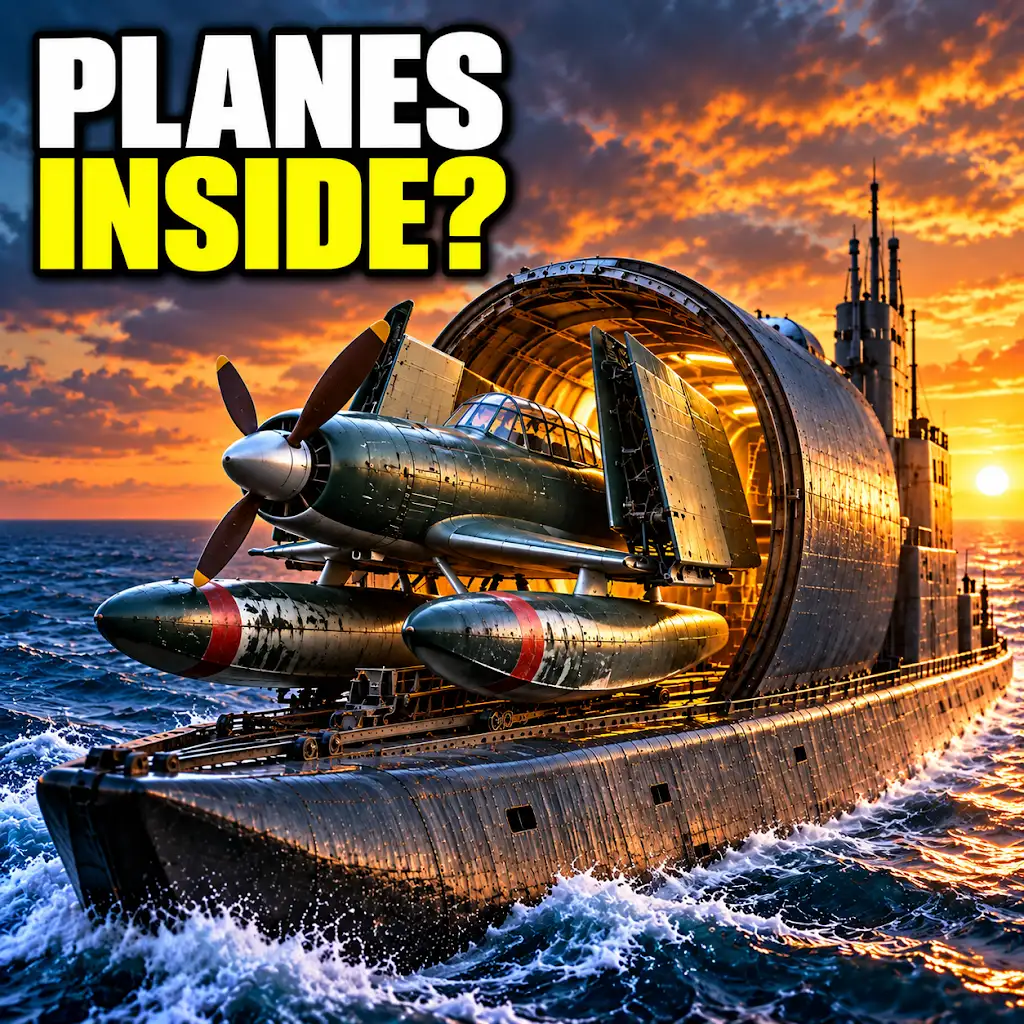
Japan Built a Submarine That Could Launch Three Planes
FAQs
What is the range of the I-400 submarine?
The I-400 submarine had an impressive range of 37,500 miles, making it one of the submarines with the longest range during World War II.
What was the purpose of the I-400 submarine?
The I-400 submarine was designed by the Imperial Japanese Navy as a strategic aircraft-carrying submarine capable of launching air strikes against distant targets.
How many aircraft could the I-400 submarine carry?
The I-400 submarine could carry up to three Aichi M6A Seiran aircraft in a watertight hangar located on the deck of the submarine.
Did the I-400 submarine see combat during World War II?
Although the I-400 submarine was commissioned during World War II, it did not see combat before the end of the war. It was primarily used for training and testing purposes.
What happened to the I-400 submarine after World War II?
After the surrender of Japan in 1945, the I-400 submarine was captured by the United States Navy. It was eventually scuttled off the coast of Hawaii in 1946 as part of Operation Road’s End.