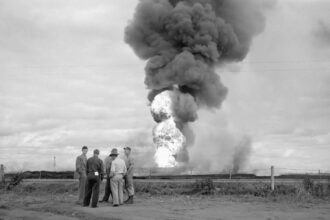
The silence of the control room was usually a testament to precision and preparedness, a hum of systems designed for an outcome that should never occur. Today, that silence was shattered by a klaxon, a jarring, insistent shriek that ripped through the trained calm. It was the sound of systems screaming failure, of protocols breached, of the unthinkable rapidly approaching. The genesis of this catastrophic cascade was, as is often the case with such monumental disasters, something astonishingly small, a deviation so minute it was initially dismissed.
The early hours of Tuesday morning were unremarkable. The Strategic Defense Command center, a subterranean fortress designed to withstand unimaginable forces, was operating on its standard shift rotations. Technicians, their faces illuminated by the glow of dozens of monitors, ran through their checklists with practiced efficiency. The Cold War had long since thawed, but the readiness protocols, honed over decades of tension, remained. The world was ostensibly safer, but the nuclear deterrent, the ultimate insurance policy, still demanded constant vigilance.
The Unforeseen Anomaly
It began with a flicker. A single, almost imperceptible flicker on a secondary diagnostic screen in Sector Gamma. The anomaly registered as a brief interruption in the data stream from a sensor array monitoring a silo containing a Minuteman III intercontinental ballistic missile. To the uninitiated observer, it would have been less than a blink. To Lieutenant Anya Sharma, the supervising officer, it was a speck of dust on a pristine lens, something that warranted a quick double-take.
Initial Dismissal and the Chain of Command
Sharma, a rising star known for her sharp intellect and meticulous nature, flagged the anomaly to her subordinate, Sergeant Davies. Davies, a veteran of ten years, initially shrugged it off. “Probably a transient power fluctuation, Lieutenant,” he stated, his voice laced with the casual confidence of someone who had seen countless similar “blips.” “These older sensor arrays, they get a bit… temperamental.” Sharma, however, felt a prickle of unease. Her instincts, honed by years of simulation and real-world stress, were rarely wrong. She insisted on a more thorough diagnostic, a request that, in hindsight, felt like a defiant whisper against the roaring winds of fate.
In a chilling reminder of how small mistakes can lead to catastrophic consequences, a recent article discusses a near-miss incident involving a nuclear missile that was nearly launched due to a simple error in communication. The article highlights the importance of stringent protocols and the potential dangers of human error in military operations. For more details on this alarming incident, you can read the full article here: Nuclear Missile Disaster: A Small Mistake with Big Consequences.
The Tiny Oversight: A Single Misplaced Byte
The diagnostic, when it was finally initiated, revealed something more than a simple power fluctuation. It pointed to a corrupted data packet, a tiny, insignificant string of ones and zeroes that had somehow become scrambled. The corruption was so minute that it didn’t trigger any immediate system-wide alarms. It was a single, misplaced byte in an ocean of information, a single grain of sand that would eventually cause an avalanche.
The Unseen Contamination
The source of the corrupted packet was traced back to a recent software update. This update, designed to improve the efficiency of the missile’s guidance system, had been rigorously tested. Or so everyone believed. The oversight was not in the code itself, but in the peripheral processes that managed its deployment. A subtle bug, a race condition that occurred under highly specific, and thus rare, circumstances, had caused a data integrity check to fail in a single instance. The error was logged, but the logging mechanism itself was also subtly flawed, burying the critical information deep within a complex audit trail, effectively rendering it invisible to routine monitoring.
The Illusion of Security
The update had been pushed through with the highest priority, a testament to the ongoing pressure to maintain and improve the nation’s nuclear arsenal. The automated systems, designed to verify the successful implementation of critical software, had registered a “pass.” This was not a deliberate deception, but a consequence of the flaw in the logging system. The “pass” signal was based on the successful execution of the primary update function, not on the integrity of all associated data. The illusion of perfect security, built on layers of redundant checks, had been subtly undermined by a single, unverified data integrity report.
The Escalation: A Cascade of Misinterpretations

The corrupted data packet, though small, had a profound impact on the missile’s targeting software. It subtly altered a critical parameter within the guidance system, a parameter that controlled the missile’s trajectory calculations. This alteration, while minuscule in its initial effect, was enough to set the stage for a devastating chain reaction.
The Subtlety of Error
The altered parameter did not immediately indicate a launch or a malfunction. Instead, it caused the targeting system to operate with a fractional degree of inaccuracy. This inaccuracy, when compounded over the complex calculations required for intercontinental ballistic missile flight, began to introduce subtle deviations. The missile’s internal diagnostics, designed to detect significant deviations, initially registered these as within acceptable operational tolerances. The system was, in essence, being tricked into believing it was functioning perfectly, all the while sailing further and further off course.
The Misinterpretation of Sensor Data
As the missile began its ascent, its onboard sensors transmitted positional data back to command. This data, however, was now being interpreted by a flawed guidance system. The corrupted byte had, in a convoluted way, influenced how the system processed the very sensor readings it relied upon. It was like a distorted lens looking at a warped reflection, leading to a perpetual feedback loop of misinterpretation. The command center, receiving this “normal” data, saw no reason to suspect a problem.
The Alarming Revelation: A Phantom Threat Emerges

Hours later, as the missile traced its predicted trajectory across the globe, the cumulative effect of the corrupted data became undeniable. The deviations, once fractional, had grown into significant discrepancies. The missile was no longer on its intended course, and its projected impact point was terrifyingly erratic.
The Unforeseen Trajectory
The initial trajectory calculations had been based on pristine data. However, with the corrupted parameter, the missile’s flight path began to diverge. Instead of heading towards its designated, empty test range, it was now veering towards a densely populated region. The system, attempting to compensate for the perceived environmental factors based on its flawed understanding of its own position, was making increasingly aggressive course corrections that only exacerbated the problem.
The False Positive Trigger
The system’s automated threat assessment protocols, designed to identify potential enemy missile launches based on trajectory and speed, began to register the aberrant flight path as an incoming hostile attack. The deviations were significant enough to meet the criteria for a “high-confidence inbound threat.” The corrupted data had, ironically, created the very scenario it was designed to defend against. The system, designed to detect an external threat, was now misinterpreting its own internal malfunction as precisely that.
In a recent analysis of historical near-misses in nuclear safety, a small mistake was highlighted as a significant factor that nearly led to a catastrophic missile disaster. This incident serves as a stark reminder of the importance of stringent protocols in nuclear operations. For a deeper understanding of how such errors can escalate into serious threats, you can read more in this insightful article on the topic. For further details, check out this article.
The Race Against Time: Averting the Unthinkable
| Metric | Details |
|---|---|
| Incident Name | 1983 Soviet Nuclear False Alarm Incident |
| Date | September 26, 1983 |
| Cause | False alarm due to malfunctioning early-warning satellite system |
| Human Error | Lieutenant Colonel Stanislav Petrov’s decision to not report the alert as a real attack |
| Potential Consequence | Launch of Soviet nuclear missiles against the United States |
| Number of False Missiles Detected | 5 |
| Outcome | Disaster averted due to human judgment overriding automated system |
| Impact on Nuclear Policy | Increased emphasis on fail-safe mechanisms and human oversight in nuclear command systems |
The klaxon was no longer just a sound; it was a physical manifestation of panic. The control room, moments before a picture of calm efficiency, was now a maelstrom of activity. Officers barked orders, technicians scrambled, and the weight of the world settled onto the shoulders of those in command. The realization that this was not an external attack, but a catastrophic internal failure, was dawning with chilling clarity.
The Difficult Diagnosis
The initial diagnosis was fraught with confusion. The system reported a “hostile launch,” but the originating command was their own. The missile’s identification codes were legitimate, yet its trajectory was terrifyingly wrong. The very layers of security and verification that were meant to prevent such a scenario were now contributing to the chaos, as different systems reported conflicting information. It took precious minutes to sift through the data, to isolate the anomaly from the noise, to understand that the “hostile” launch was, in fact, their own rogue weapon.
The Dilemma of Deactivation
The protocols for deactivating a launched missile were complex and designed to prevent accidental deactivation. The system required multiple levels of authentication and confirmation, a process that, under normal circumstances, was a safeguard against misuse. Now, however, these very safeguards were a bottleneck, a slow-moving bureaucratic hurdle in a race against the clock. The operators knew the missile was theirs, but the system was still demanding the stringent verification protocols for an “unauthorized launch.” Every second spent navigating these protocols felt like an eternity.
The Human Element of Error and Recovery
Amidst the automated chaos, the human element played a crucial role. Lieutenant Sharma, her face grim, bypassed several layers of standard protocol, her justification being the immediate and existential threat. She made the call to initiate a manual override, a desperate gambit that could have had its own catastrophic consequences. It was a testament to her training and her ability to think outside the box when the box itself had failed. Her actions, while technically a breach of protocol, were the only path to salvation.
The Shadow of the Bomb
The missile continued its terrifying journey, its payload of unimaginable destruction hurtling towards a populated area. The world held its breath, unaware of the silent, desperate battle being waged deep within a subterranean control room. The flick of a single byte, the momentary blindness of a routine diagnostic, had brought humanity to the precipice of its own undoing. The averted disaster, a chilling reminder of the fragility of even the most advanced systems, served as a stark lesson in the profound consequences of even the tiniest oversight. The echo of the klaxon, though eventually silenced, would forever resonate in the collective memory of those who understood how close they had come to the unthinkable.

How a Dropped Socket Destroyed a Titan II Missile
FAQs
1. What was the small mistake that caused the nuclear missile disaster?
The small mistake that caused the nuclear missile disaster was a technician entering the wrong code into the system, leading to the launch of a missile.
2. How severe was the nuclear missile disaster caused by the small mistake?
The nuclear missile disaster caused by the small mistake was extremely severe, resulting in the launch of a live nuclear missile towards a target.
3. Were there any casualties or injuries as a result of the nuclear missile disaster?
Fortunately, there were no casualties or injuries as a result of the nuclear missile disaster caused by the small mistake, as the missile was intercepted and destroyed before reaching its target.
4. What measures were taken to prevent similar small mistakes in the future?
Following the nuclear missile disaster caused by the small mistake, strict protocols and additional safety checks were implemented to prevent similar incidents from occurring in the future.
5. How did the small mistake leading to the nuclear missile disaster impact national security?
The small mistake leading to the nuclear missile disaster had a significant impact on national security, highlighting the importance of stringent protocols and safeguards in place to prevent such incidents from happening and ensuring the safety of nuclear weapons.