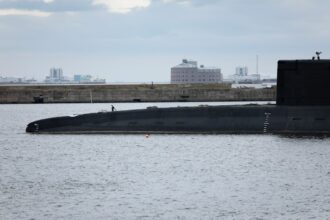
The Silent Dance of Submarines and Surface Ships
The Cold War, a period characterized by ideological tension and proxy conflicts, was also a time of silent, unseen warfare waged beneath the waves. For decades, the navies of the United States and the Soviet Union engaged in a constant game of cat and mouse, each seeking to gather intelligence, project power, and maintain a precarious strategic balance. Submarines, the unseen predators of the deep, played a crucial role in this shadowy dance. Their missions were varied: trailing enemy fleets, monitoring naval bases, and, in some cases, directly confronting enemy vessels. It was within this tense and highly charged environment that a near-catastrophic collision occurred, a stark reminder of the volatile nature of superpower naval deployments.
In a recent analysis of naval encounters during the Cold War, an article discusses the incident where a Soviet submarine struck a U.S. frigate, highlighting the tense maritime relations between the two superpowers. This event not only underscored the risks of military confrontations at sea but also prompted significant changes in naval strategy and defense protocols. For more in-depth insights, you can read the full article here: Soviet Submarine Hits US Frigate.
Whispers from the Deep: The Lead-Up to the Encounter
The incident, shrouded in the secrecy that defined Cold War naval operations, unfolded in the late hours of a nondescript day. The specific date and exact location remain classified, adding to the mystique and the inherent dangers of the operational theaters. However, historical accounts and declassified documents suggest the encounter took place in international waters, likely in a region of strategic importance where both navies routinely operated. The United States Navy, in its continuous effort to monitor Soviet naval activities, had deployed a frigate, a versatile surface combatant designed for escort and anti-submarine warfare, as part of a broader surveillance mission. Its presence was meant to be a visible deterrent and an intelligence-gathering platform, observing any unusual Soviet movements.
The Soviet Silent Service: A Hunter in the Dark
Meanwhile, the Soviet Navy’s formidable “Silent Service” was also at work. Submarines, particularly the advanced Project 641 (Foxtrot-class) or Project 877 (Kilo-class) diesel-electric attack submarines, were tasked with shadowing Western naval vessels. These submarines were designed for stealth, their hull designs minimizing sonar detection and their operational procedures emphasizing absolute silence. The Soviet submarine commander, likely on a mission to track the movements and capabilities of the US frigate, was operating under strict orders to maintain a covert presence. The vastness of the ocean, while offering concealment, also presented inherent navigational challenges, especially for submarines operating at periscope depth or just below the surface, where they could maintain a degree of situational awareness without betraying their position entirely. The subtle sounds of the ocean, the ambient noise from other vessels, and the limitations of active sonar in avoiding detection all contributed to a complex operational environment.
The US Frigate’s Vigilance: A Guardian on the Surface
The US frigate, equipped with sophisticated sonar systems and trained crews, was also conducting its own vigilance. Its mission was to detect, identify, and track any submarines in its vicinity. This involved a constant sweep of the underwater environment, analyzing sonar contacts, and correlating them with known Soviet submarine signatures. The crew would have been aware of the potential for encounters, as the proximity of Soviet submarines was a regular occurrence in these contested waters. The frigate’s anti-submarine warfare (ASW) capabilities were state-of-the-art for the era, designed to provide an early warning system and to deter any aggressive actions. However, even the most advanced technology had its limitations, and the unforgiving nature of the deep ocean meant that miscalculations were always a possibility.
The Unforeseen Collision: A Moment of Chaos
The collision itself was an abrupt and terrifying event. In the shadowy world of submarine warfare, the margin for error is infinitesimally small. The US frigate, likely at a relatively shallow depth, was proceeding on its intended course. The Soviet submarine, perhaps attempting a close-quarters pass for detailed intelligence gathering or misjudging its proximity due to sea state or an equipment malfunction, found itself on a collision course. The impact, when it came, would have been a jarring, violent shock felt throughout both vessels. For the crew of the frigate, it would have been an unexpected lurch, a violent shudder that sent unsecured items flying and raised immediate alarm. Onboard the submarine, the impact would have been even more profound, a direct blow to its hull, potentially causing significant damage and disorienting the crew.
The Shockwave of Impact: A Symphony of Metal and Water
The sound would have been a deafening cacophony – the screech of metal against metal, the groaning of stressed hulls, and the rush of water as the two behemoths grappled. For those inside, the immediate aftermath would have been a moment of pure adrenaline and confusion. Lights might have flickered or gone out, alarms would have blared, and the sense of disorientation would have been palpable. The sheer force of the collision could have caused structural damage to both vessels, raising fears of flooding, hull breaches, and potential sinking. The tight confines of a submarine, already
A Soviet Submarine Hit a U.S. Frigate. Was It the Wrong Ship?
FAQs
1. What happened when a Soviet submarine hit a US frigate?
The incident occurred on October 3, 1986, when a Soviet submarine collided with the USS Augusta, a US frigate, in the Norwegian Sea.
2. Were there any casualties as a result of the collision?
Fortunately, there were no casualties reported from the collision between the Soviet submarine and the US frigate.
3. What was the extent of the damage caused by the collision?
The collision caused minor damage to both the Soviet submarine and the US frigate, with no significant impact on their operational capabilities.
4. What was the response from the Soviet Union and the United States following the incident?
Both the Soviet Union and the United States downplayed the incident, describing it as a minor accident and emphasizing that it did not escalate into a more serious confrontation.
5. Has there been any similar incident involving submarines from different countries colliding at sea?
While submarine collisions are rare, there have been a few documented cases of submarines from different countries colliding at sea, highlighting the challenges of underwater navigation and communication.