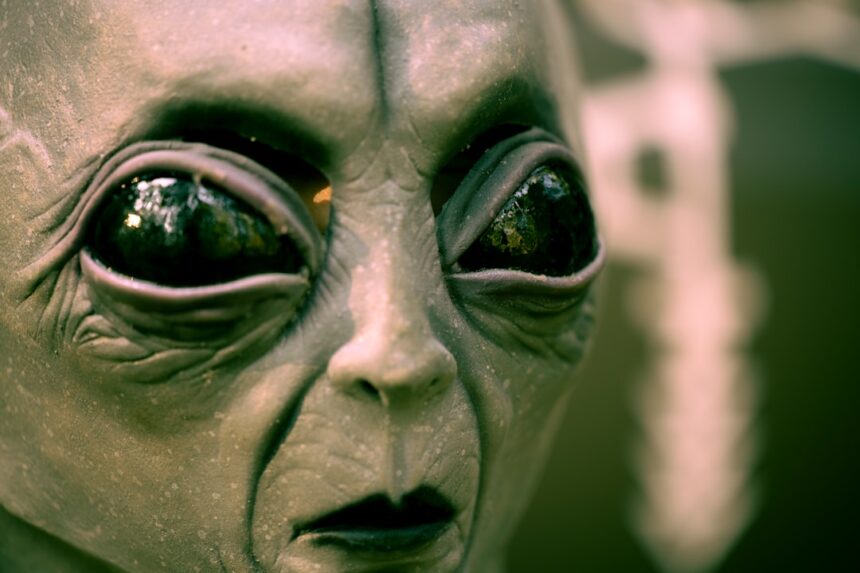
So, you’re curious about whether remote viewing has ever pointed to aliens on the Moon? It’s a pretty interesting question, and one that has definitely been explored within the remote viewing community. The short answer is: yes, some remote viewers have reported impressions and imagery that could be interpreted as evidence of alien presence or activity on the Moon.
However, it’s crucial to understand what “remote viewing” is and what these reports actually represent. It’s not like watching a documentary; it’s more like catching glimpses of information through a fog. This article will dive into what remote viewing is, how it’s been applied to extraterrestrial topics, the specific claims made about the Moon, and the significant challenges and limitations involved in interpreting such data.
Before we get to the Moon specifically, let’s clarify what remote viewing is. It’s a claimed psychic ability to perceive information about a target, which is typically distant in space or time, without using the known five senses. Think of it as a mental sense, sort of like intuition but with a structured protocol.
The Origins and Development
Remote viewing emerged from research conducted by SRI International in the 1970s, funded in part by the U.S. government. The goal was to see if psychic phenomena could be harnessed for intelligence gathering. Physicists like Harold Puthoff and Russell Targ were key figures. They developed protocols to train individuals to access and describe information about hidden targets.
How It’s Supposed to Work
The process usually involves a “viewer” who is given a randomly generated code or coordinates (the “cue”) that corresponds to a target. The viewer then attempts to describe the target through sensory impressions, emotions, shapes, colors, and other subjective experiences. A “recorder” or “analyst” then tries to decipher these descriptions and match them to the actual target.
The Subjectivity Factor
One of the biggest things to grasp is that remote viewing data is inherently subjective. It’s not a photograph or a video recording. What a viewer “sees” is filtered through their own consciousness, biases, and imagination. This is why rigorous analysis and multiple viewers are often used to try and corroborate impressions. It’s more about patterns emerging across different sessions than a single definitive statement.
Recent discussions about the possibility of remote viewing aliens on the Moon have sparked interest in various theories and investigations. For those intrigued by this topic, an insightful article can be found at In The War Room, which delves into the implications of extraterrestrial life and the potential evidence supporting such claims. This exploration not only examines historical accounts of lunar missions but also highlights the ongoing debates surrounding the existence of alien civilizations beyond our planet.
Remote Viewing and Extraterrestrial Subjects
The allure of extraterrestrial life is a natural draw for remote viewers, and it’s not surprising that this topic has been a frequent subject of investigation. The idea is that if RV can access information about distant places or hidden things on Earth, perhaps it can also access information about life beyond our planet.
Early Investigations
From its inception, the potential for remote viewing to explore the unknown, including possible alien life, was a consideration. Early researchers and viewers, while focusing on more conventional intelligence targets, often acknowledged this broader possibility. The idea of using RV to investigate “what’s out there” has always been part of the conversation.
Common RV Targets Related to ET
Beyond specific objects or locations, remote viewing has been used to explore broader concepts like:
- Alien biology: What do different alien species look like? How do they function?
- Alien technology: What kind of advanced devices do they possess?
- Alien civilizations: What are their societies like? What are their motivations?
- Historical encounters: Were there past interactions between humans and ETs?
This broad application sets the stage for more specific investigations into places like the Moon.
Claims of Alien Activity on the Moon
Now, let’s focus on the Moon. Over the years, within the remote viewing community, certain sessions have yielded descriptions that have been interpreted as evidence of alien structures or presences on Earth’s nearest celestial neighbor.
Specific Remote Viewing Sessions
Several well-known remote viewing projects and independent sessions have involved lunar targets. These often involve viewers being tasked to describe specific areas of the Moon or to investigate general questions about lunar anomalies.
Project Stargate and Lunar Targets
While the primary focus of Project Stargate was on terrestrial intelligence targets, there were instances where lunar or extraterrestrial subjects were explored, either officially or through unofficial interest. These were often more experimental.
Independent Remote Viewers
Many independent remote viewers, often working outside of formal government programs, have also taken on lunar targets. These sessions can be found in books, online forums, and dedicated RV communities.
Recurring Themes and Imagery
When examining reports from various viewers about the Moon, some recurring themes and imagery tend to appear, even if the specific details vary:
- Underground structures: Many descriptions include the idea of facilities or habitats located beneath the lunar surface, perhaps for protection from radiation or extreme temperatures.
- Artificial constructions: Viewers sometimes describe geometric shapes, metallic elements, or what appear to be non-natural formations.
- Light or energy sources: Some sessions report seeing unusual lights or sensing energy fields not attributable to natural lunar phenomena.
- “Watchers” or automated systems: In a few cases, viewers have described sensing a presence or what feels like automated observation, rather than necessarily active biological beings.
- Evidence of past use: Some reports suggest not a current active presence but remnants of ancient bases or operations.
It’s important to note that these are interpretations of subjective data, not direct observations.
Examples of Specific “Hits”
Some remote viewers have claimed to describe specific features on the Moon that, when later compared with enhanced or obscure lunar imagery, appear to correlate. For instance, descriptions of “domes,” “tunnels,” or “anomalous shadows” have been presented as potential evidence. These are often complex and require significant interpretation to connect to known visual data.
Challenges in Interpreting Lunar RV Data

The interpretation of remote viewing data, especially concerning something as vast and alien as the Moon, is fraught with challenges. It’s not as simple as saying “viewer saw X, and there’s X on the Moon.”
The “Garbage In, Garbage Out” Principle
Remote viewing is highly susceptible to the viewer’s own preconceptions, knowledge, and even desires. If a viewer has a strong belief in lunar aliens, their subconscious might fill in gaps in a way that supports that belief. This is often referred to as “suggestion bias.”
Lack of Definitive Proof
Crucially, remote viewing, by its very nature, does not provide definitive proof in the way scientific observation or verifiable evidence does. It’s more about generating possibilities or clues that might warrant further investigation. A remote viewing impression is not a scientific paper.
Ambiguity and Symbolism
The impressions received in remote viewing can be highly symbolic or abstract. A viewer might describe “a big shiny thing” which could be a natural mineral deposit, a piece of discarded human equipment, or something else entirely. The leap from that abstract impression to a specific alien artifact is a significant interpretive step.
“Blind” vs. “Single-Blind” vs. “Double-Blind”
The rigor of a remote viewing study is often assessed by how “blind” it is.
- Single-blind: The viewer doesn’t know the target.
- Double-blind: Neither the viewer nor the person evaluating the transcript knows the target until after the analysis.
Most lunar investigations, especially independent ones, might not meet strict double-blind standards, making interpretation more susceptible to bias.
The Role of Imagination and Pareidolia
The human brain is excellent at finding patterns, even where none exist. This is called pareidolia. In remote viewing, it’s easy to mistake random mental imagery, imagination, or the tendency to “see faces in the clouds” for genuine psychic information. This is a constant battle for viewers and analysts.
Recent discussions about the possibility of remote viewing aliens on the Moon have sparked interest in various theories and investigations. One intriguing article explores the implications of such phenomena and delves into the experiences of those who claim to have perceived extraterrestrial activities beyond our planet. For more insights on this captivating subject, you can read the full article here. This exploration not only raises questions about the existence of life beyond Earth but also challenges our understanding of consciousness and perception.
What Remote Viewing Data Might Suggest
| Location | Activity | Time |
|---|---|---|
| Moon | Remote Viewing | Ongoing |
Despite the challenges, the collective impressions from remote viewing sessions concerning the Moon are intriguing to those interested in the topic. It’s not about proving aliens exist, but rather about exploring what the data suggests.
Beyond Mere Speculation
Proponents argue that when multiple viewers, working independently and without knowledge of each other’s specific impressions, describe similar phenomena—such as underground bases or non-natural structures—it suggests something more than mere coincidence or individual imagination.
Corroboration Among Viewers
The idea is that if Viewer A describes a “large underground tunnel complex” and Viewer B (working on the same target independently) describes “subsurface shelters with strange metallic conduits,” these shared elements gain weight. This is one of the core principles used to try and validate RV data.
Statistical Significance
Some researchers in the RV field attempt to apply statistical analysis to the convergence of information from multiple viewers. The argument is that the probability of such consistent descriptions arising by chance alone becomes very low.
Connecting RV to Lunar Anomalies
Remote viewing data is often used to try and explain or provide context for anomalies seen in actual lunar photography. For instance, if a remote viewer consistently describes activity in a certain crater, researchers might then examine photographic evidence of that crater more closely.
The “Face on Mars” Analogy
This is similar to how some people interpret ambiguous geological features in images as artificial structures (like the famous “Face on Mars”). Remote viewing is seen by some as a way to get additional information about such visual anomalies.
The “What If” Scenario
Ultimately, much of the discussion around remote viewing and lunar aliens falls into the realm of “what if.” What if these impressions are pointing to something real? What if there are hidden aspects of lunar history or present-day activity that we are not privy to through conventional means?
Potential for Further Inquiry
Even if not definitive proof, remote viewing reports could, in theory, be used to guide future scientific missions or observations. If a viewer repeatedly “sees” something in a specific location, it might be worth directing telescopes or probes to that spot for a closer look.
The Limitations and Skepticism
It’s vital to address the significant skepticism surrounding remote viewing. From a scientific standpoint, remote viewing is not a widely accepted phenomenon.
Lack of Reproducibility in Scientific Settings
The biggest hurdle for remote viewing is its inconsistent reproducibility in controlled scientific experiments. While there have been studies that claimed positive results, many have failed to replicate those findings, or the results have been criticized for methodological flaws.
The Scientific Consensus
The mainstream scientific community generally regards remote viewing as pseudoscience. The lack of a clear, verifiable mechanism and the persistent issues with bias and interpretation mean it hasn’t crossed the threshold into accepted scientific fact.
Explanations for RV Phenomena
Skeptics offer several explanations for why remote viewing sessions might seem to yield meaningful information:
- Cold Reading: Techniques used by psychics to gain information about a person through subtle cues and generalized statements. While RV isn’t directly cold reading a person, the analyst might inadvertently use similar principles.
- Confirmation Bias: The tendency to search for, interpret, favor, and recall information in a way that confirms one’s pre-existing beliefs.
- Memory Contamination: Even in blind protocols, unintentional hints or information can leak through, influencing the viewer.
- Coincidence and Chance: With a large enough pool of viewers and targets, some overlap and seemingly accurate impressions are statistically likely to occur.
The Burden of Proof
Ultimately, the burden of proof lies with those who claim remote viewing is a valid method for obtaining information. Until a more rigorous, consistently reproducible, and independently verifiable methodology is established, the claims, including those about lunar aliens, will remain in the realm of speculation and fringe interest.
Distinguishing from Fictional Accounts
It’s also important to differentiate between remote viewing reports and science fiction narratives. While many RV descriptions might sound like they’re from a sci-fi novel, the key difference (or lack thereof, for skeptics) lies in the claimed origin of the information.
Conclusion: A Glimpse into the Unknown, Not a Definitive Answer
So, to circle back to the initial question: have aliens been on the Moon according to remote viewing? Some remote viewers have certainly described things that, when interpreted, suggest alien presence or activity on the Moon. This has included underground structures, artificial constructs, and hints of non-human intelligence.
However, it’s crucial to approach these claims with a healthy dose of critical thinking. Remote viewing is a subjective and controversial field. The interpretations are complex, prone to bias, and lack the kind of concrete, verifiable evidence that would satisfy scientific standards.
The Enduring Appeal
The appeal of remote viewing, especially concerning extraterrestrial subjects like the Moon, lies in its promise of access to hidden knowledge. It taps into our deep curiosity about the universe and our place within it. It offers a potential pathway to understanding mysteries that current scientific instruments might not be equipped to reveal.
A Tool for Exploration, Not Discovery
Perhaps the most practical way to view remote viewing in this context is as a tool for exploration and idea generation, rather than definitive discovery. It can point in directions, spark questions, and perhaps even suggest areas for further investigation using more conventional methods. The claims about aliens on the Moon, while intriguing, remain within this speculative landscape. They offer a fascinating glimpse into what some believe is possible, but they do not constitute proof.
He Remote Viewed the Moon. Then Something Saw Him.
FAQs
What is remote viewing?
Remote viewing is the practice of seeking impressions about a distant or unseen target using paranormal means, such as extrasensory perception (ESP) or “sensing” with the mind.
What is the concept of remote viewing aliens on the Moon?
The concept of remote viewing aliens on the Moon involves using the practice of remote viewing to gather information or impressions about potential alien activity or structures on the Moon without physically being present.
Is there any scientific evidence to support remote viewing?
While some individuals claim to have had success with remote viewing, the practice is not supported by scientific evidence. The scientific community generally considers remote viewing to be pseudoscience.
What is the likelihood of finding aliens on the Moon through remote viewing?
The likelihood of finding aliens on the Moon through remote viewing is highly speculative and not supported by credible scientific research. There is currently no verifiable evidence of alien activity on the Moon.
What are some alternative explanations for remote viewing experiences related to aliens on the Moon?
Some alternative explanations for remote viewing experiences related to aliens on the Moon could include psychological factors, such as imagination, suggestion, or cognitive biases. It’s important to approach such claims with skepticism and critical thinking.