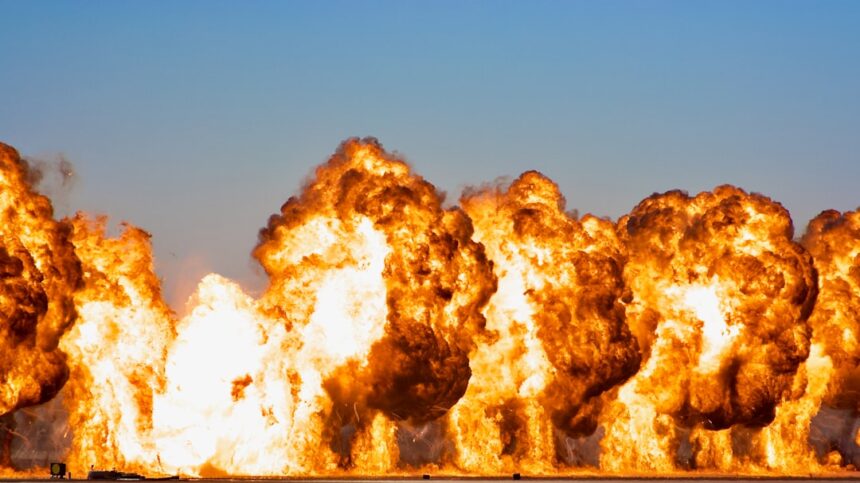
The deafening roar of the missile launch echoed across the barren testing range, a familiar sound to those who had witnessed countless such events. Yet, this time, something was different. Moments after ignition, a blinding flash erupted from the base of the rocket, followed by a violent tremor that shook the very earth. The missile, a gleaming titan of military engineering, fragmented into a thousand pieces, a testament to a catastrophic failure. Amidst the chaos and the acrid smoke, a chilling realization dawned on the observers: the warhead, a payload designed for unimaginable destruction, had survived.
The immediate aftermath of the explosion was a scene of controlled panic. Safety protocols, honed through years of simulations and drills, kicked into high gear. Teams of highly specialized personnel, clad in protective gear, descended upon the debris field, their movements precise and urgent. The primary objective was clear: to locate and secure the nuclear warhead, a task fraught with immense danger. The very fact that the warhead, subjected to the violent forces of a missile explosion, remained intact was a stark and unsettling revelation. It challenged long-held assumptions about the fragility of such potent devices and underscored a terrifying potential for unintended consequences.
The Mechanics of Missile Failure
The investigation into the missile’s catastrophic failure would become a monumental undertaking. Experts would meticulously dissect every fragment, analyzing stress fractures, material composition, and the precise sequence of events that led to the disintegration.
Initial Ignition Anomalies
Even before the visible explosion, subtle anomalies in the missile’s performance would be scrutinized. Was there an issue with the fuel mixture, the ignition sequence, or a premature detonation of a minor component? These seemingly small details could hold the key to the larger disaster.
Structural Integrity Under Stress
The missile’s airframe, designed to withstand immense aerodynamic forces, had clearly failed. Engineers would assess how the structural integrity was compromised, whether it was a design flaw, a manufacturing defect, or a combination of factors exacerbated by the extreme conditions of launch.
The Role of the Propulsion System
The heart of any missile is its propulsion system. Investigators would delve deep into the functioning of the engines, seeking any evidence of malfunction that could have led to an uncontrolled burn or an internal explosion, thereby initiating the missile’s demise.
The Warhead’s Surprising Endurance
The survival of the nuclear warhead itself was the most alarming aspect of the incident. It defied expectations and raised profound questions about the design and construction of these weapons.
Material Science and Its Limits
Nuclear warheads are encased in robust materials designed to withstand extreme temperatures, pressures, and impacts. However, the forces unleashed by a missile explosion, including significant kinetic energy and intense heat, were believed to be beyond the survivability parameters. The warhead’s intactness suggested a level of resilience that had not been fully appreciated.
The Detonation Mechanism’s Resilience
The internal detonation mechanism of a nuclear weapon is a complex system designed to initiate the nuclear chain reaction. The fact that this mechanism, and indeed the fissile material itself, remained stable and uncompromised after such a violent event was a testament to the advanced engineering employed.
Inertial Confinement and Its Implications
While the exact design of the warhead remained classified, experts would speculate on the role of inertial confinement within its structure. This principle, where the mass of the warhead itself helps to contain and stabilize the detonation process, might have played an unforeseen role in its survival.
In a fascinating exploration of military resilience, an article on In The War Room discusses how certain nuclear warheads have been designed to survive missile explosions, showcasing the advanced engineering and safety protocols in place to prevent catastrophic failures. This piece delves into the implications of such technology on global security and the ongoing debates surrounding nuclear deterrence strategies.
The Perilous Recovery Operation
The recovery of the intact nuclear warhead was a mission of paramount importance, requiring the utmost caution and expertise. The potential for accidental detonation, however remote, was a terrifying prospect that loomed over every step of the operation.
Assembling the Specialized Teams
No ordinary military unit could undertake such a task. Elite teams, comprised of nuclear engineers, explosives ordnance disposal (EOD) specialists, radiation hazard experts, and highly trained security personnel, were assembled. Their knowledge and experience were indispensable.
The EOD Challenge: Handling a Potentially Live Weapon
The EOD teams faced the unenviable task of assessing and disarming a device that was, by its very nature, designed to detonate. Their understanding of the warhead’s intricate safety mechanisms and their ability to neutralize them without triggering an accidental event were critical.
Radiation Monitoring and Containment
Even if the warhead remained inert, the possibility of radioactive contamination from damaged components or spilled fissile material was a serious concern. Sophisticated radiation detection equipment and containment protocols were essential to ensure the safety of the recovery teams and the surrounding environment.
Securing the Debris Field
The first phase of the recovery involved meticulously securing the explosion site. This meant establishing a perimeter, controlling access, and systematically cataloging and recovering all fragments of the missile and the warhead.
The Importance of Site Mapping and Documentation
Every piece of debris was a potential clue. Detailed mapping of the explosion site and thorough photographic and video documentation were crucial for understanding the event and for the safe handling of recovered materials.
Preventing Unauthorized Access and Tampering
The presence of a nuclear warhead, even a seemingly inert one, presented a significant security risk. The perimeter had to be impenetrable to prevent unauthorized access, sabotage, or even opportunistic theft by individuals or groups with malicious intent.
The delicate act of Warhead Extraction
Once the debris field was secured and the warhead’s location precisely identified, the actual extraction began. This was a process that demanded extreme precision and unwavering adherence to safety protocols.
Cranes and Specialized Handling Equipment
The warhead, likely heavy and potentially unstable, would require specialized lifting and transport equipment. Cranes with calibrated lifting capacity and custom-designed cradles would be employed to minimize any further stress on the device.
Transportation Protocols: A High-Stakes Journey
The journey from the testing range to a secure facility would be a closely guarded secret and a high-stakes operation. Convoy routes would be meticulously planned, security measures would be multilayered, and contingency plans for every conceivable scenario would be in place.
The Scrutiny of the Warhead’s Integrity

With the warhead safely secured, an intense period of examination and analysis began. Scientists and engineers would pore over every detail, seeking to understand the extent of any damage and, most importantly, to confirm its inert status.
Non-Destructive Testing and Material Analysis
The primary goal was to assess the warhead’s condition without triggering any latent dangers. Non-destructive testing techniques, such as X-rays, gamma ray imaging, and ultrasonic inspections, would be employed to examine the internal structure and materials.
Assessing Fissile Material Stability
The most critical aspect of the analysis would be to confirm the stability of the fissile material – the plutonium or uranium that constitutes the core of the nuclear weapon. Any sign of degradation or instability would be a cause for extreme concern.
Examining the Detonation Circuitry
The intricate circuitry responsible for initiating the nuclear reaction would be meticulously inspected. Investigators would look for signs of damage that could compromise safety features or, conversely, indicate a surprising resilience.
Reconstructing the Sequence of Events
By analyzing the warhead and the surrounding debris, investigators would attempt to reconstruct the precise sequence of events that led to the missile’s destruction and the warhead’s survival.
Forensic Examination of the Debris
Each fragment of the missile would be analyzed for its origin, the forces it experienced, and its proximity to the warhead at the moment of impact. This would provide a detailed picture of the explosion’s dynamics.
Ballistic and Structural Modeling
Advanced computer simulations would be used to model the missile’s flight path, the explosion’s trajectory, and the impact forces on the warhead. This would help to validate or refine hypotheses about the warhead’s survival.
The Question of Accidental Detonation
Throughout the entire process, the specter of accidental detonation would remain. Every decision, every action, would be weighed against the potential for triggering such a catastrophic event.
Redundant Safety Mechanisms: A Double-Edged Sword
While redundant safety mechanisms are designed to prevent accidental detonation, their interaction with the extreme forces of an explosion could have had unforeseen consequences. Understanding this interplay would be crucial.
The Psychological Impact on the Teams
The immense pressure and the constant awareness of the danger would take a significant psychological toll on the recovery and analysis teams. Their professionalism and discipline in the face of such a daunting task would be commendable.
Implications for Nuclear Weapon Design and Safety
The survival of the nuclear warhead sent shockwaves through the defense and scientific communities. It necessitated a re-evaluation of existing safety protocols, design philosophies, and the very understanding of how these weapons behave under extreme duress.
A Review of Safety Standards
The incident would undoubtedly trigger a comprehensive review of all existing safety standards and procedures related to the design, manufacture, transport, and storage of nuclear weapons.
Revisiting Vulnerability Assessments
Current assessments of nuclear warheads’ vulnerability to accidental detonation or unintended detonation during accidents would likely be revised. The testing range incident provided a real-world, albeit unplanned, stress test.
Enhancing Safety Features in Future Designs
It was anticipated that future nuclear weapon designs would incorporate even more robust safety features, potentially drawing lessons from the warhead’s unexpected resilience.
The Future of Nuclear Deterrence
The incident also raised questions about the reliability and predictability of nuclear weapons in the context of deterrence. If a warhead can survive a missile explosion, what other unforeseen scenarios might it endure?
The Calculus of Escalation and De-escalation
The ability of a nuclear weapon to survive such a catastrophic event could subtly alter the calculus of escalation and de-escalation in a conflict scenario, adding another layer of complexity to strategic planning.
The Role of Accidental War in Strategic Thinking
The near-miss incident would undoubtedly bring the concept of accidental war, sparked by technological malfunction or miscalculation, back to the forefront of strategic discussions.
International Ramifications and Arms Control
The news of a surviving nuclear warhead, even under controlled circumstances, could have significant international ramifications. It might reignite debates around nuclear proliferation and arms control.
Global Perceptions of Nuclear Risk
Such an event, even if contained, could heighten global anxieties about the inherent risks associated with nuclear arsenals, potentially influencing public opinion and diplomatic efforts.
The Importance of Transparency and Communication
In the wake of such an incident, the importance of transparency and open communication between nuclear powers would be underscored, helping to prevent misunderstandings and manage potential crises.
In a fascinating exploration of military technology, an article discusses how certain nuclear warheads have been designed to withstand the impact of missile explosions. This resilience is crucial for ensuring that these weapons remain functional even in the chaotic aftermath of a strike. For more insights on this topic, you can read the full article here: nuclear warhead survival. The advancements in engineering and materials science play a significant role in enhancing the durability of these powerful devices, which are pivotal in modern defense strategies.
Lessons Learned and the Path Forward
| Metric | Description | Typical Values | Notes |
|---|---|---|---|
| Missile Explosion Yield | Energy released by the missile explosion near the warhead | 10-100 kilotons TNT equivalent | Varies depending on missile type and warhead size |
| Distance from Explosion | Proximity of the warhead to the missile explosion | 5-50 meters | Closer distances increase damage risk |
| Warhead Structural Integrity | Ability of the warhead casing to withstand shock and heat | High-strength alloys and composites | Critical for survival of internal components |
| Thermal Resistance | Warhead’s ability to resist high temperatures from explosion | Up to 2000°C for short durations | Protects explosive lenses and nuclear material |
| Shockwave Tolerance | Resistance to mechanical shock from blast wave | Up to 1000 g peak acceleration | Depends on internal damping and design |
| Radiation Shielding | Protection against prompt radiation from explosion | Lead or depleted uranium layers | Prevents premature detonation or damage |
| Survival Probability | Likelihood warhead remains functional after explosion | Varies widely; typically 70-95% at safe distances | Depends on all above factors combined |
The nuclear warhead that survived the missile explosion became a stark reminder of the immense power and the inherent dangers of nuclear technology. The lessons learned from this incident would shape future policies, designs, and the ongoing dialogue surrounding nuclear weapons.
The Enduring Vigilance Required
The incident served as a powerful testament to the fact that even with the most advanced technology, unforeseen events can occur. This underscores the need for perpetual vigilance and a commitment to continuous improvement in safety and security.
The Human Element in Nuclear Safety
While technology plays a crucial role, the human element – the training, discipline, and ethical considerations of those involved in nuclear weapons programs – remains paramount. The incident highlighted the importance of human oversight and robust decision-making processes.
The Ongoing Pursuit of Arms Reduction
Ironically, such events, while terrifying, could also serve as a catalyst for renewed efforts towards arms reduction. The near-disaster might prompt a more urgent recognition of the ultimate goal: a world free from the existential threat of nuclear weapons.
The Scientific and Engineering Community’s Response
The scientific and engineering communities would be tasked with integrating the findings from this incident into their research and development. This would involve not just improving existing systems but also exploring entirely new approaches to ensure the absolute safety of nuclear materials.
Adapting Design Philosophies
The traditional assumptions about the fragility of nuclear warheads under extreme stress would need to be re-evaluated, leading to potentially radical shifts in design philosophies.
Investing in Advanced Simulation and Testing
The incident would likely spur further investment in advanced simulation and testing capabilities, allowing for more comprehensive evaluation of weapon systems under a wider range of extreme scenarios.
The Societal and Ethical Imperative
Beyond the technical aspects, the incident carries profound societal and ethical implications. It forces a global reckoning with the immense responsibility that comes with possessing weapons of such destructive potential.
Public Awareness and Education
Raising public awareness about the complexities and risks associated with nuclear weapons is crucial for informed societal dialogue and the development of responsible policies.
The Moral Compass of Nuclear Nations
Ultimately, the path forward will be guided by the moral compass of the nations that possess nuclear weapons. The incident demands a serious and sustained commitment to ensuring that these weapons are never used, and that their existence becomes a relic of the past. The warhead, a symbol of terrifying power, had survived its own fiery demise, leaving behind a legacy of urgent questions and a renewed imperative for global security.

How a Dropped Socket Destroyed a Titan II Missile
FAQs
1. What happened in the incident involving a nuclear warhead surviving a missile explosion?
The incident involved a missile explosion during a test launch, where the nuclear warhead on the missile survived the explosion.
2. How common is it for a nuclear warhead to survive a missile explosion?
It is extremely rare for a nuclear warhead to survive a missile explosion, as they are designed to be destroyed in such scenarios to prevent nuclear detonation.
3. What are the safety measures in place to prevent nuclear warheads from detonating in case of an explosion?
Nuclear warheads are equipped with multiple safety features, such as arming mechanisms that require specific conditions to be met before detonation can occur, and physical barriers to prevent accidental detonation.
4. What are the potential risks associated with a nuclear warhead surviving a missile explosion?
The potential risks include the warhead falling into the wrong hands, leading to nuclear proliferation or terrorist threats, as well as environmental contamination if the warhead is not properly recovered and disposed of.
5. How are incidents like these investigated and prevented in the future?
Incidents involving nuclear warheads surviving missile explosions are thoroughly investigated by relevant authorities to determine the cause and implement necessary safety improvements. Preventive measures may include stricter testing protocols, enhanced safety mechanisms, and increased oversight of nuclear weapons programs.