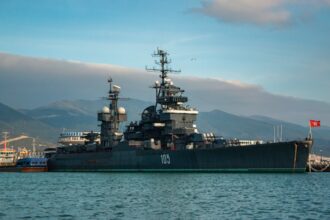
The industrial skyline of Alang, India, a place synonymous with the methodical dismantling of giants, has recently welcomed a new, albeit familiar, resident. The K-222, a vessel that had plied the world’s oceans for decades, has officially joined the ranks of decommissioned ships undergoing the irreversible process of scrapping. This event marks not just the end of a single ship’s journey, but a poignant punctuation mark on an era of maritime history, signaling the retirement of a type of vessel that, while perhaps not glamorous, was a steadfast workhorse of global trade. The K-222’s hull, once a familiar sight in ports across the globe, is now being systematically reduced to its constituent metals, a testament to its long service and the relentless march of technological evolution in the shipping industry.
The Long Voyage of the K-222
The K-222’s story began not in the sun-drenched beaches of Gujarat, but in a shipyard far from the Indian subcontinent. Launched in an era when shipbuilding was undergoing significant advancements, the K-222 represented a blend of robust engineering and operational efficiency for its time. Its design, while perhaps now considered dated, was at the forefront of maritime technology when it first set sail, a testament to the ingenuity of its creators. For years, it faithfully served its purpose, transporting goods and contributing to the intricate web of international commerce. Its voyages were not mere nautical journeys; they were threads woven into the fabric of global supply chains, connecting continents and economies. The stories held within its steel hull are legion – tales of tempestuous seas weathered, of bustling ports navigated, and of the countless individuals who worked aboard her, their lives intertwined with the rhythm of the ocean and the hum of her engines.
Origins and Early Career
The exact date and shipyard of the K-222’s construction are now part of its historical record, a testament to its birth into a world eager for efficient transport. As a cargo vessel, its primary role was the movement of goods. Whether it was bulk commodities, manufactured products, or specialized cargo, the K-222 was designed for resilience and capacity. Its early career likely saw it traversing established trade routes, becoming a familiar presence in the shipping lanes. This period was characterized by a different set of operational demands and technological expectations compared to today’s maritime landscape. Ships like the K-222 were built to last, to endure the rigors of the sea, and to provide a reliable service for their owners and charterers. The economic and geopolitical landscapes of its formative years would have shaped its operational patterns and the types of cargo it most frequently carried.
Evolution of Maritime Technology and the K-222’s Place
As the decades progressed, the maritime industry, like all sectors, witnessed an exponential surge in technological advancement. New designs emerged, boasting greater fuel efficiency, enhanced safety features, and increased cargo capacity. Ships became larger, faster, and more automated. While the K-222 remained a capable vessel, it was gradually overtaken by these newer, more advanced generations of ships. This is not a reflection of failure, but rather the natural progression of an industry driven by innovation and the constant pursuit of greater economic viability. The K-222, along with many of its contemporaries, occupied a vital niche in the transition period, serving effectively until newer technologies became both feasible and economically advantageous. Its continued operation for so long is a testament to its sturdy construction and the dedicated crews who maintained it.
The decommissioning and scrapping of the K-222, a notable Soviet submarine, marks a significant moment in naval history, reflecting the broader trends in military asset management and technological advancements. For a deeper understanding of the implications of such decommissioning processes and their impact on naval strategy, you can read a related article on this topic at In The War Room.
The Inevitable Farewell: Decommissioning Processes
The decision to decommission a vessel like the K-222 is never taken lightly. It represents the culmination of a long operational life and the acknowledgment of economic realities. The process itself is multifaceted, involving meticulous documentation, surveys, and the final relinquishing of the ship’s operational status. For a ship that has been a part of the global fleet, its decommissioning is an event that resonates within the maritime community, signifying the end of an era for that particular vessel and, in a broader sense, for the types of ships it represents. The formal act of decommissioning is the prelude to its final journey, not to a new port of call, but to a scrapyard where its physical form will be disassembled.
Regulatory and Economic Considerations
The twilight of a ship’s operational life is often dictated by a confluence of regulatory and economic factors. International maritime regulations are constantly evolving, particularly concerning environmental standards and safety protocols. Older vessels, while perhaps meeting the standards of their era, may struggle to comply with the latest mandates without prohibitively expensive retrofitting. Furthermore, the economic viability of operating an older ship can diminish over time. Newer vessels often offer superior fuel efficiency, lower maintenance costs, and greater cargo-handling capabilities, making them more competitive in the global market. The K-222, having served its purpose for a substantial period, would have reached a point where these considerations made its continued operation economically unfeasible, leading to the decision for its final retirement.
The Final Voyage to Alang
The K-222’s last voyage was not under its own power to a bustling trading hub, but a more somber journey to the beaches of Alang, India. This coastal stretch is globally renowned as the world’s largest ship graveyard, a place where colossal vessels are brought to be systematically dismantled. The journey to Alang is often made under tow, the once proud ship now a silent passenger on its final passage. This destination is chosen for a variety of reasons, including the specialized labor force, the established infrastructure for dismantling large vessels, and the economic feasibility of the process. The arrival of a ship like the K-222 at Alang is a significant event, marking the commencement of its ultimate transformation.
Alang: The Crucible of Reclamation

Alang, a name that evokes images of immense structures being meticulously taken apart, is more than just a scrapyard. It is a complex ecosystem of maritime reclamation, a place where the steel and machinery of once-proud ships are given a new life, albeit in a different form. The process is labor-intensive and requires specialized skills, honed over years of practice by the workforce. The K-222’s arrival here signifies the transition from a functional entity to raw materials, a process that is both economically vital and environmentally significant in its own right. The sheer scale of the operation is breathtaking, a testament to the ingenuity of repurposing and recycling on an industrial level.
The Art and Science of Shipbreaking
Shipbreaking in Alang is a highly skilled, albeit dangerous, occupation. It involves a meticulous and systematic approach to dismantling a vessel, from the removal of hazardous materials to the cutting of steel plates. Specialized teams are employed for each stage, ensuring that the process is carried out as efficiently and safely as possible, given the inherent risks. The K-222, upon arrival, would have undergone an initial assessment, followed by the careful removal of anything deemed hazardous, such as fuel residues, oils, and asbestos. The main structure is then approached with large cutting torches, gradually reducing the massive hull into manageable sections. This process requires immense strength, precision, and a deep understanding of structural integrity.
Economic and Environmental Implications
The shipbreaking industry in Alang plays a significant role in the Indian economy, providing employment for thousands and supplying vast quantities of recycled steel to the domestic market. This recycled metal is then used in various industries, contributing to the nation’s industrial output. However, the environmental implications of shipbreaking have historically been a concern. While significant progress has been made in recent years to improve safety and environmental standards, challenges remain. The responsible disposal of hazardous materials and the prevention of pollution are ongoing priorities for the industry and regulatory bodies. The K-222’s dismantling, like that of any ship, is subject to these evolving standards and considerations.
The K-222’s Legacy: More Than Just Steel
While the physical K-222 is being reduced to scrap, its legacy extends beyond its metallic composition. It represents a period in maritime history, a testament to the engineering prowess of its time, and the countless stories of those who served aboard her. Ships like the K-222 were the backbone of global trade for decades, facilitating the movement of goods that fueled economies and connected cultures. Their retirement is a natural progression, but it also prompts reflection on the evolution of technology and the enduring spirit of maritime endeavor. The lessons learned from operating and maintaining these vessels continue to inform the design and operation of the ships that sail today.
A Symbol of Maritime Evolution
The decommissioning of the K-222 serves as a powerful symbol of the relentless evolution within the maritime industry. It highlights the transition from older, more robust but less efficient designs to the sophisticated, technologically advanced vessels of today. Each ship that enters the scrapyard carries with it the accumulated knowledge and experience of its operational life. This knowledge is not lost; it is integrated into the design and construction of future ships, ensuring continuous improvement. The K-222’s end marks the closing of a chapter, but its existence and service have contributed to the ongoing narrative of maritime progress.
The Human Stories Within
Beyond the technical specifications and economic considerations, the K-222 was home to many. Generations of sailors, engineers, and officers lived and worked within its confines. Their dedication, skill, and resilience were instrumental in its long and arduous service. The stories of their voyages, the camaraderie forged at sea, and the challenges overcome are an integral part of the ship’s legacy. While the physical vessel is dismantled, these human stories endure, a testament to the profound connection between people and the ships they serve. The K-222 may be gone, but the experiences it facilitated will continue to resonate within the maritime community.
The K-222, a notable submarine of the Soviet Navy, has recently been decommissioned and scrapped, marking the end of an era for this remarkable vessel. For those interested in learning more about the history and significance of submarines like the K-222, a related article can be found at this link, which delves into the technological advancements and strategic roles of submarines throughout naval history. This transition highlights the ongoing evolution of naval warfare and the importance of modernizing fleets to meet contemporary challenges.
The End of an Era, The Beginning of a New Cycle
| Metric | Details |
|---|---|
| Submarine Name | K-222 |
| Type | Project 661 Anchar (NATO reporting name: Papa-class) |
| Commissioned | 1969 |
| Decommissioned | 1989 |
| Reason for Decommission | High maintenance costs and reactor issues |
| Scrapping Location | Severodvinsk, Russia |
| Scrapping Completion Year | Early 1990s |
| Notable Features | Fastest submarine ever built, titanium hull |
The dismantling of the K-222 in Alang represents the undeniable end of its operational era. It signifies the passing of a particular type of maritime vessel, one that, while perhaps not as technologically advanced as its modern counterparts, played an indispensable role in global commerce for an extended period. Its journey from the shipyard to the scrapyard encapsulates the life cycle of a ship, from its birth as a symbol of progress to its final reclamation. This process, while marking an end, also initiates a new cycle, where the materials of the K-222 will be reborn, contributing to new industries and new creations. The sea, ever in motion, continues to witness the ebb and flow of its great vessels.

The Soviet Submarine That Broke a Speed Record—and Its Own Stealth
FAQs
What is K-222?
K-222, also known as the Soviet submarine K-222, was a nuclear-powered submarine built by the Soviet Union in the 1960s.
Why was K-222 decommissioned?
K-222 was decommissioned due to its age and the high costs associated with maintaining and operating the aging nuclear-powered submarine.
When was K-222 decommissioned?
K-222 was decommissioned in 2010 after serving in the Soviet and Russian navies for over 40 years.
Was K-222 scrapped?
Yes, K-222 was eventually scrapped after being decommissioned. The process of scrapping the submarine involved dismantling it and disposing of its components in an environmentally safe manner.
What was the significance of K-222?
K-222 was the world’s fastest submarine, capable of reaching speeds of up to 44.7 knots. It was also the first submarine to be equipped with a titanium hull, making it a significant technological achievement in submarine design.