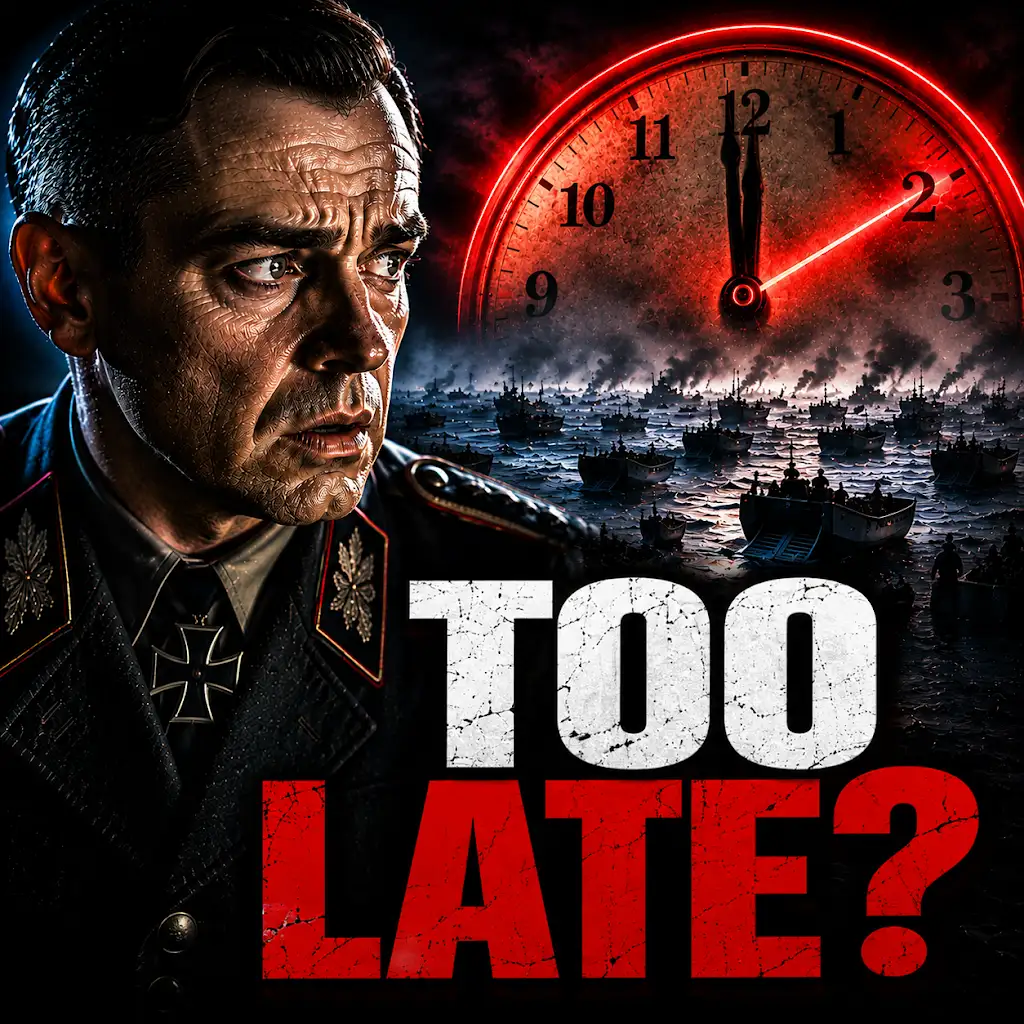
The morning of June 6, 1944, dawned with a deceptively calm sky over the English Channel. For years, Adolf Hitler had anticipated this very moment, a culmination of Allied planning and a direct threat to his painstakingly constructed Festung Europa. Yet, the reality of D-Day, the Allied invasion of Normandy, caught the Führer and his inner circle in a state of confusion, miscalculation, and ultimately, a delayed and increasingly desperate response. His reaction, shaped by his own strategic rigidity, his diminishing grasp on battlefield realities, and the complex web of command within the Nazi regime, proved to be a critical turning point in the war.
Hitler had long been convinced that a cross-channel invasion was inevitable. The strategic imperative for the Western Allies to open a second front against Germany was clear, and the vast buildup of forces in Britain, coupled with relentless bombing campaigns, left little doubt about their intentions. However, his predictions regarding the timing and location of this momentous assault were often clouded by his own biases and a persistent underestimation of Allied capabilities.
Misplaced Confidence in the Atlantic Wall
The cornerstone of Hitler’s defensive strategy in the West was the “Atlantic Wall.” This formidable, albeit unevenly constructed, series of fortifications, bunkers, minefields, and coastal artillery was designed to repel any Allied landing. Hitler poured immense resources and propaganda into projecting an image of impregnability, fostering a sense of security within Germany that was not entirely justified by the reality on the ground.
The Myth of Invincibility: Propaganda vs. Reality
The Nazi propaganda machine relentlessly hammered home the strength of the Atlantic Wall, showcasing images of imposing concrete structures and stern-faced soldiers. This narrative served to bolster domestic morale and, crucially, to sow doubt and hesitation among Allied strategists. However, the Wall’s effectiveness was heavily dependent on troop quality, supply lines, and continuous reinforcement, all of which were being strained by the demands of the Eastern Front and other theaters of war. Allied intelligence, through extensive aerial reconnaissance and the invaluable work of the Resistance, had a far clearer picture of the Wall’s vulnerabilities.
Hitler’s Strategic Blind Spots Regarding the Wall
While Hitler understood the concept of a heavily fortified coastline, his strategic vision often faltered in its practical implementation. He was prone to micro-managing aspects of the defense, issuing directives that were sometimes contradictory or unrealistic. Furthermore, he failed to fully grasp the ingenuity and adaptability of Allied amphibious assault tactics, which were designed to overcome precisely the types of defenses the Atlantic Wall presented. His belief that the Wall should be sufficient often led to a reluctance to reinforce it adequately, especially in the face of urgent requests from his commanders on the ground.
The Deception Game: Allied Ploy and German Misdirection
The Allies masterfully employed a sophisticated deception campaign, codenamed “Operation Fortitude,” to mislead the Germans about the true landing sites. This intricate web of disinformation, including phantom armies and elaborate radio traffic, was designed to draw German reserves away from Normandy. Hitler, while not entirely dismissing the possibility of deception, ultimately fell victim to its effectiveness.
Operation Fortitude: A Masterclass in Deception
Operation Fortitude was a multi-layered operation that convinced the Germans that the main invasion would occur at the Pas-de-Calais, the shortest and most logical crossing point of the English Channel. This involved creating the fictional First United States Army Group (FUSAG) under the command of the charismatic General George S. Patton, complete with inflatable tanks, dummy landing craft, and exaggerated radio communications. The sheer scale and apparent detail of this deception campaign proved incredibly persuasive.
Hitler’s Susceptibility to Deception
Hitler’s own paranoia and his tendency to believe the most dramatic or threatening scenarios often played into the hands of Allied deception. While he was aware of the possibility of diversionary tactics, his mind was ultimately fixated on the Pas-de-Calais. This fixation, coupled with the overwhelming evidence fabricated by Operation Fortitude, led him to commit vital Panzer reserves to the Pas-de-Calais area, leaving Normandy critically under-defended.
The Fog of War: Confusion and Miscommunication on D-Day
On the morning of June 6, 1944, the German command structure was a scene of disarray. Critical intelligence regarding the impending invasion was either misinterpreted, delayed, or simply not acted upon with the urgency required. Hitler himself was asleep for a significant portion of the initial landings, a fact that would have profound implications for the immediate response.
The Führer’s Slumber: A Critical Delay
Adolf Hitler was famously a heavy sleeper and a night owl. On the night of June 5th and the early morning of June 6th, he was asleep at his Wolfsschanze (Wolf’s Lair) headquarters in East Prussia. This meant that the initial reports of the Allied landings on the Normandy beaches did not reach him directly and promptly. Instead, they had to be relayed through a chain of command, encountering friction and debate at various levels.
Initial Reports: Uncertainty and Underestimation
The first reports that reached the German high command spoke of airborne landings and naval bombardments in the Normandy region. These were initially dismissed by some as mere diversionary tactics, a continuation of the expected feints before the main assault on the Pas-de-Calais. Field Marshal Erwin Rommel, commander of Army Group B in Normandy, was one of the few who recognized the gravity of the situation immediately, but even his urgent pleas for action were not initially heeded with the necessary haste.
The “Paratrooper Joke”: A Stark Miscalculation
One of the most infamous examples of misjudgment was the initial reaction to reports of Allied airborne landings. Some German officers, conditioned by earlier propaganda and a disbelief in the scale of Allied planning, reportedly dismissed these reports as a “paratrooper joke,” believing that such a large-scale airborne operation was simply beyond Allied capabilities. This dismissive attitude, fueled by overconfidence and a lack of on-the-ground situational awareness, allowed the airborne divisions to consolidate their positions with less immediate opposition than might have been the case.
The Chain of Command: Bureaucracy and Hesitation
The German military command structure was notoriously complex and often characterized by infighting and a reluctance to take decisive action without explicit Führer authorization. This bureaucratic inertia proved to be a significant impediment to an effective response on D-Day.
Generaloberst Alfred Jodl and the OKW Dilemma
Generaloberst Alfred Jodl, Chief of the Operations Staff of the Oberkommando der Wehrmacht (OKW – High Command of the Armed Forces), was a key figure in relaying information and seeking authorization. However, his position within the OKW, often caught between the wishes of Hitler and the realities faced by commanders in the field, led to a degree of caution and delay. The OKW was also heavily influenced by intelligence coming from other branches, sometimes leading to conflicting assessments of the situation.
The Role of Field Marshal Gerd von Rundstedt
Field Marshal Gerd von Rundstedt, the overall commander of German forces in the West, was a respected but somewhat detached figure. His command was spread across a vast territory, and his ability to react decisively was hampered by the lack of readily available mobile reserves, which had been strategically placed elsewhere by Hitler’s orders. His subordinate commanders in Normandy, most notably Rommel, were more acutely aware of the immediate threat but struggled to gain the necessary authorization to deploy their forces effectively.
The Führer’s Awakening: A Delayed and Fragmented Response
When Adolf Hitler finally awoke and grasped the full magnitude of the Allied invasion, his reaction was a mixture of anger, disbelief, and a desperate attempt to regain control. However, the window of opportunity for a decisive counterattack was rapidly closing.
The “Führer Directive” and the Call for Reserves
Upon being fully briefed, Hitler’s initial reaction was one of fury. He felt betrayed by his commanders and incensed by what he perceived as an underestimation of the enemy. His immediate orders were for a massive counterattack to throw the Allies back into the sea. This involved the urgent recall of critical Panzer divisions stationed in other parts of France, divisions that were essential for the defense of the Pas-de-Calais.
The 12th SS Panzer Division “Hitlerjugend”
One of the most potent German reserve formations, the 12th SS Panzer Division “Hitlerjugend,” composed largely of young men who had grown up under Nazi ideology, was stationed in Belgium. Its deployment to Normandy was a priority, but its journey was hampered by Allied air superiority and the need to bypass congested roads. Even once deployed, its effectiveness was diminished by its inexperience and the heavy casualties it sustained.
The Panzer Lehr Division
The Panzer Lehr Division, another elite armored formation, was also intended for deployment. However, its redeployment was significantly delayed, further illustrating the logistical nightmares and the impact of Allied air interdiction. This division, renowned for its training and equipment, would have been a formidable force if it had been able to engage the Allied beachheads earlier.
The “No Retreat” Order: Hitler’s Unyielding Command
A defining characteristic of Hitler’s military leadership was his absolute refusal to countenance strategic retreats. This rigid adherence to the principle of holding every inch of ground, even when tactically disadvantageous, would have devastating consequences in Normandy.
The Pitfalls of Static Defense
Hitler’s “no retreat” order meant that German units were often committed to holding positions against overwhelming odds, leading to their annihilation. Instead of allowing for phased withdrawals to more defensible lines or to consolidate forces for a counterattack, his directives often condemned units to a slow and agonizing destruction. This contrasted sharply with the more fluid and adaptable defensive strategies sometimes employed by his own generals, who recognized the necessity of maneuver in the face of superior Allied firepower and air superiority.
The Cost of Unnecessary Sacrifice
The insistence on holding ground at all costs led to immense casualties for the Wehrmacht in Normandy. Units were bled dry in futile attempts to maintain positions that were rapidly becoming untenable. This not only weakened the German defense but also deprived Hitler of the very forces he needed for a decisive counterblow.
The Battle for Normandy: A War of Attrition
Once the initial shock and confusion subsided, the battle for Normandy devolved into a brutal war of attrition. Hitler’s strategic decisions, or lack thereof, profoundly shaped the nature of this struggle, ultimately favoring the Allies’ superior resources and industrial might.
The Allied Air Superiority: A Decisive Factor
The most significant advantage the Allies possessed on D-Day and throughout the Normandy campaign was their overwhelming air superiority. Allied bombers and fighter-bombers relentlessly attacked German troop concentrations, supply lines, and armored formations, severely hampering their ability to reinforce and maneuver.
The “Air Bridge” Under Siege
The Atlantic Wall was designed to repel an amphibious assault, but it offered little protection against aerial bombardment. German troop movements, especially at night or under the cover of darkness, were constantly threatened. The German air force, the Luftwaffe, was severely depleted by the war and could not contest Allied air supremacy. This effectively created an “air bridge” for the Allies, allowing them to resupply and reinforce their troops with relative impunity.
The Tyranny of the Luftwaffe’s Absence
The absence of significant German air resistance meant that Allied armor and infantry could operate with a freedom unimaginable on the Eastern Front. This allowed for rapid advances, effective tactical support, and the isolation of German units. Hitler’s inability to effectively counter this aerial dominance was a testament to the declining power of the Wehrmacht.
The Battle of the Hedgerows: A Grind of Attrition
The Normandy countryside, characterized by its dense hedgerows and sunken lanes, proved to be a brutal and unforgiving battlefield. The Allies, despite their technological advantages, found themselves engaged in a painstaking and bloody advance, clearing each hedgerow with extreme caution.
The Ineffectiveness of German Armor Deployment
While Hitler had intended to deploy his Panzer reserves to crush the beachhead, the Allied air superiority and the logistical challenges meant that these armored formations were often deployed piecemeal and in conditions unfavorable for their optimal use. Furthermore, the terrain itself, with its narrow lanes and limited visibility, often negated the advantages of German armor, making them vulnerable to Allied anti-tank weapons.
The Allied “Breakout” and its Strategic Implications
Ultimately, the Allied forces managed to break out of the Normandy bocage, thanks in part to tactical innovations and the sheer overwhelming force they could bring to bear. This breakout, culminating in the Falaise Pocket, trapped and destroyed large numbers of German troops and armor, marking a decisive turning point in the Normandy campaign and signaling the beginning of the end for German resistance in the West.
The Aftermath: A Strategic Defeat and a Precursor to Collapse
The failure to repel the D-Day invasion and the subsequent loss of Normandy represented a strategic catastrophe for Nazi Germany. Hitler’s response, characterized by miscalculations, delays, and rigid adherence to flawed doctrines, had sealed the fate of his Western defenses.
The Loss of Western Europe: A Strategic Disaster
The invasion of Normandy opened a vital second front that Germany could no longer sustain. The loss of France, Belgium, and the Netherlands led to the collapse of the Western Front and the relentless advance of Allied forces towards the German homeland. The strategic initiative had irrevocably shifted to the Allies.
The Psychological Blow to the Nazi Regime
Beyond the military implications, D-Day delivered a devastating psychological blow to the Nazi regime and its supporters. The myth of the invincible Atlantic Wall was shattered, and the prospect of defeat, once distant, became starkly real. The relentless bombing of German cities and the ongoing devastation on the Eastern Front, combined with the open invasion of the West, eroded public morale and fueled dissent within the military.
Hitler’s Diminishing Grip on Power
The failures in Normandy further exposed the limitations of Hitler’s leadership and his detachment from battlefield realities. While he remained in control of the Nazi state, his strategic judgment was increasingly questioned by those around him, and the foundations of his authority began to crack under the immense pressure of an all-out war that Germany was demonstrably losing. The events of D-Day and the subsequent campaign were not just a military defeat; they were a profound indictment of Hitler’s strategic vision and a harbinger of the ultimate collapse of the Third Reich.