
The history of cryptography is an intricate tapestry woven with threads of innovation and vulnerability. For every breakthrough in secure communication, a counter-effort has emerged, seeking to unravel its protections. This ongoing dialectic, a perpetual arms race between cipher designers and cryptanalysts, has driven the evolution of cryptographic systems and the understanding of their inherent strengths and weaknesses. This article explores key junctures in this historical compromise, examining instances where the integrity of cryptographic systems was breached, the methods employed, and the subsequent impact on security practices.
The genesis of cryptographic system compromise can be traced back to antiquity, where early forms of secret writing were met with equally early attempts at decipherment. These initial breaches laid the groundwork for sophisticated cryptanalytic techniques that would emerge over millennia. You can learn more about John Walker by watching this informative video.
The Spartan Scytale: A Twist of Fate
One of the earliest known cryptographic devices, the Spartan scytale, relied on transposition for its security. A strip of parchment was wound around a cylindrical rod of a specific diameter, and the message written along its length. When unwound, the letters appeared jumbled.
- Method of Compromise: The scytale’s security was entirely dependent on the secrecy of the rod’s diameter. If an adversary acquired a rod of the same size, or through trial and error, discovered the correct diameter, the message could be easily reconstructed. This highlights a fundamental principle of cryptography: the strength of a system often rests on a single, potentially discoverable secret.
- Impact: While simple, the scytale illustrates the vulnerability inherent in systems that rely on a physical key. Its compromise was often a matter of infiltration or capture.
Caesar Cipher: Substitution’s Achilles’ Heel
Julius Caesar’s eponymous cipher, a simple substitution cipher, involved shifting each letter of the plaintext a fixed number of positions down the alphabet. For instance, with a shift of three, ‘A’ would become ‘D’, ‘B’ would become ‘E’, and so on.
- Method of Compromise: The Caesar cipher, despite its historical significance, is remarkably weak. Its vulnerability stems from the fixed nature of the shift and the limited number of possible keys (only 25 for the Latin alphabet). Cryptanalysts could systematically try each possible shift until a coherent message emerged, a process known as brute-force attack.
- Impact: The ease with which the Caesar cipher can be broken demonstrates the inadequacy of simple substitution for serious secrecy. It paved the way for more complex substitution ciphers and the eventual development of frequency analysis.
The history of cryptographic system compromises is a fascinating journey that highlights the ongoing battle between security and vulnerability. For a deeper understanding of this topic, you can explore the article titled “The Evolution of Cryptographic Failures” on In The War Room, which delves into significant breaches and the lessons learned from them. To read more, visit In The War Room.
The Dawn of Frequency Analysis and its Repercussions
The development of frequency analysis marked a significant turning point in the history of cryptographic compromise. This technique provided a systematic means of breaking substitution ciphers, thereby forcing cryptographers to devise more robust methods.
Al-Kindi’s Breakthrough: A Linguistic Scalpel
The Arab polymath Al-Kindi, in the 9th century, is credited with articulating the principles of frequency analysis. He observed that in any given language, certain letters and letter combinations occur with predictable frequencies.
- Method of Compromise: By analyzing the frequency of characters in a ciphertext and comparing them to the known frequencies of letters in the language of the plaintext, cryptanalysts could deduce the mapping between ciphertext and plaintext letters. For example, if “E” is the most common letter in English, and “X” is the most common in a given ciphertext, it is highly probable that “X” represents “E”.
- Impact on Monolithic Substitution: Frequency analysis proved devastatingly effective against simple monoalphabetic substitution ciphers, where each plaintext letter consistently maps to one ciphertext letter. This forced the abandonment of such ciphers for any serious security application.
Polyalphabetic Ciphers and Their Eventual Demise
In response to frequency analysis, polyalphabetic ciphers, such as the Vigenère cipher, emerged. These ciphers used multiple substitution alphabets, changing the substitution pattern based on a keyword. This seemingly rendered frequency analysis ineffective, as the same plaintext letter could be represented by different ciphertext letters.
- Method of Compromise: Kasiski’s Method and Friedman’s Work: While initially perceived as unbreakable, polyalphabetic ciphers eventually succumbed to sophisticated analysis. Friedrich Kasiski, in the 19th century, observed that repeated sequences of letters in a ciphertext might correspond to repeated sequences of plaintext letters encrypted with the same part of the key. By measuring the distance between these repetitions, one could deduce the length of the key. Once the key length was determined, the cipher could be broken down into multiple Caesar ciphers, each amenable to frequency analysis. Later, William F. Friedman in the early 20th century further refined these techniques, developing the “index of coincidence,” a powerful statistical tool for determining key length and cracking polyalphabetic ciphers.
- Impact: The breach of polyalphabetic ciphers underscored the enduring power of statistical analysis in cryptanalysis. It demonstrated that even seemingly complex systems could be unraveled through careful observation of patterns and an understanding of linguistic properties.
The Mechanical and Electromechanical Era of Compromise
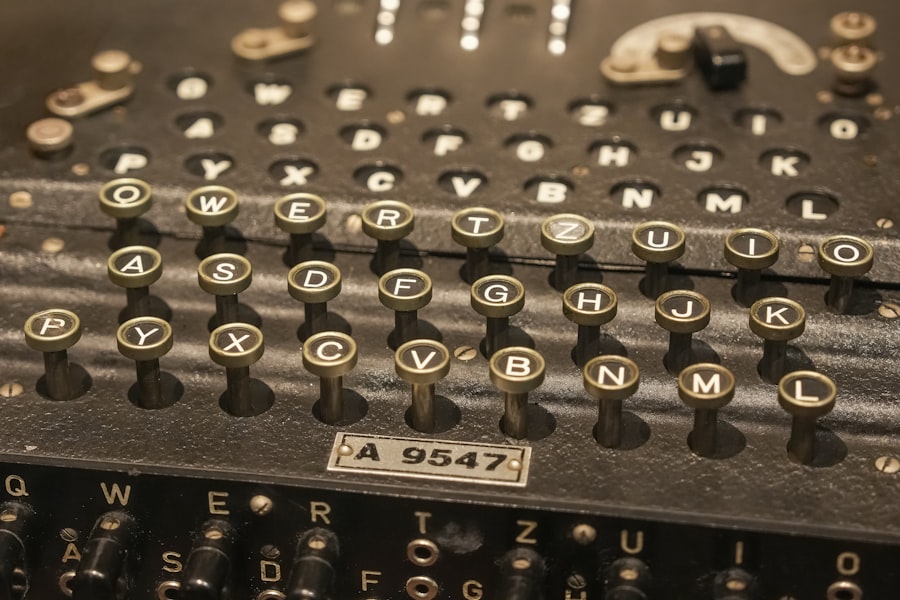
The 20th century witnessed the rise of sophisticated mechanical and electromechanical encryption machines. These devices introduced unprecedented levels of complexity, but they too proved susceptible to determined cryptanalytic efforts.
The Enigma Machine: A Colossal Undertaking
The German Enigma machine, used extensively during World War II, was an electromechanical rotor-based cipher machine. Its intricate design, with multiple rotors, a reflector, and a plugboard, created an enormous number of possible encryption transformations, making it seem virtually unbreakable.
- Methods of Compromise: Bletchley Park’s Triumph: The cracking of the Enigma code by Allied cryptanalysts at Bletchley Park stands as one of history’s most significant cryptographic achievements. Their success was multifaceted:
- Operator Error: German operators sometimes made predictable mistakes, such as using common words (e.g., “Heil Hitler”) as messages or repeating parts of the message key. These “cribs” provided invaluable footholds for analysis.
- Design Flaws: A crucial design flaw was the Enigma’s inability to encrypt a letter to itself. This seemingly minor detail was exploited by British cryptanalysts through techniques like the “Banburismus” and later incorporated into the “bombe” machines.
- The Bombe Machines: Alan Turing and his team developed electromechanical “bombe” machines, which systematically tested possible Enigma settings, dramatically accelerating the decryption process. These machines functioned as early forms of computational brute-force.
- Capture of Codebooks and Hardware: On several occasions, Allied forces managed to capture Enigma machines, rotor settings, and codebooks, providing vital intelligence for cryptanalytic efforts.
- Impact: The cracking of Enigma had a profound impact on the outcome of World War II, providing the Allies with crucial intelligence. It highlighted the importance of interdisciplinary collaboration (mathematics, engineering, linguistics), the vulnerability of even complex systems to design flaws and operational errors, and the power of dedicated, organized cryptanalytic efforts.
The Lorenz Cipher: Breaking Tunny
Another formidable German cipher machine, the Lorenz SZ40/42, known as “Tunny” by the British, was even more complex than Enigma. It was used for high-level communications between German high command.
- Methods of Compromise: Colossus and Statistical Analysis: The Allied efforts to break Lorenz were even more challenging than Enigma. Its compromise involved:
- Cryptanalysis of Mismanagement: A significant breakthrough occurred when a German operator twice transmitted the same message with the same key settings, revealing the structure of the underlying key. This operator error provided the initial “crib” to understand the Lorenz’s internal logic.
- The Colossus Computers: The complexity of Lorenz’s key stream necessitated automated analysis. This led to the development of Colossus, the world’s first programmable electronic digital computer. Colossus machines were instrumental in performing statistical analysis on the vast amounts of intercepted Lorenz traffic, identifying patterns and ultimately deciphering the messages.
- Impact: The successful decryption of Lorenz code provided critical strategic intelligence, further solidifying the role of computing in cryptanalysis. It demonstrated that even highly sophisticated, automated ciphers could be compromised through a combination of human error and advanced computational power.
The Digital Age: New Frontiers of Compromise
With the advent of digital computing, cryptographic systems evolved to incorporate public-key cryptography and more robust symmetric-key algorithms. However, this new era also brought forth novel avenues for compromise, ranging from sophisticated mathematical attacks to side-channel vulnerabilities.
Public-Key Cryptography: The RSA Challenge
Public-key cryptography, spearheaded by algorithms like RSA (Rivest–Shamir–Adleman), revolutionized secure communication by allowing secure key exchange over insecure channels. Its security relies on the computational difficulty of factoring large numbers.
- Methods of Compromise: Factoring Advances and Implementation Flaws:
- Integer Factorization Progress: While the underlying mathematical problem (factoring large numbers) remains computationally hard for sufficiently large keys, advances in factorization algorithms and the increasing power of computers have continuously pushed the boundaries of what is feasible. Each new record in factoring increasingly larger numbers represents a potential threat to older, smaller RSA keys.
- Side-Channel Attacks: Even if the mathematical core of RSA remains strong, implementations can introduce vulnerabilities. Side-channel attacks exploit information leaked during the encryption or decryption process, such as timing differences, power consumption, or electromagnetic emissions. Researchers have demonstrated how these subtle leaks can reveal private keys.
- Poor Random Number Generation: The security of RSA relies heavily on the generation of truly random prime numbers. Flaws in random number generators can lead to the generation of predictable or weak primes, making the private key easier to deduce. For instance, in 2012, a significant number of RSA keys were found to be vulnerable due to the use of insufficiently random primes generated by certain hardware tokens.
- Impact: The ongoing challenge to RSA and other public-key algorithms underscores that even mathematically sound systems are only as secure as their implementation and the underlying computational assumptions hold true. It highlights the importance of robust random number generation and careful protection against side-channel leaks.
Symmetric-Key Ciphers: AES and Beyond
Modern symmetric-key algorithms like the Advanced Encryption Standard (AES) employ highly complex operations designed to resist known cryptanalytic techniques. AES has withstood rigorous scrutiny and remains widely regarded as secure when correctly implemented.
- Methods of Compromise: Weak Keys, Implementation Bugs, and Quantum Threats:
- Weak Keys: While AES itself is robust, the choice of a weak or easily guessable key can render any encryption virtually useless. This is an operational, rather than algorithmic, compromise.
- Implementation Bugs: Software or hardware implementations of AES might contain bugs that inadvertently leak plain information or weaken the cipher’s integrity. These can range from subtle timing leaks to buffer overflows.
- Quantum Computing (Future Threat): A significant future threat to current symmetric-key ciphers, including AES, comes from the potential advent of large-scale quantum computers. While AES is considered robust against classical cryptanalysis, Grover’s algorithm could theoretically reduce the effective key length by half, making brute-force attacks more feasible. This has spurred intense research into post-quantum cryptography.
- Side-Channel Attacks: Similar to public-key systems, implementations of AES can be vulnerable to side-channel attacks, especially when running on shared hardware or in environments where an attacker can monitor physical characteristics.
- Impact: The continued robustness of AES against classical attacks showcases the sophistication of modern cryptographic design. However, the looming threat of quantum computing represents a paradigm shift, necessitating a proactive approach to developing and transitioning to quantum-resistant cryptographic systems. The emphasis remains on scrupulous implementation and operation to prevent practical compromises.
The history of cryptographic system compromises reveals a fascinating evolution of security practices and vulnerabilities. One notable incident involved the infamous Enigma machine used during World War II, which was ultimately deciphered by Allied cryptanalysts, leading to significant strategic advantages. For a deeper understanding of various instances of cryptographic failures and their implications, you can explore this insightful article on the subject. It provides a comprehensive overview of how these breaches have shaped modern encryption techniques and security protocols. Check it out here.
The Never-Ending Battle: A Metaphor for Progress
| Year | Cryptographic System | Type of Compromise | Impact | Details |
|---|---|---|---|---|
| 1993 | MD5 Hash Function | Collision Vulnerability | Integrity Compromise | First practical collision attacks demonstrated, undermining trust in MD5 for digital signatures. |
| 1995 | DES (Data Encryption Standard) | Brute Force Attack | Confidentiality Breach | DES key length found too short; successful brute force attacks demonstrated feasibility. |
| 2004 | WEP (Wired Equivalent Privacy) | Cryptanalysis and Key Recovery | Wireless Network Compromise | Weaknesses in IV reuse and RC4 implementation led to easy key recovery and network breaches. |
| 2008 | SHA-1 Hash Function | Collision Attacks | Integrity Compromise | Cryptanalysis showed SHA-1 collisions feasible, leading to deprecation recommendations. |
| 2013 | RSA Key Generation | Weak Key Generation | Private Key Exposure | Research found many RSA keys shared prime factors, enabling private key recovery. |
| 2017 | ROCA Vulnerability | Key Generation Flaw | Private Key Compromise | Flawed RSA key generation in smartcards and TPMs allowed private key extraction. |
| 2018 | Meltdown and Spectre | Side-Channel Attacks | Data Leakage | Hardware vulnerabilities allowed attackers to bypass memory isolation, affecting cryptographic keys. |
| 2020 | SHA-1 | Practical Collision | Integrity Compromise | Google and CWI Amsterdam demonstrated a practical SHA-1 collision attack named “SHAttered”. |
| 2021 | Log4Shell (Log4j Vulnerability) | Remote Code Execution | System Compromise | Though not a cryptographic algorithm flaw, it impacted systems relying on cryptographic authentication. |
| 2023 | Quantum Computing Threat | Potential Cryptanalysis | Future Confidentiality Risk | Advances in quantum computing pose risks to RSA and ECC cryptosystems, prompting post-quantum cryptography research. |
The history of cryptographic system compromise is not merely a chronicle of failures, but rather a dynamic narrative of adaptation and resilience. Each breached cipher has served as a crucible, forging stronger, more sophisticated methods of protection. The cryptanalyst, in this analogy, is the relentless current, constantly probing the banks of secure communication, seeking fissures and weaknesses. The cryptographer, in turn, is the architect of the dam, perpetually reinforcing and re-engineering, learning from every breach.
This constant interplay ensures that cryptographic security is never a static target but a continually evolving landscape. The methods of compromise have advanced from simple observation to sophisticated statistical analysis, to powerful computational brute force, and now, to the emerging quantum threat. Understanding this history is crucial, for it informs our present practices and guides our future endeavors in securing digital realms. The lessons learned from the compromises of the past are not mere historical footnotes; they are foundational principles upon which the security of our modern networked world intimately depends. The battle between code makers and code breakers will continue, each compromise pushing the boundary of what is considered secure, and in doing so, driving innovation forward.
WATCH THIS 🔐 The Submarine That Broke The Cold War | Naval Intelligence Espionage | SOSUS Compromise
FAQs
What is a cryptographic system compromise?
A cryptographic system compromise occurs when the security of a cryptographic algorithm, protocol, or implementation is broken, allowing unauthorized parties to access, alter, or decrypt protected information.
What are some historical examples of cryptographic system compromises?
Notable historical compromises include the breaking of the Enigma machine during World War II, the discovery of weaknesses in the Data Encryption Standard (DES) in the 1990s, and the exposure of vulnerabilities in the MD5 and SHA-1 hash functions.
How have cryptographic compromises impacted security practices?
These compromises have led to the development of stronger algorithms, increased emphasis on key management, and the adoption of more rigorous standards and protocols to enhance data security.
What role did the Enigma machine compromise play in cryptography history?
The Enigma machine compromise during World War II was a pivotal event that demonstrated the importance of cryptanalysis and led to advances in both cryptographic techniques and computing technology.
Why was the Data Encryption Standard (DES) eventually considered insecure?
DES was considered insecure due to its relatively short 56-bit key length, which became vulnerable to brute-force attacks as computing power increased, leading to its replacement by the Advanced Encryption Standard (AES).
What lessons have been learned from past cryptographic system compromises?
Key lessons include the necessity of continuous evaluation of cryptographic algorithms, the importance of using sufficiently long keys, and the need for secure implementation and key management practices.
How do cryptographers respond to discovered vulnerabilities?
Cryptographers typically analyze the vulnerabilities, publish their findings, and work on developing and recommending more secure algorithms and protocols to replace compromised systems.
Are modern cryptographic systems immune to compromise?
No cryptographic system is completely immune to compromise; however, modern systems are designed to be resilient against known attack methods and are regularly updated to address emerging threats.
What is the significance of cryptographic system compromise history for current cybersecurity?
Understanding the history of cryptographic compromises helps cybersecurity professionals anticipate potential weaknesses, improve security measures, and avoid repeating past mistakes.