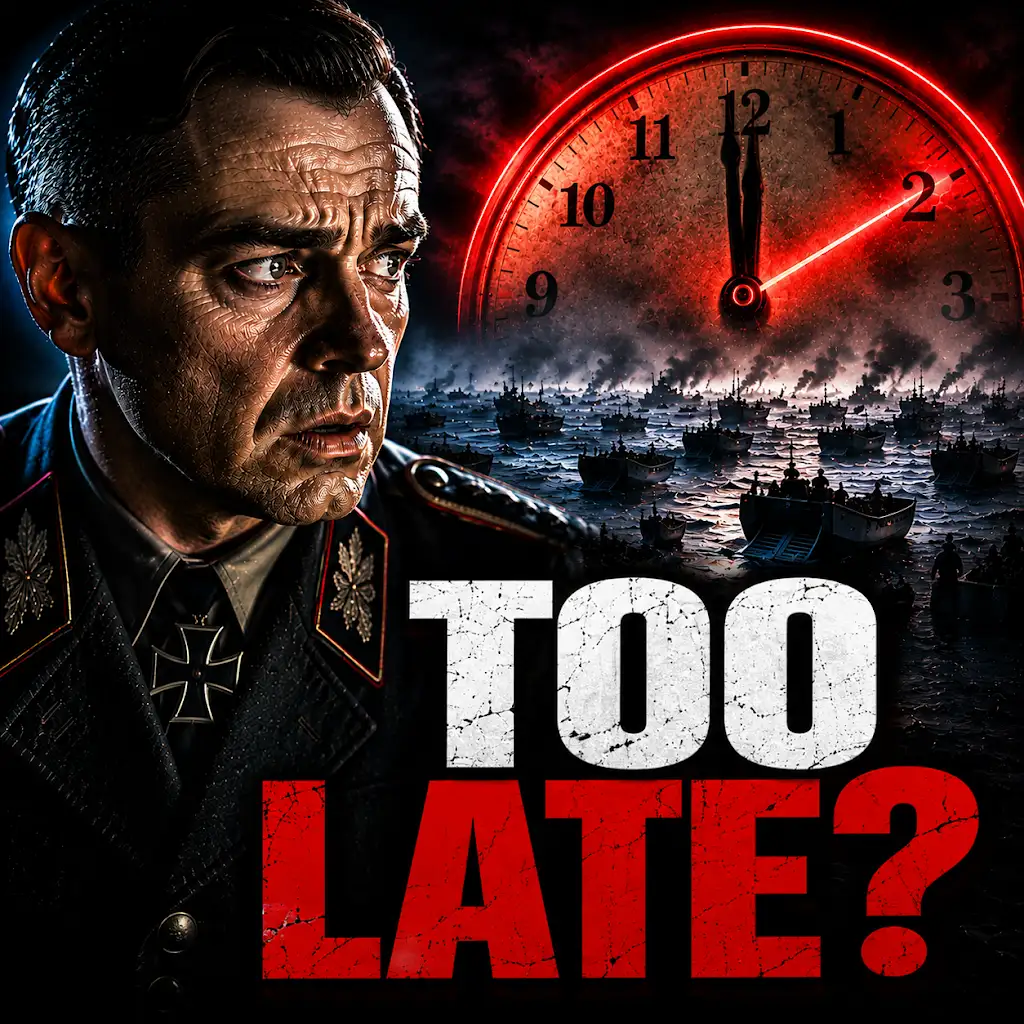
The pre-dawn hours of June 6, 1944, marked a turning point in the Second World War, a day that would forever be etched in history as D-Day. For Germany, it was a day of unprecedented crisis, a desperate struggle against an enemy that had finally broken through the formidable Atlantic Wall. The Allied invasion of Normandy was not a sudden, unforeseen event; warnings had been heeded, intelligence reports analyzed, and defenses painstakingly constructed. Yet, the sheer scale and audacity of the Allied operation, coupled with a series of critical German miscalculations and unfortunate circumstances, converged to create a twelve-hour window of profound vulnerability and eventual catastrophic loss for the Third Reich. This article delves into those critical hours, examining the German perspective as their meticulously prepared defenses began to crumble.
The Illusion of Security: Pre-Invasion German Preparedness
Prior to D-Day, Germany, under the command of Field Marshal Erwin Rommel and General Gerd von Rundstedt, had invested immense resources into fortifying the Atlantic Wall. This vast network of concrete bunkers, minefields, anti-tank obstacles, and coastal artillery was designed to repel any Allied amphibious assault. The belief was that a well-defended coastline, coupled with the perceived limitations of Allied amphibious capabilities, would be sufficient to deter an invasion or at least inflict unacceptable casualties upon the attackers. However, this perception of security was built on a foundation of flawed assumptions and internal disagreements within the German high command.
Rommel’s Frantic Efforts and Rundstedt’s Doubts
Field Marshal Erwin Rommel, imbued with a sense of urgency, was convinced that the invasion would come in the spring of 1944 and that the defenses needed to be strengthened to an even greater degree. He famously declared that the Atlantic Wall would be “more formidable than the Siegfried Line” and that he intended to “destroy the enemy in the water, before he can reach our shores.” His energetic efforts saw the rapid construction of new defenses, the deployment of additional troops, and the laying of vast quantities of mines and obstacles. However, Rommel’s vision was often at odds with the strategic doctrines of some of his superiors.
General Gerd von Rundstedt, the overall commander of Army Group B, held a more conservative view. While he acknowledged the need for defenses, he was also acutely aware of the depleted state of German forces on the Western Front, a consequence of the relentless demands of the Eastern Front and Allied strategic bombing. Rundstedt favored a more mobile defense, keeping significant armored reserves in readiness to counter-attack once the main Allied landing sites were identified. This fundamental disagreement between Rommel and Rundstedt regarding the optimal deployment of forces, particularly armored divisions, would prove to be a critical factor on D-Day.
The Strategic Importance of Reserves
The deployment of German armored reserves was a subject of intense debate. Rommel, believing the invasion would be imminent and focused on immediate coastal defense, wanted these divisions positioned closer to the coast. Rundstedt, however, argued for keeping them further inland, allowing them to be deployed to whichever sector was most heavily attacked, thus concentrating their considerable power against a fully committed Allied force. Ultimately, Hitler, who was often the final arbiter of such strategic decisions, had placed control of the strategic reserves, including the Panzer divisions, directly under his command, further complicating their rapid deployment. This lack of decisive command and control over the crucial armored formations was a significant pre-war weakness that would manifest catastrophically on D-Day.
Intelligence Failures and Allied Deception
Despite the considerable intelligence gathering efforts by the German Abwehr (military intelligence), they were largely outmaneuvered by the Allied deception plans, codenamed “Operation Fortitude.” The Allies meticulously crafted a false image of an impending invasion force in Kent, codenamed “First U.S. Army Group” (FUSAG), under the command of the highly visible General George S. Patton. This elaborate charade, complete with inflatable tanks, fake airfields, and radio transmissions, successfully diverted significant German forces, including crucial Panzer divisions, to the Pas-de-Calais region, the most geographically logical invasion point. On June 6th, the German high command, including Rommel, was largely convinced that the Normandy landings were a feint, a prelude to the main assault on Pas-de-Calais. This misjudgment would prove to be one of the most consequential errors of the entire campaign.
The Dawn of Invasion: The First Hours of Chaos
As the Allied airborne divisions began their descent into Normandy in the early hours of June 6th, the German defenders were still largely unaware of the true scale of the operation unfolding. The initial landings, while facing fierce resistance, were met with a fragmented and often uncoordinated German response.
Paratrooper Landings and Local Resistance
The Allied airborne assault, designed to secure key bridges and road junctions behind the invasion beaches, was crucial in sowing confusion and disrupting German communications and command structures. German troops in these areas, often isolated and outnumbered, fought bravely but were frequently overwhelmed. The paratroopers, despite suffering significant casualties and a chaotic drop, managed to disrupt German reinforcements and sow a pervasive sense of disarray.
The Coastal Defenses Under Fire
The first waves of Allied seaborne troops hit the beaches of Utah, Omaha, Gold, Juno, and Sword. The formidable defenses of the Atlantic Wall, so painstakingly constructed, were now subjected to the full fury of the Allied assault. Naval bombardment and aerial attacks had softened some of the defenses, but many strongpoints remained intact and capable of inflicting devastating casualties.
Omaha Beach: The Inferno of the First Waves
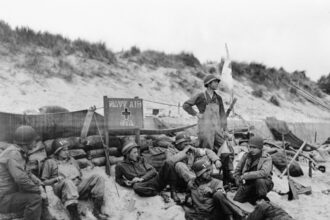
Omaha Beach became infamous for the sheer ferocity of the German defense and the horrific casualties sustained by the first American assault waves. The pre-invasion bombardment had been less effective here than elsewhere, leaving German machine-gun nests and artillery positions largely intact. The rough seas and strong currents also scattered the landing craft, forcing many soldiers to disembark in deep water, vulnerable to enemy fire. The terrain itself, a series of bluffs and ravines, offered the Germans excellent defensive positions. The “butcher’s bill” for Omaha was staggering, a testament to the unyielding German resistance in the face of overwhelming odds.
Utah Beach: A More Successful Landing
In contrast to Omaha, the landings at Utah Beach were relatively more successful. The primary reason for this was a navigational error by the lead landing craft, which pushed the assault waves further west than originally planned. This brought them ashore in a less heavily defended sector, bypassing some of the most formidable obstacles. While still facing resistance, the American forces at Utah were able to establish a foothold more rapidly and with significantly fewer casualties than their counterparts at Omaha.
The Atlantic Wall Breached: Initial German Reactions
News of the landings spread rapidly through the German command structure, but the initial reactions were often confused and hesitant. The belief that this was merely a diversionary attack persisted in some quarters, delaying the commitment of vital reserves. Communications were hampered by the airborne attacks, and the sheer speed of the Allied landings overwhelmed many local German commanders.
Breakdown in Communication and Command
The Allied airborne operations, particularly the destruction of key bridges and communication lines, played a crucial role in disrupting German command and control. This prevented effective coordination between front-line units and the higher command, leading to delayed and often ineffective responses. The fog of war, amplified by the chaos of the invasion, descended heavily upon the German defenses.
The Role of Luftwaffe and Kriegsmarine
The Luftwaffe (air force) and Kriegsmarine (navy) were expected to play a significant role in repelling the invasion. However, on D-Day, their contributions were significantly hampered. The Luftwaffe had been severely depleted by months of Allied strategic bombing, and many of its available aircraft were engaged in operations elsewhere. Similarly, the Kriegsmarine’s main surface fleet was largely confined to port, and its limited U-boat forces were struggling to counter the overwhelming Allied naval presence. The absence of significant air and naval support left the German Army to bear the brunt of the invasion largely on its own.
The Shifting Tide: Midday Struggles and Missed Opportunities
As the morning wore on, the Allied beachheads began to expand, and the German high command grappled with the increasingly undeniable reality of a full-scale invasion. The critical decision of when and where to commit the strategic reserves became paramount, but the continued influence of Allied deception and internal German indecision began to seal their fate.
The Battle for the Beaches: Fierce German Resistance
On all the landing beaches, German units, though often outnumbered and outgunned, fought with tenacity and skill. They utilized their well-placed fortifications to inflict heavy casualties on the advancing Allies. The battles were brutal and costly, with both sides suffering immense losses.
Gold, Juno, and Sword Beaches: Allied Breakthroughs
While Omaha and Utah faced unique challenges, the British and Canadian forces on Gold, Juno, and Sword beaches, though encountering strong resistance, were generally able to achieve their objectives and secure vital bridgeheads. The coordinated efforts of naval gunfire support and the deployment of specialized armor, such as the Churchill tanks and flail tanks, helped to overcome many of the obstacles.
The Inadequacy of German Counter-Attacks
The German counter-attacks in the early to mid-day of D-Day were largely piecemeal and uncoordinated. The lack of clear intelligence regarding the main Allied thrust, coupled with the lingering belief that Normandy was a feint, meant that the crucial armored reserves were not deployed with the speed and concentration necessary to effectively push the Allies back into the sea.
The 12th SS Panzer Division “Hitlerjugend” and the 21st Panzer Division
Two key Panzer divisions, the 12th SS Panzer Division “Hitlerjugend” and the 21st Panzer Division, were positioned in Normandy. However, their deployment was hampered by Allied air superiority, which made daylight movement extremely dangerous. The 12th SS Panzer Division, comprised of fanatically loyal young soldiers, launched fierce but ultimately unsuccessful counter-attacks, particularly in the Caen sector. The 21st Panzer Division, commanded by Major General Edgar Feuchtinger, was the only German armored division that managed to launch a significant counter-attack on D-Day, targeting the junction between the British and Canadian beaches. Despite initial success, their attack was eventually halted by overwhelming Allied air and artillery power.
Hitler’s Indecision: The “Führer’s Orders”
A critical element in the German failure was the delayed authorization for the deployment of the strategic armored reserves. Hitler, still under the influence of the deception plans and reluctant to commit his prized panzer divisions to what he believed might be a secondary battle, hesitated for crucial hours. His infamous “Führer’s orders” were not immediately given, and when they finally came, the window of opportunity had narrowed considerably.
The Erosion of the Atlantic Wall: Late Afternoon and Evening Developments
As the afternoon wore on, the Allied forces had firmly established their beachheads, and the initial German resistance, though still fierce in places, began to buckle under the sustained pressure. The German high command faced the grim realization that the invasion was not a feint, but a full-blown assault on their Western defenses.
Allied Consolidation and Expansion
With the initial landing phases successful, Allied forces began the crucial task of consolidating their gains and expanding their bridgeheads. This involved pushing inland, securing key villages and transportation routes, and linking up the various landing sectors.
The Race for Caen
The capture of Caen, a vital transportation hub, was a primary objective for the British and Canadian forces. The battle for Caen would prove to be a protracted and bloody affair, extending far beyond D-Day, but the initial push on D-Day itself established a strong presence in the region.
The Fragmented German Response Continues
Despite the growing understanding of the invasion’s seriousness, the German response remained fragmented. The continuous Allied air attacks prevented large-scale troop movements, and the scattered nature of the fighting made it difficult to mount a cohesive defense.
The Retreat and Reorganization
In some sectors, German units were forced to retreat to secondary defensive lines. This often involved disengaging under heavy fire and attempting to regroup, a perilous undertaking against an advancing enemy.
The Naval Battle for the Channel
While the land battles raged, the Allied navies maintained a crucial role in suppressing German coastal defenses and preventing any significant German naval interference. The Kriegsmarine, already weakened, was unable to mount any meaningful challenge to the overwhelming Allied naval superiority.
The Grim Reckoning: D-Day’s Aftermath for Germany
As the first twelve hours of D-Day drew to a close, the German military faced a catastrophic setback. The Atlantic Wall had been breached, their strategic reserves had been deployed too late and ineffectively, and the Allies had secured a vital foothold on the continent. The psychological impact of this defeat was profound, and the strategic landscape of the war had irrevocably shifted.
The Loss of Territory and Resources
By the end of D-Day, the Allies had captured significant territory in Normandy, establishing several bridgeheads. This meant the loss of valuable strategic positions and the commitment of German forces to a defensive battle on unfamiliar terrain. The matériel and manpower losses sustained by the German military on D-Day were considerable and difficult to replace.
The Cost in Lives and Equipment
The German casualties on D-Day, though difficult to precisely quantify, were substantial. They included killed, wounded, and captured soldiers. Furthermore, significant amounts of equipment, including tanks, artillery, and defensive fortifications, were destroyed or captured by the advancing Allied forces.
The Strategic Implications: The Opening of the Second Front
The success of D-Day meant that the long-awaited Second Front in Western Europe was finally open. This relieved pressure on the Soviet Union on the Eastern Front and forced Germany to fight a two-front war with its depleted resources. The strategic initiative had decisively shifted to the Allies.
The Beginning of the End?
For the German high command, D-Day represented a devastating blow. The carefully constructed illusion of invincibility had been shattered, and the prospect of a protracted and ultimately losing war became starkly apparent. The events of June 6, 1944, marked a critical turning point, signaling the beginning of the end for the Third Reich. The critical twelve hours of D-Day were not just a military defeat; they were a profound crisis that exposed the fatal flaws in German strategy, command, and intelligence, paving the way for the eventual Allied victory.