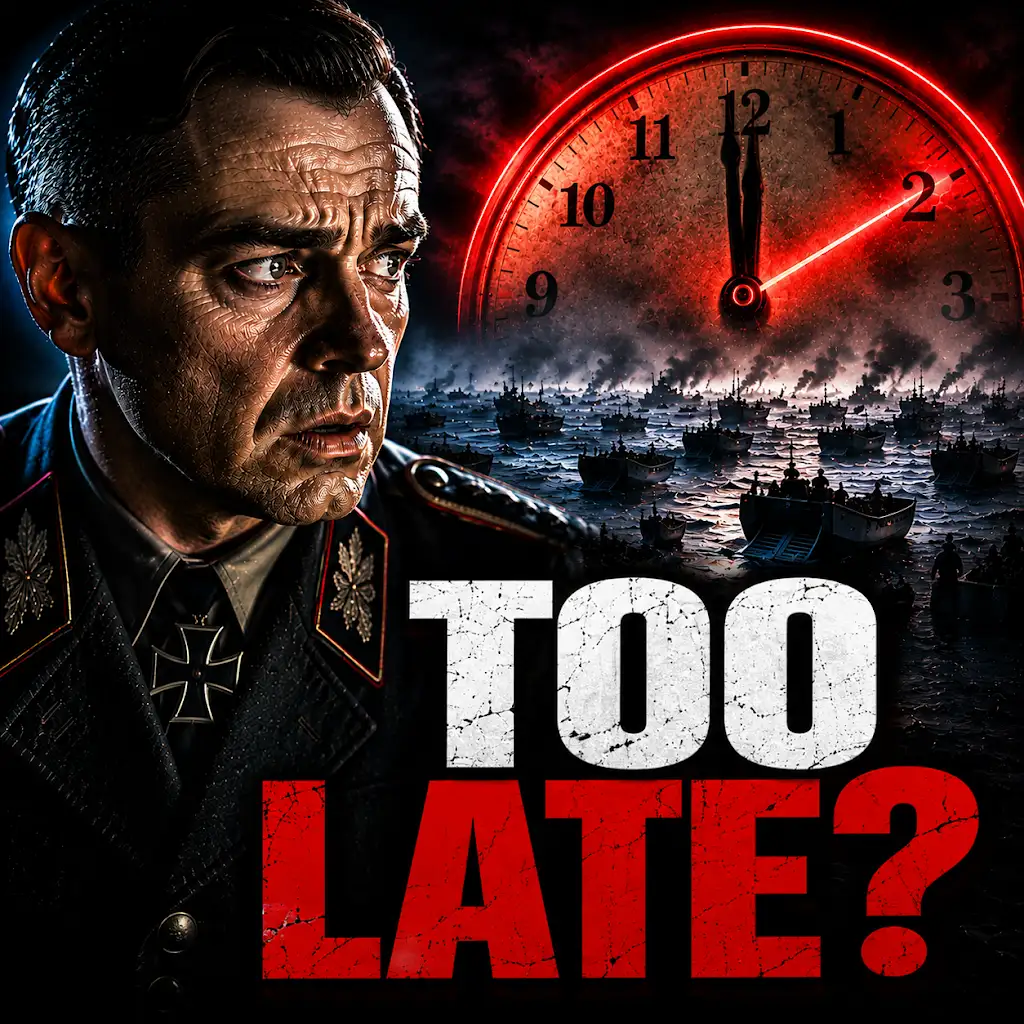
The Allied invasion of Normandy on June 6, 1944, known as D-Day, remains one of history’s most pivotal military operations. While much attention is rightfully given to the Allied planning and execution, the German perspective, particularly the strategic thinking and actions of Field Marshal Erwin Rommel, offers a crucial lens through which to understand the events of that fateful day. Rommel, renowned for his daring tactics in North Africa, was tasked with defending the Atlantic Wall, a formidable series of coastal fortifications. His assessment of the impending invasion and his proposed strategies, however, were ultimately not fully implemented, leading to a series of missed opportunities and a failure to adequately counter the Allied assault.
Rommel’s Assessment of the Threat
Prior to D-Day, Rommel was acutely aware of the escalating threat posed by the Allied forces. Unlike many of his superiors in the German high command, who remained complacent and divided on the true intentions of the Allies, Rommel possessed a clear and urgent understanding of the danger. He recognized that this was not merely a feint or a diversionary tactic, but the main thrust of an invasion aimed at liberating occupied Europe.
The Specter of Allied Air Superiority
One of Rommel’s primary concerns was the overwhelming air superiority enjoyed by the Allies. He witnessed firsthand the devastating impact of Allied bombing campaigns on German infrastructure and troop morale. He understood that before any amphibious landing could be truly successful, the Allies would need to neutralize German air defenses and establish air superiority over the invasion beaches. This meant that any significant German counterattack or reinforcement effort would be subject to intense aerial interdiction, severely hampering its effectiveness. Rommel believed that the defense of the Atlantic Wall must be predicated on the assumption of continuous Allied air attacks.
The Importance of the Beachhead Defense
Rommel’s core strategic belief was that the Atlantic Wall, despite its impressive construction, could not withstand a prolonged siege. He argued vehemently that the crucial phase of the battle would occur on the beaches themselves. If the Allies could establish a solid foothold, their superior resources in terms of manpower, equipment, and airpower would inevitably lead to their eventual victory. Therefore, Rommel’s strategy centered on preventing the Allies from ever gaining that initial beachhead. He advocated for a defensive posture that prioritized immediate and decisive counterattacks to push the invaders back into the sea before they could consolidate their positions.
Misunderstandings within the German High Command
A significant hurdle Rommel faced was the internal dissent and differing opinions within the German high command regarding the location and timing of the Allied invasion. Some believed the primary invasion would occur at the Pas-de-Calais, the narrowest point of the English Channel, due to its proximity to Britain. Others, like Field Marshal Gerd von Rundstedt, commander of Army Group D, were more cautious and believed the invasion could happen anywhere along the French coast. This lack of consensus led to a divided deployment of German forces, with crucial armored reserves stationed far from the potential landing zones, a situation Rommel found deeply frustrating.
Rommel’s Proposed Defensive Strategy
Based on his assessments, Rommel developed a comprehensive defensive strategy for the Atlantic Wall. His vision was proactive, emphasizing the need to engage the enemy as early and as aggressively as possible. He understood that a static defense, reliant solely on fixed fortifications, would eventually be overcome.
The “Forward Defense” Doctrine
Rommel’s most significant strategic departure from the established German doctrine was his advocacy for a “forward defense.” This meant moving significant defensive forces, including tanks and artillery, much closer to the coastline. His rationale was that these mobile units needed to be in a position to launch immediate counterattacks as soon as the Allied landing craft hit the beaches. He believed that the longer the Allies had to establish their beachhead, the more difficult it would be to dislodge them. Rommel famously stated that the battle would be won or lost within the first 24 hours.
Fortification and Obstacle Deployment
While Rommel understood the limitations of static defenses, he also recognized their importance. He oversaw the extensive deployment of obstacles along the coast, including anti-tank ditches, minefields, concrete bunkers, and the iconic “Rommelspargel” (Rommel’s Asparagus) – wooden stakes designed to impale or damage low-flying Allied aircraft. His goal was to create a formidable barrier that would sow confusion and attrition among the landing forces, giving his forward-positioned troops the crucial time needed to engage. He also pushed for the construction of extensive underground complexes to protect his troops and equipment from aerial bombardment and artillery fire.
The Role of Airpower and Naval Interdiction
Rommel was acutely aware of the critical role air and naval power would play. He pushed for the deployment of more Luftwaffe units to the coastal areas and advocated for a more aggressive stance from the German navy in challenging Allied naval forces. However, the Luftwaffe was already stretched thin across multiple fronts, and the Kriegsmarine, depleted after years of attrition, was largely incapable of mounting a significant challenge to the overwhelming Allied naval presence. This made Rommel’s plans for air and naval interdiction a difficult proposition to realize.
The Strategic Disagreements and Missed Opportunities
The fundamental disagreements between Rommel and other high-ranking German commanders, particularly regarding the disposition of armored reserves, proved to be a critical factor in the outcome of D-Day. Rommel’s vision for an immediate and decisive counterattack was consistently undermined by these strategic divergences.
The Crucial Question of Panzer Reserves
The most contentious issue was the placement of the Panzer divisions. Rommel believed these powerful armored formations should be positioned close to the front lines, ready to strike the moment the invasion began. This would allow them to engage the Allied forces while they were most vulnerable, still on the beaches or in the immediate landing zones. However, Field Marshal Gerd von Rundstedt and the OKW (Oberkommando der Wehrmacht – Supreme High Command of the Armed Forces) viewed the Panzer divisions as a strategic reserve, to be deployed only after the true scale and location of the invasion were confirmed. This led to a divided command structure and a significant delay in the deployment of these vital counterattack forces.
Hitler’s Ambivalence and the “Wait and See” Approach
Adding to the confusion was Adolf Hitler’s own indecisiveness. While Rommel was pushing for a clear and aggressive defensive posture, Hitler often adopted a “wait and see” approach, hesitant to commit precious resources without absolute certainty. This led to a fluctuating command structure and a lack of consistent strategic direction. When Rommel finally received authorization to deploy some of the Panzer reserves, it was too late to effectively counter the initial Allied landings.
The Deception Campaigns and Allied Misdirection
The Allies, under the leadership of General Dwight D. Eisenhower, were masters of deception. Operation Fortitude, a sophisticated disinformation campaign, successfully convinced the German high command, including Rommel to some extent, that the main invasion would occur at the Pas-de-Calais. This misdirection played a crucial role in the German decision to keep significant forces, including valuable Panzer divisions, in that region, leaving Normandy relatively less defended. While Rommel suspected the broader French coast was a possibility, the sheer effectiveness of the Allied deception had a tangible impact on his strategic calculations and the deployment of forces under his command.
The Day of the Invasion: Rommel’s Frustration
On June 6, 1944, as the Allied armada stormed the beaches of Normandy, Rommel was far from the front lines. He had been granted a brief leave to visit his wife in Germany, a decision that would become a point of historical debate. The news of the invasion reached him, and he immediately attempted to return to France, but his journey was hampered by the very air superiority he had feared.
The Initial Allied Successes
The Allied landings, despite facing determined German resistance at some points, were largely successful in establishing beachheads. The overwhelming naval bombardment and air cover provided by the Allies neutralized many of the coastal defenses, and the sheer volume of troops and equipment that landed proved to be a formidable force. Rommel’s emphasis on an immediate counterattack was desperately needed, but the forces were not in place to deliver it effectively.
The Delayed and Ineffective Counterattacks
When German counterattacks were finally launched, they were piecemeal and lacked the overwhelming force necessary to dislodge the entrenched Allied forces. The Panzer divisions, when they finally arrived, were often hampered by Allied air attacks and fought in difficult terrain, leading to attritional battles rather than decisive victories. Rommel’s strategic vision of a swift and brutal counterpunch had been rendered impotent by the delays and the fragmented deployment of his forces.
The Weather Factor and Rommel’s Forecast
Rommel had a keen understanding of weather patterns. He had predicted that a period of poor weather would be necessary for the Allies to launch their invasion, as it would mask their movements and disrupt German reconnaissance. He was also concerned about a potential invasion during the high tide, which would bring the landing craft closer to the fortifications. Unfortunately, the weather on D-Day was relatively fair for the initial landings, but then deteriorated, which ironically hindered German reinforcements and resupply efforts more than the initial landing. Rommel’s foresight on the weather’s importance was accurate, but it ultimately worked against the German defense by facilitating the initial Allied assault and then impeding German responses.
The Aftermath and Rommel’s Legacy
In the aftermath of D-Day, Rommel continued to fight valiantly, but the strategic initiative had been irretrievably lost. The Normandy campaign became a grinding war of attrition, a battle that Germany, with its dwindling resources and compromised strategic planning, could not win.
The Failure to Contain the Beachhead
The fundamental failure of the German defense on D-Day, and one that Rommel had predicted and desperately tried to avoid, was the inability to contain the Allied beachhead. Once the Allies had established a secure foothold, their superior logistical capabilities and vast manpower reserves allowed them to gradually expand their control of the territory. Rommel’s forward defense strategy, which aimed to prevent this from happening, was not fully implemented due to command disagreements and the effectiveness of Allied deception.
Rommel’s Role in the July 20 Plot
The mounting failures and the perceived incompetence of the regime ultimately led Rommel to become involved, albeit reluctantly, in the July 20, 1944, plot to assassinate Hitler. He believed that removing Hitler was the only way to end the war and save Germany from further destruction. However, his involvement was discovered, and he was given the choice of a public trial or suicide. He chose the latter, dying on October 14, 1944.
A Strategic Vision Unfulfilled
Erwin Rommel’s D-Day strategy was characterized by a clear-eyed assessment of the enemy and a proactive, aggressive defensive posture. He understood the critical importance of immediate counterattacks and the dangers of static defense against a technologically superior and numerically dominant enemy. His vision, however, was ultimately a casualty of internal German disagreements, Hitler’s indecisiveness, and the masterful deception employed by the Allies. Rommel remains a tragic figure, a brilliant tactician whose strategic foresight was not fully heeded, and whose efforts to defend the Atlantic Wall were ultimately undone by a series of missed opportunities and a fundamentally flawed German command structure. His legacy on D-Day is one of a visionary strategist whose crucial insights were tragically sidelined.