The Shadow of the Bear: The K-22 and its Place in Soviet Naval Strategy
The Cold War was a period defined by ideological struggle, proxy conflicts, and an ever-present threat of nuclear annihilation. At its heart, this struggle was also a technological arms race, with both the United States and the Soviet Union pouring immense resources into developing ever more sophisticated and deadly weaponry. In the maritime domain, this competition manifested in a relentless pursuit of naval supremacy, particularly in the silent and deadly realm of submarine warfare. Among the most formidable instruments of Soviet naval power during this era was the Project 671 ‘Yorik’ class of attack submarines, and within this class, the K-22 stands as a significant, if not always widely publicized, example of the Soviet Union’s commitment to projecting power beneath the waves. These submarines were not merely vessels; they were extensions of a grand strategy, designed to challenge American dominance at sea, interdict vital supply lines, and, if necessary, deliver devastating retaliatory strikes.
The K-22, like its sister ships, represented a leap forward in Soviet submarine design and operational capability. Its development was intrinsically linked to the evolving nature of naval warfare in the latter half of the 20th century. As sonar technology improved on both sides, the need for quieter, faster, and more heavily armed submarines became paramount. The Soviet Union, often playing catch-up in certain technological areas, poured significant effort into closing these perceived gaps, and the K-22 was a testament to this dedication. Understanding the K-22 requires delving into the broader context of the Soviet Navy’s objectives, the technological innovations that shaped its design, and the operational doctrines that guided its deployment. It was a product of a system driven by a desire to achieve parity, if not superiority, against a technologically advanced adversary, and its existence served as a constant reminder of the Soviet Union’s formidable, and often opaque, military might.
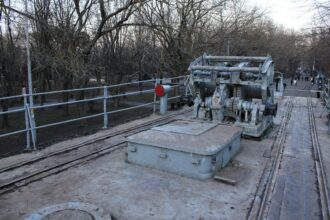
The Soviet Echo II submarine K-22, known for its advanced capabilities during the Cold War, has been the subject of various analyses and discussions regarding its impact on naval warfare. For a deeper understanding of the strategic significance of such submarines, you can explore a related article that delves into the technological advancements and operational history of the Echo II class. Check it out here: Soviet Echo II Submarine Insights.
Project 671 ‘Yorik’ Class: A Technological Leap for the Soviet Navy
The Project 671 ‘Yorik’ class of submarines, of which the K-22 was a part, was a significant development in Soviet submarine design. Commissioned into service in the late 1960s and early 1970s, these submarines represented a considerable advance over their predecessors, addressing key limitations and incorporating new technologies. Their design aimed to create a versatile attack submarine capable of operating effectively in both the open ocean and more confined waters, posing a serious threat to Western naval forces, particularly carrier battle groups and troop transports. The ‘Yorik’ class was designed with a double hull, a feature that offered improved buoyancy and structural integrity, contributing to their survivability in combat. This design also allowed for the integration of more advanced sonar systems and a greater internal volume for equipment and crew.
Hull Design and Survivability
The adoption of a double hull by the Project 671 submarines was a crucial design decision that significantly enhanced their operational capabilities and survivability. Unlike single-hulled submarines, which rely on a single pressure hull for both buoyancy and structural integrity, double-hulled designs feature an inner pressure hull surrounded by an outer hull. This outer hull, often referred to as the “light hull,” is not designed to withstand significant external pressure and serves primarily to provide hydrodynamic streamlining and to house ballast tanks, sonar arrays, and other equipment. The space between the two hulls, the “free-flooding” area, could take on water during dives, contributing to buoyancy and acting as a buffer against minor damage.
The benefits of this configuration for the K-22 and its class were numerous. Firstly, it improved the submarine’s overall buoyancy, allowing it to carry more equipment and weapons without compromising its ability to submerge and maintain depth. Secondly, the double hull provided a degree of protection against mines and torpedoes. While a direct hit would undoubtedly be catastrophic, the outer hull could absorb some of the blast energy, potentially protecting the critical inner pressure hull from immediate destruction. This enhanced survivability was a key consideration for Soviet designers, who recognized the importance of their submarines remaining operational for extended periods, especially in the face of sophisticated Western anti-submarine warfare (ASW) capabilities. Furthermore, the spaciousness afforded by the double hull facilitated the integration of more advanced and larger sonar systems, which were essential for detecting and tracking enemy vessels in the increasingly complex underwater battlespace of the Cold War.
Propulsion and Performance
The propulsion system of the Project 671 ‘Yorik’ class submarines, including the K-22, was a critical factor in their effectiveness. These submarines were powered by advanced nuclear reactors, which provided them with virtually unlimited endurance at sea, a stark contrast to the operational limitations of their diesel-electric counterparts. The reactors were designed to be relatively quiet, a vital attribute for a submarine operating in a highly contested environment. The K-22, like its sisters, was equipped with a single shaft and propeller, optimized for speed and maneuverability.
The performance characteristics of the ‘Yorik’ class submarines were a significant improvement over previous Soviet designs. They were capable of reaching respectable submerged speeds, allowing them to keep pace with or outrun Western naval formations, particularly aircraft carrier groups. Their diving depth was also substantial, enabling them to operate in the deeper waters of the world’s oceans, further enhancing their ability to evade detection. The combination of nuclear power, respectable speed, and considerable diving depth made the Project 671 submarines formidable hunter-killers, capable of undertaking a wide range of missions, from intelligence gathering to direct offensive operations against enemy warships. The engineering prowess displayed in these propulsion systems underscored the Soviet Union’s commitment to achieving technological parity with the West, even if it meant significant investment and development.
Armament and Offensive Capabilities of the K-22
The effectiveness of any attack submarine hinges on its offensive capabilities, and the K-22 was no exception. As a Project 671 ‘Yorik’ class submarine, it was equipped with a potent array of weaponry designed to engage a variety of naval targets, from destroyers and cruisers to aircraft carriers and other submarines. The Soviet Navy’s doctrine emphasized the need for submarines that could not only defend themselves but also project offensive power, and the K-22 was a clear embodiment of this philosophy. Its armament suite was carefully chosen to provide flexibility and lethality, ensuring it could fulfill a range of combat roles.
Torpedo Systems: The Primary Sting
The primary offensive armament of the K-22, like most submarines of its era, consisted of torpedoes. These self-propelled underwater weapons were the submarine’s most direct means of attack, capable of inflicting severe damage or sinking enemy vessels. The K-22 was equipped with multiple torpedo tubes, typically located in the bow of the submarine. These tubes allowed for rapid reloading and the firing of multiple torpedoes in a salvo, increasing the probability of a successful hit against a moving target.
The types of torpedoes carried by the K-22 were also indicative of Soviet naval technological advancements. While specific details are often classified, it is known that Soviet submarines of this class carried a mix of acoustic homing torpedoes, which actively sought out the noise of an enemy vessel, and wire-guided torpedoes, which could be controlled by the submarine’s crew after launch, allowing for course corrections and improved targeting. These torpedoes likely included both anti-ship variants, designed to destroy larger surface vessels, and anti-submarine torpedoes, intended to counter enemy submarines. The effectiveness of the torpedo systems was crucial for the K-22’s role as a hunter-killer, allowing it to engage and neutralize enemy threats at significant ranges. The Soviet Union invested heavily in torpedo development, aiming to produce weapons that were fast, accurate, and equipped with advanced fuzing systems.
Missile Launching Capability: Expanding the Reach
Beyond its torpedo armament, the Project 671 ‘Yorik’ class submarines, including the K-22, possessed the capability to launch anti-ship missiles. This represented a significant expansion of their offensive reach and
A Soviet Submarine Hit a U.S. Frigate. Was It the Wrong Ship?
FAQs
1. What was the purpose of the Soviet Echo II submarine K-22?
The Soviet Echo II submarine K-22 was designed for anti-submarine warfare and reconnaissance missions during the Cold War.
2. How large was the Soviet Echo II submarine K-22?
The Soviet Echo II submarine K-22 had a length of approximately 90 meters and a displacement of around 4,000 tons when submerged.
3. What armaments did the Soviet Echo II submarine K-22 carry?
The Soviet Echo II submarine K-22 was equipped with torpedoes, anti-ship missiles, and mines for use in combat situations.
4. When was the Soviet Echo II submarine K-22 commissioned into the Soviet Navy?
The Soviet Echo II submarine K-22 was commissioned into the Soviet Navy in the late 1960s and served until the early 1990s.
5. Where is the Soviet Echo II submarine K-22 located now?
The Soviet Echo II submarine K-22 is currently on display as a museum ship in a Russian port, allowing visitors to explore its interior and learn about its history.