The Enigma of the Submarine Aircraft Carrier: A Technological Marvel of WWII
The Second World War was a crucible of innovation, a period where desperate times spurred audacious engineering. Among the myriad of technological advancements, few concepts were as daring and conceptually revolutionary as the submarine aircraft carrier. This fusion of two formidable weapons platforms – the stealthy, submerged hunter and the aerial scout and strike fighter – represented a paradigm shift in naval warfare. While the concept wasn’t entirely new, it found its most significant and ambitious realization during this global conflict, primarily through the efforts of Japan and, to a lesser extent, its allies. The idea was simple yet profound: to bring the reach of aircraft to the vast, unpatrolled expanses of the ocean, far beyond the confines of land-based airfields, and to do so from a vessel that could operate with the element of surprise.
## Origins and Early Explorations
The idea of a submersible vessel capable of deploying aircraft had been toyed with even before the First World War. Early submarines were slow, unreliable, and had limited range. Aircraft, conversely, were rapidly evolving and demonstrating their potential for reconnaissance and attack. The marriage of these two nascent technologies seemed a logical, if complex, progression.
### Pre-War Concepts and Prototypes
The very earliest notions of a submarine carrying aircraft date back to the early 20th century. In 1915, the British submarine E14 was fitted with a primitive crane to launch a Sopwith Camel for reconnaissance over Gallipoli. While successful in its limited role, it was more of a demonstration of possibility than a fully integrated system. The French Navy also experimented with carrying aircraft on submarines, notably the Niefisk class, which were designed to carry a single seaplane in a hangar. However, these early attempts were often cumbersome and lacked the sophisticated integration and operational capacity that would define later designs. The core challenge was always the practicalities of storing, launching, and recovering aircraft from a vessel that spent much of its time underwater. The sheer size of early aircraft, coupled with the limited space available on a submarine’s pressure hull, presented significant engineering hurdles.
### The Japanese Vision: Project Kōryū
It was Japan, a nation with a deep maritime tradition and a pressing need to project power across the vast Pacific, that truly embraced the concept of the submarine aircraft carrier. Driven by a desire to neutralize distant enemy fleets and conduct long-range reconnaissance, the Imperial Japanese Navy initiated ambitious development programs. Project Kōryū, meaning “Dragon’s Hide,” was one of the most significant undertakings. This program aimed to create a series of large, specialized submarines that could carry not just one or two, but an entire squadron of aircraft. The philosophy behind these colossal vessels was to use them as mobile air bases, capable of launching surprise attacks on Allied naval forces or even shore installations. The vision was to have these submersible carriers operate far ahead of the main fleet, providing vital intelligence and striking power, while remaining largely undetected until the moment of attack. The sheer scale of these intended vessels, some envisioned to be over 7,000 tons, speaks volumes about the ambition of the Japanese naval strategists.
In exploring the fascinating intersection of naval warfare and aviation during World War II, one can delve into the innovative designs of submarines equipped with bomber plane hangars. These remarkable vessels not only served as stealthy underwater predators but also as mobile airbases, capable of launching aircraft for reconnaissance and attack missions. For a deeper understanding of this unique aspect of military strategy, you can read more in the related article found at In The War Room.
## The Mighty I-400 Class: The Pinnacle of Submarine Aircraft Carrier Design
The most iconic and advanced example of the submarine aircraft carrier was undoubtedly Japan’s I-400 class. These were not mere submarines with a few planes strapped to the deck; they were purpose-built behemoths designed from the keel up to integrate a hangar and launch system for multiple aircraft. The I-400 class represented the zenith of this technological endeavor, pushing the boundaries of submarine design and operational capability.
### Design and Engineering Innovations
The I-400 class submarines were enormous, dwarfing most contemporary submarines. They were over 400 feet long and displaced over 6,500 tons surfaced, making them larger than some Allied cruisers. Their primary armament consisted of large-caliber deck guns and torpedoes, but their defining feature was the massive cylindrical hangar built atop the pressure hull. This hangar, measuring 115 feet long and 12 feet in diameter, was capable of housing three Yokosuka MXY7 Ohka kamikaze planes or, more commonly, three Aichi E16A Zuiun reconnaissance/attack seaplanes. The submarines were equipped with a unique catapult system to launch these aircraft. Once launched, the aircraft would operate independently, and the submarine would submerge to wait for their return. The recovery of these seaplanes was a complex and time-consuming operation, usually involving a crane and the submarine surfacing. The design also incorporated a folding periscope and other features to minimize the submarine’s silhouette when surfaced for aircraft operations. The sheer engineering challenge of creating a watertight hangar capable of withstanding immense water pressure, while simultaneously providing a stable platform for aircraft launch and recovery, was immense.
### Operational Capabilities and Aircraft Payload
The I-400 class submarines were designed with a specific operational doctrine in mind. Their primary mission was long-range reconnaissance and strategic attack. The Zuiun seaplanes they carried were capable of carrying a substantial bomb load or a torpedo, making them a significant threat. The intention was to launch these aircraft against targets as far away as the Panama Canal. The submarines themselves possessed a remarkable range, allowing them to operate deep within enemy-controlled waters. Their ability to launch aircraft from a submerged or near-surface position offered an unprecedented level of surprise. The vision was for these carriers to act as mobile, stealthy air bases, capable of striking targets that were otherwise beyond the reach of conventional naval aviation. The psychological impact of such an attack, launched from an unseen enemy beneath the waves, would have been considerable. The aircraft were equipped with folding wings to fit within the hangar, and the launch mechanism was designed for relative speed, though the subsequent recovery process was considerably slower.
## Strategic Rationale and Deployment
The development and deployment of submarine aircraft carriers were driven by specific strategic imperatives, particularly for Japan, which faced a numerically superior Allied naval force.
During World War II, the innovative designs of submarines and their capabilities were significantly enhanced, leading to the development of unique features such as bomber plane hangars. These adaptations allowed submarines to launch and recover aircraft, providing them with a strategic advantage in naval warfare. For a deeper understanding of this fascinating topic, you can explore a related article that delves into the intricacies of submarine warfare and its evolution throughout the war. To read more about it, visit this article.
### Japan’s Pacific Strategy
Facing the overwhelming industrial might of the United States, Japan’s naval strategy relied heavily on surprise, deception, and the projection of power beyond its immediate island defenses. The submarine aircraft carriers were seen as a way to redress this imbalance. By bringing air power to bear on targets far from existing airfields, they could disrupt enemy supply lines, launch devastating surprise attacks, and gather crucial intelligence without risking large carrier groups. The concept was particularly attractive for operations in the vast Pacific, where distances were immense and the enemy’s movements were not always predictable. The idea of a submarine appearing near a vital Allied base, launching aircraft for a destructive raid, and then disappearing back beneath the waves was a potent strategic weapon. The potential to attack targets like Pearl Harbor or the Panama Canal from unexpected vectors was a recurring theme in strategic discussions.
### Limited Combat Effectiveness and Missed Opportunities
Despite their impressive design, the I-400 class submarines saw very limited combat. By the time they were operational, the tide of the war had already turned decisively against Japan. Many were still undergoing trials or were en route to their intended mission when the war ended. One notable planned operation was an attack on the Ulithi Atoll, a major Allied naval base, in an attempt to sink American aircraft carriers. However, the mission was ultimately aborted due to the surrender of Japan. The vast majority of the completed I-400 class submarines were scuttled by their own crews or captured by Allied forces after the war. The few that did see any action were often used for reconnaissance or to transport special forces. The limited operational deployment meant that the true potential and effectiveness of these unique vessels remained largely untested in combat. The enormous resources poured into their construction could have arguably been better allocated to other more conventional naval assets given the changing realities of the war.
## Other Nations’ Experiments and Considerations
While Japan was the most prominent nation to develop and deploy submarine aircraft carriers, other powers also explored similar concepts, though with less ambitious designs and outcomes.
### Allied Interest and Counter-Developments
The Allied powers, particularly the United States and Great Britain, were aware of Japan’s submarine carrier programs. While they did not develop dedicated submarine aircraft carriers on the same scale, they did experiment with various methods of integrating aircraft with submarines. The U.S. Navy experimented with carrying floatplanes on some of its submarines, primarily for reconnaissance. These were typically launched and recovered using cranes, a much

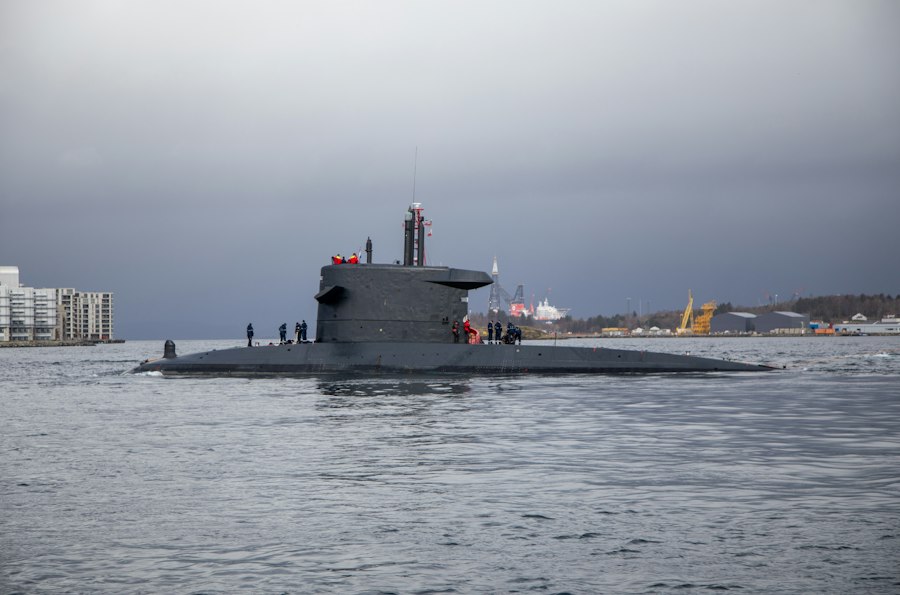
Japan Built a Submarine That Could Launch Three Planes
FAQs
What was the purpose of a WW2 submarine with a bomber plane hangar?
The purpose of a WW2 submarine with a bomber plane hangar was to allow the submarine to carry and launch a small reconnaissance or attack aircraft for missions beyond the range of the submarine itself.
Which country developed and used WW2 submarines with bomber plane hangars?
Germany developed and used WW2 submarines with bomber plane hangars, specifically the Type IX U-boat, which was modified to accommodate a small reconnaissance seaplane called the Arado Ar 231.
How were the aircraft launched and retrieved from the submarine with a hangar?
The aircraft carried in the hangar of the WW2 submarine would be assembled on the deck, launched using a catapult system, and retrieved by landing on the water near the submarine. A crane would then hoist the aircraft back onto the deck for disassembly and storage.
What advantages did a WW2 submarine with a bomber plane hangar offer in terms of military strategy?
A WW2 submarine with a bomber plane hangar offered the advantage of extending the submarine’s reconnaissance and attack capabilities beyond its normal range. The aircraft could scout ahead, attack enemy ships, or provide support to friendly forces, increasing the submarine’s effectiveness in naval operations.
Were WW2 submarines with bomber plane hangars widely used during the war?
No, WW2 submarines with bomber plane hangars were not widely used during the war. Germany experimented with the concept on a limited scale, but logistical challenges, the vulnerability of the aircraft to enemy defenses, and the development of other technologies ultimately limited the practicality and widespread adoption of this design.