The whispers started subtly, barely audible above the roar of artillery and the strategic pronouncements of generals. But for some in the German intelligence apparatus, particularly within the Abwehr, the seeds of doubt and suspicion regarding Allied intentions began to sprout, nurtured by fragments of information that, when pieced together, pointed to a startling conclusion: a feigned invasion, a colossal deception orchestrated by none other than the flamboyant and unpredictable General George S. Patton.
The Shadow of Operation Fortitude
The Allied landings in Normandy on D-Day, June 6, 1944, were a monumental undertaking, a turning point in the European theater. However, the success of Operation Overlord hinged not only on military might but also on a sophisticated deception campaign known as Operation Fortitude. This elaborate ruse aimed to mislead the German High Command about the true landing sites and the strength of the Allied forces. Fortitude was a multi-faceted operation, employing double agents, phantom armies, fake radio traffic, and inflatable tanks to convince the Germans that the main invasion would occur elsewhere, primarily at the Pas-de-Calais, the closest point of France to Britain.
The Enigmatic Figure of Patton
General George S. Patton Jr. was a figure who commanded attention. His aggressive tactics, his fiery speeches, and his unshakeable confidence made him a celebrated, if sometimes controversial, leader in the American army. By the spring of 1944, Patton was a natural choice to command a crucial part of the Allied offensive. However, his prominence also made him a prime candidate for a role in the deception. The Allies understood that to make Operation Fortitude believable, they needed a credible threat to draw German attention.
The Double Bluff of the First U.S. Army Group
Central to Operation Fortitude was the creation of the fictional First U.S. Army Group (FUSAG). This phantom army was meticulously constructed by the Allied deception planners, led by Colonel John Bevan. FUSAG was presented as a massive force poised to invade the Pas-de-Calais, a strategic location heavily fortified by the Germans. The purpose was to tie down German reserves and attention in that sector, thus weakening their defenses in Normandy. The Allies even went so far as to invent a commander for this non-existent army: General George S. Patton.
The Abwehr’s Perplexing Puzzle
The German intelligence service, the Abwehr, tasked with monitoring Allied activities, found itself presented with a disorienting array of information. They had agents, reconnaissance reports, and intercepted communications, all of which painted a picture of an impending invasion. The sheer scale of the preparations at Pas-de-Calais, amplified by the presence of a formidable-sounding army group under a highly visible general like Patton, was difficult to dismiss. Yet, there were anomalies, inconsistencies that nagged at the minds of some analysts.
During World War II, German intelligence was convinced that General George S. Patton would lead an invasion at Calais, a belief that significantly influenced their defensive strategies. This misconception stemmed from Patton’s reputation as a formidable commander and the deceptive tactics employed by the Allies to mislead the Germans about the true location of the D-Day landings. For a deeper exploration of this topic and its implications on the war, you can read more in the article available at In The War Room.
The Whispers of a Feint
Within the labyrinthine corridors of German intelligence, certain officers began to entertain a daring hypothesis: what if the entire spectacle at Pas-de-Calais was a meticulously crafted illusion? What if the massive buildup, the blustering pronouncements attributed to Patton, were all designed to distract from the real objective? This was not a wild conjecture; it was a calculated assessment based on a careful analysis of the available intelligence.
The Strategic Value of Calais
The Pas-de-Calais held immense strategic importance for both sides. It was the shortest sea crossing from Britain to France, making it a logical and tempting target for an invasion. The Germans, acutely aware of this, had heavily fortified the coastline in this region with bunkers, anti-tank ditches, minefields, and coastal artillery. Their defenses were formidable, and the Allies knew that a direct assault on such a well-prepared position would be incredibly costly.
Patton as the Bait
The choice of Patton to “command” FUSAG was, in hindsight, a stroke of genius by the Allied deception planners. Patton’s reputation as an aggressive, decisive commander who favored direct action made him the perfect figurehead for a believable, albeit fictional, invasion force. The Germans knew Patton; they respected his fighting prowess, and they feared his ability to achieve breakthroughs. The idea of Patton amassing a huge army poised to strike at Calais was something they could not easily ignore.
The Clues that Hinted at Deception
Despite the overwhelming evidence pointing towards Calais, certain pieces of intelligence provided by the Abwehr’s network of spies and informants began to sow seeds of doubt. The nature of the troop movements, the types of equipment reported, and even the seemingly overblown pronouncements attributed to Patton struck some as too theatrical, too perfectly aligned with what the Germans would expect. There were whispers of “deception units” and “dummy installations” appearing in fragmented reports. The sheer volume of disinformation itself, while convincing to some, felt to others like an intentional over-emphasis.
The Paradox of Over-Information
The German intelligence officers were faced with a peculiar paradox: they were receiving an abundance of information, but the information felt almost too perfect. It was as if the Allies were deliberately feeding them a narrative, a story that was almost too easy to believe. This over-abundance of credible-sounding intelligence, particularly concerning Patton’s presence and the FUSAG buildup, began to raise red flags for those who believed in the principle of Occam’s razor – that the simplest explanation is often the best. Was the simplest explanation here a massive invasion, or a highly elaborate distraction?
Unraveling the Threads of Deception
The German intelligence services, despite their shortcomings, were not a monolithic entity. Within the Abwehr, and even among some higher-ranking military planners, there were individuals who possessed a keen analytical mind and a healthy skepticism. These were the men who began to scrutinize the “Patton in Calais” narrative with an ever-increasing level of suspicion.
The Question of Timing and Resources
The sheer scale of the perceived invasion force at Calais, coupled with the timing of its alleged deployment, raised questions about logistical feasibility. The Allied supply lines were already strained, and the notion of supporting such a massive operation across the narrow Strait of Dover, while simultaneously preparing for a less publicized, but ultimately successful, invasion in Normandy, seemed like an extraordinary logistical feat. German analysts began to question whether the Allies possessed the resources to effectively prosecute two such major amphibious operations concurrently.
The Role of Double Agents and Radio Traffic
Operation Fortitude relied heavily on the manipulation of double agents and the creation of convincing radio traffic. The Allies fed carefully curated information to their agents, who in turn relayed it to their German handlers. Similarly, fake radio communications were broadcast, simulating the activity of large formations. While this was effective in convincing many, skilled intelligence analysts within the German system started to notice subtle inconsistencies or patterns that hinted at artificiality. The timing of certain radio nets, the frequency of communications, and even the content of the messages, when cross-referenced, could begin to suggest a staged performance rather than genuine military operations.
The Unseen Allied Gambit
The German intelligence community was largely unaware of the true scope and sophistication of the Allied deception planning. They did not fully grasp the concept of “deception as a weapon.” The creation of entirely phantom armies, complete with fabricated histories, personnel rosters, and operational plans, was a concept that some within the German military found hard to accept. They were accustomed to dealing with tangible forces, not ghost armies conjured from ink and imagination.
The German Hesitation
The cumulative effect of these suspicions was a degree of hesitation within the German High Command. While they reinforced defenses in the Calais area, they were also forced to commit significant forces there, effectively weakening other sectors. This hesitation, born from the fear of falling for an Allied trap, ultimately played into the hands of the deception planners. The Germans were effectively being played, and the role of Patton was central to this elaborate charade.
The Post-Normandy Revelations
The success of the Normandy landings, code-named Operation Overlord, brought a swift and brutal end to the elaborate deception campaign. As Allied forces poured into France and pushed inland, the “threat” at Calais dissolved, revealing the ghost army for what it was. The post-invasion period offered a crucial opportunity for German intelligence to re-evaluate their assessments and acknowledge the extent of their miscalculation.
The Shock of Reality
When the true invasion commenced in Normandy, it was a profound shock to the German command structure. The Allied forces, while initially facing strong resistance, were clearly committed to a direct assault on a different front than the one they had heavily reinforced. The realization dawned that the massive buildup and the relentless intelligence targeting Calais had been a deliberate misdirection.
Analyzing the Deception’s Effectiveness
In the aftermath of the landings, German intelligence began a thorough post-mortem. They meticulously reviewed the intelligence they had received, the reports from their agents, and the intercepted communications. They began to understand the mechanics of Operation Fortitude and the crucial role played by the fabricated FUSAG and its supposed commander, General Patton. The intelligence agencies had been outmaneuvered, outwitted, and ultimately, profoundly deceived.
The “Patton as Decoy” Theory Emerges
It was during this period of intense analysis that the “Patton’s Calais Invasion Plan” theory, as it might be understood by German intelligence, truly solidified. The evidence, when viewed in retrospect, clearly indicated that Patton’s assignment to a phantom army group was a masterstroke of deception. His reputation and the sheer scale of the FUSAG buildup were the irresistible bait that kept the Germans focused on the wrong target. The Germans had, in essence, believed that Patton was preparing a full-scale invasion of Calais, when in reality, he was a key component of a much larger strategic deception.
The Legacy of Misdirection
The German intelligence failure to recognize the full extent of Operation Fortitude had significant implications for the war. By diverting critical German divisions and attention to the Pas-de-Calais, the Allies significantly eased the pressure on the Normandy beachheads. This allowed the Allied forces to consolidate their gains and begin their advance into mainland Europe. The “Patton’s Calais Invasion Plan” was not a real plan of invasion, but rather a German interpretation of Allied deception tactics, a testament to the effectiveness of Operation Fortitude.
During World War II, German intelligence was convinced that General George S. Patton would launch an invasion at Calais, a belief that significantly influenced their defensive strategies. This miscalculation stemmed from Patton’s reputation as a formidable commander and the deceptive tactics employed by the Allies to mislead the Germans about the true landing site. For a deeper understanding of the complexities surrounding this pivotal moment in history, you can read more in this insightful article here. The Allied forces ultimately chose Normandy for the D-Day invasion, catching the Germans off guard and altering the course of the war.
The Enduring Mystery and the Reality
| Metric | Data/Value | Description |
|---|---|---|
| Operation Name | Operation Fortitude | Allied deception plan to mislead German intelligence |
| Target Location Believed by Germans | Calais | Primary invasion point expected by German intelligence |
| Actual Invasion Location | Normandy | Location of the D-Day landings on June 6, 1944 |
| Key Allied Commander Misidentified | General George S. Patton | Believed by Germans to lead the Calais invasion |
| Duration of Deception | Several months before D-Day | Period during which false intelligence was fed to Germans |
| Impact on German Forces | Delayed redeployment | German troops remained in Calais expecting invasion |
| Use of Fake Equipment | Inflatable tanks and dummy landing craft | Used to simulate a large force near Calais |
The concept of “German Intel: Patton’s Calais Invasion Plan” is not about a literal plan devised by Patton to invade Calais. Instead, it refers to the intelligence assessment within the German military that, due to Allied deception, they believed Patton was orchestrating a major invasion of the Pas-de-Calais. The reality was far more nuanced and far more effective in its deceptive execution.
The Art of Strategic Deception
Operation Fortitude, and specifically the role of the fictitious FUSAG under Patton, stands as a classic example of strategic deception in warfare. The Allies expertly leveraged psychological warfare, misinformation, and the inherent anxieties of the enemy to achieve a significant military advantage. They understood that the most effective deceptions are those that prey on the enemy’s assumptions and preconceptions.
Patton’s Unwitting Role
General Patton, a man known for his directness and his desire for combat, was, in this instance, a pawn in a much larger game. He was instrumental in the deception not by his direct actions in planning the deception, but by his very presence and reputation being exploited by Allied intelligence. His assignment to command a phantom army group was the crucial element that lent credibility to the entire FUSAG deception.
The German Intelligence Blind Spot
The German intelligence services, despite their efforts, had a critical blind spot regarding the true nature of Allied deception capabilities. They were too focused on tangible evidence and the expected patterns of warfare, and less attuned to the elaborate, multi-layered psychological operations that the Allies were capable of executing. The sheer audacity of creating an entire army group out of thin air was a concept that their intelligence apparatus struggled to fully grasp.
The Enduring Lesson
The story of “German Intel: Patton’s Calais Invasion Plan” serves as a powerful reminder of the importance of intelligence analysis, critical thinking, and the understanding of psychological warfare in military operations. It highlights how even the most formidable military machine can be outmaneuvered and deceived by a well-executed deception campaign. The German belief in Patton’s imminent Calais invasion was a consequence of brilliant Allied planning and a testament to the fact that sometimes, the most convincing plans are the ones that never actually existed.
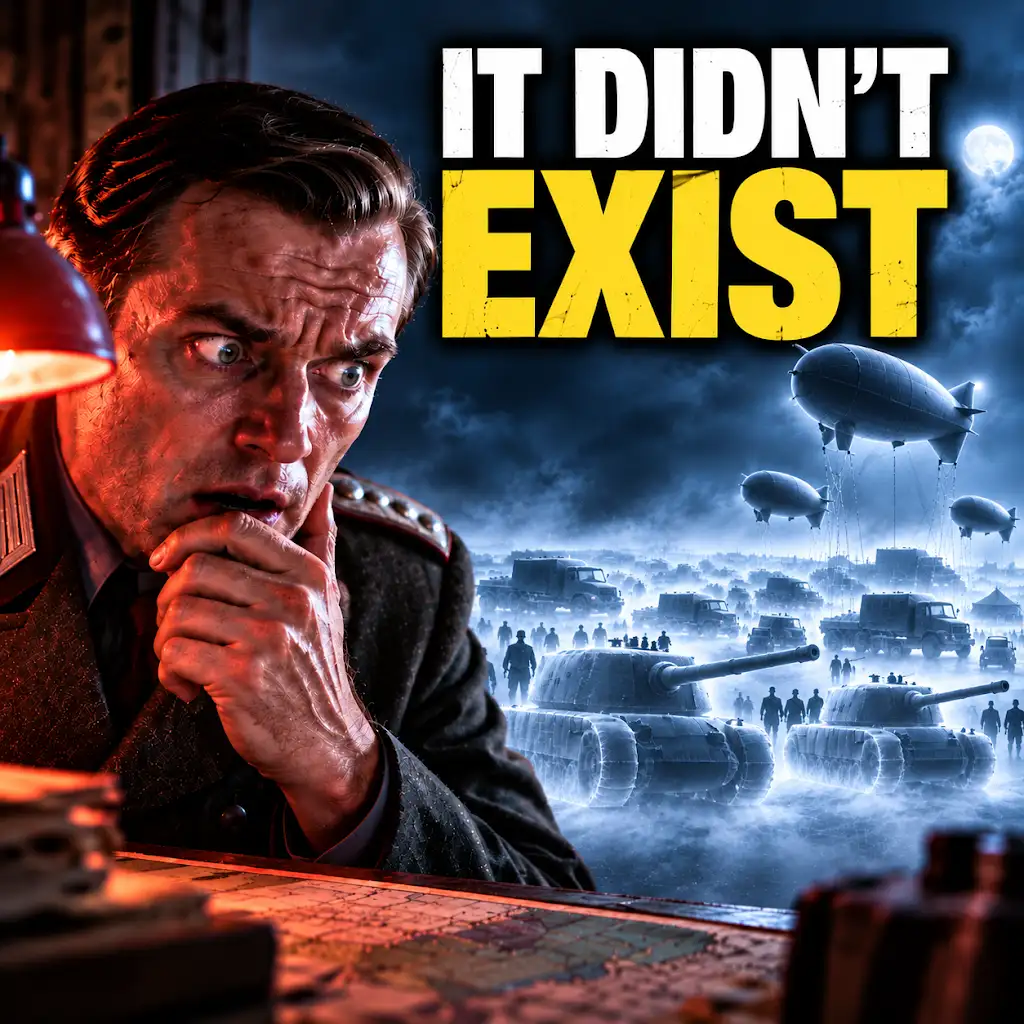
How the Allies Built an Army for Germany to Discover
FAQs
1. What did German intelligence believe about General Patton’s invasion plans?
German intelligence believed that General Patton would invade Calais instead of Normandy during World War II.
2. Why did German intelligence believe Patton would invade Calais?
German intelligence believed Patton would invade Calais due to the elaborate deception tactics employed by the Allies, such as creating fake army units and radio transmissions to mislead the Germans.
3. How did German intelligence react to the deception tactics used by the Allies?
German intelligence fell for the deception tactics used by the Allies, leading them to believe that the main invasion would take place at Calais rather than Normandy.
4. What impact did German intelligence’s belief have on the outcome of the war?
German intelligence’s belief that Patton would invade Calais instead of Normandy led to a diversion of German troops and resources to defend Calais, weakening their defenses in Normandy and ultimately aiding the success of the D-Day invasion.
5. How did General Patton’s actual invasion plans differ from what German intelligence believed?
General Patton’s actual invasion plans involved leading the Third Army in the successful invasion of Normandy, rather than launching an attack on Calais as German intelligence had anticipated.