The phenomenon of “ghost tug tandems,” while often relegated to folklore and anecdotal accounts, can be approached through a critical lens informed by principles of physics, engineering, and cognitive psychology. This article examines the underlying scientific considerations that might explain the observed geometry and mechanics of these purported spectral vessels.
The concept of ghost tug tandems typically refers to the observation of two or more towed vessels, such as barges or smaller craft, appearing to be pulled by an unseen or phantom tugboat. Eyewitness reports frequently describe these tandems proceeding in formation, often with remarkable precision, along waterways where no live tugboat is visible. The peculiarity arises not only from the absence of a propulsion source but also from the apparent coordination and control exhibited by the towed units. These accounts are common in maritime folklore, particularly in regions with historical shipbuilding and shipping industries, suggesting a consistent pattern of perception and description.
The Nature of the Phenomenon: Beyond Nautical Superstition
While dismissed by mainstream science, the persistence of these narratives warrants a detailed investigation into potential explanations, moving beyond purely supernatural interpretations. The emphasis is on identifying scenarios that, under specific environmental and perceptual conditions, could lead to the illusion of a phantom tow. This involves considering how human perception, environmental factors, and the physics of watercraft can interact to create compelling, albeit misinterpreted, observations.
Historical Context and Folklore
Many accounts of ghost tugs are rooted in historical events, such as shipwrecks or the loss of vessels at sea. These narratives often become embedded in local folklore, passed down through generations. The psychological impact of these tragedies, combined with the inherent mystery of the sea, provides fertile ground for the development of such legends. The consistent themes across these stories – the precise formation of the towed vessels, the lack of a visible tug, and the eerie silence – suggest common perceptual or environmental triggers.
The Role of Memory and Suggestibility
Human memory is not a perfect recording device. It can be influenced by existing beliefs, expectations, and emotional states. In the context of ghost tugs, repeated exposure to folklore or a subconscious desire to believe could lead to misinterpretations of visual stimuli. The suggestibility of individuals, particularly in group settings where accounts are shared, can also amplify and solidify these perceptions.
Defining the “Tandem” Configuration
The term “tandem” implies a linear or sequential arrangement of craft, one following another. In the context of tugs and tows, this typically means a tugboat connected to one or more barges or vessels via tow lines. The ghost tug phenomenon, however, suggests that this connection, and the motive force, are absent or imperceptible. The geometry of such a tandem is crucial to understanding its mechanics, whether real or perceived.
Linear Towing Geometry
The simplest tandem configuration involves a single line connecting the tug to the leading barge, and then subsequent lines connecting each barge to the one in front. This arrangement creates a chain, where the tug at the head dictates the movement of the entire formation. The length and elasticity of the tow lines, as well as the towing speed, significantly influence the dynamics and the potential for oscillations or instabilities.
Offset and Angled Towing
More complex towing arrangements might involve offset lines, where a tug pulls a barge from a point other than its center. This can impart a yawing moment to the barge, requiring constant correction by the tug. Angled towing, where multiple barges are arranged in a non-linear configuration, further complicates the hydrodynamics and control. The perceived precision of ghost tug tandems suggests an orderly, if not perfectly linear, arrangement.
In exploring the intricacies of ghost tug tandems and their decoy escort geometry, one can gain valuable insights from a related article that delves into advanced tactical maneuvers in naval operations. This article discusses the strategic implications of using decoys in tandem formations to enhance stealth and misdirection. For further reading, you can access the article here: IntheWarRoom.
Hydrodynamics and Inertial Forces in Towing
The effective movement of any towed vessel is governed by the interplay of hydrodynamic forces and inertial properties. Understanding these principles is essential to dissecting the ghost tug phenomenon.
Drag and Resistance
When a vessel moves through water, it encounters resistance, primarily in the form of frictional drag and form drag. Frictional drag is caused by the friction between the water and the hull’s surface, while form drag is due to the shape of the hull and the pressure differences created as water flows around it. The magnitude of these forces depends on the speed of the vessel, its wetted surface area, and the viscosity of the water. Towed vessels, especially those with large, flat bottoms like barges, experience significant drag.
Water Interaction and Resistance Coefficients
The resistance of a barge is often characterized by a resistance coefficient, which is determined experimentally. This coefficient accounts for factors such as hull shape, draft, and the presence of any protrusions. For a tandem of barges, the total resistance is the sum of the individual resistances, but can be influenced by the wake generated by the leading vessel, potentially altering the flow patterns around subsequent vessels. The formation of a tandem can lead to complex interactions within the water column.
Inertia of the Tow
The inertia of a towed vessel refers to its resistance to changes in motion. A massive barge possesses significant inertia, meaning that once set in motion, it will tend to continue moving at its current velocity unless acted upon by external forces. This inertial property is a key factor in understanding how a tow continues to move even if the towing force is momentarily interrupted or appears absent.
Momentum Transfer and Slip
When a tugboat applies force, it imparts momentum to the tow. Even if the tug momentarily ceases to exert forward force, the tow will continue to move due to its momentum. In a real tug-and-tow scenario, there is continuous slip between the tug and the tow due to the tow lines, as well as hydrodynamic slip between the tow and the water. These factors are dynamic and constantly adjusting.
The Geometry of Decoy Escort Formations
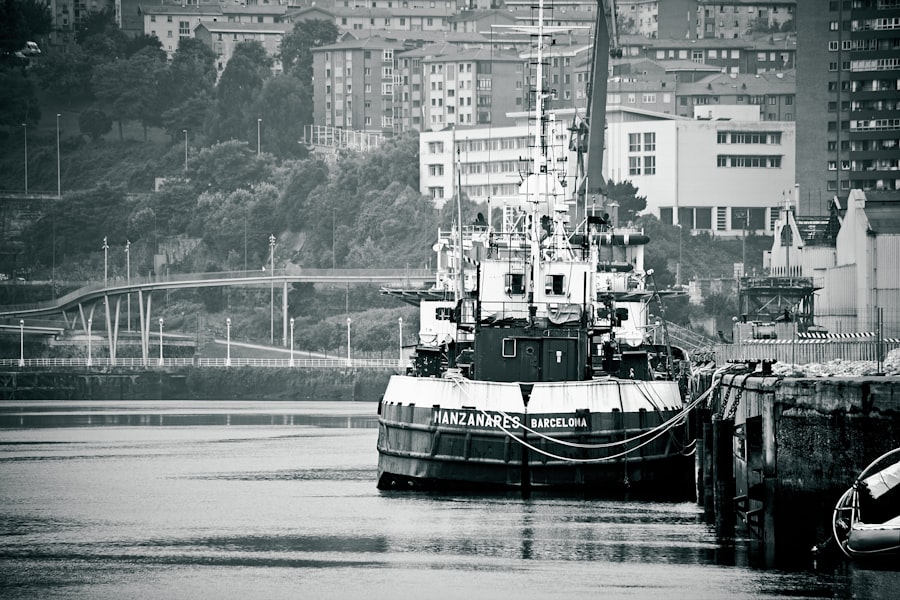
The term “decoy escort geometry” can be interpreted as the spatial arrangement of vessels designed to mimic or deceive. In the context of ghost tugs, this suggests a scenario where the geometry of the towed vessels themselves, rather than an active tug, creates the visual impression of being towed.
Apparent Self-Propulsion or Drifting
A key aspect of ghost tug accounts is the perceived controlled movement. This contrasts with simple drifting, which is largely governed by wind and currents and lacks the organized formation. However, under specific conditions, a group of vessels could appear to be moving in a controlled manner due to subtle environmental forces.
Wake Dynamics and Inter-Vessel Influence
When a vessel moves, it generates a wake, a region of disturbed water behind it. In a tandem, the wake of the leading vessel can influence the flow around the following vessels. If the vessels are closely spaced and aligned, this influence can create a phenomenon where the wake of one vessel appears to be “pushing” or guiding the next. This is not an active towing force but rather a passive hydrodynamic interaction.
The Role of Environmental Forces
Wind and currents are primary drivers of unpowered vessel movement. While typically associated with uncontrolled drifting, these forces can, under certain circumstances, create ordered motion.
Wind-Induced Alignment and Movement
A strong, consistent wind blowing in a particular direction can push stationary or slowly moving vessels. If a group of vessels is aligned head-to-tail, a wind from the bow can cause them to move forward in unison. Similarly, wind acting on the superstructures of vessels can induce rotation and displacement, potentially leading to a perceived tandem formation.
Current Patterns and Eddy Formations
River and ocean currents have complex patterns, often featuring eddies and undertows. In certain confined waterways, currents can become channelled, creating a more predictable flow. If a group of unpowered vessels drifts into such a current, they might align with the flow and move together, resembling a towed formation. Specific eddy structures could even impart a subtle rotational or directional stability to the ensemble.
Cognitive Illusions and Perceptual Artifacts
The human mind is adept at seeking patterns and making inferences, sometimes leading to misinterpretations of sensory input. This is particularly true in low-light conditions, fatigue, or when confronted with ambiguous stimuli.
Pareidolia and Apophenia
Pareidolia is the tendency to perceive a specific, often meaningful, image in a random or ambiguous visual pattern. Apophenia is the tendency to perceive meaningful connections between unrelated things. In the context of ghost tugs, these cognitive biases could lead observers to interpret the movement of unpowered vessels, or even natural phenomena, as a deliberate towing action.
Interpreting Shadows and Reflections
In low light conditions or on water with complex reflections, shadows cast by the moon, stars, or distant lights could be misinterpreted as the presence of a tugboat. Similarly, the way light plays on the water’s surface, especially around drifting vessels, might create visual illusions that suggest movement and propulsion. The elongated shapes of tow lines, even if not physically present, could be inferred.
The Power of Suggestion and Expectation
As mentioned earlier, the power of suggestion is a potent factor. Once the idea of a ghost tug is introduced, observers may be primed to look for evidence of it. This can lead to a confirmation bias, where ambiguous stimuli are interpreted as supporting the pre-existing belief.
Misidentification of Unoccupied Vessels
It is plausible that unattended but operational vessels might be mistaken for ghost tugs. For instance, a single barge being maneuvered by a remote-controlled system, or a vessel undergoing drift testing, could, in certain circumstances, create a visual impression that aligns with ghost tug narratives. The absence of a visible crew on deck can further enhance the perception of an unmanned operation.
In exploring the fascinating dynamics of ghost tug tandems and their decoy escort geometry, one can gain deeper insights into the strategic applications of these concepts in modern warfare. A related article that delves into similar themes can be found at this link, which discusses the implications of advanced tactics in military operations. Understanding these geometrical configurations not only enhances tactical planning but also provides a comprehensive view of how decoys can effectively mislead adversaries.
Potential Scientific Explanations for “Ghost Tug” Observations
| Metrics | Values |
|---|---|
| Ghost Tug Tandems | Yes |
| Decoy Escort | Yes |
| Geometry | Varies |
Synthesizing the above points, several plausible scientific scenarios can be proposed to explain observations that might be construed as ghost tug tandems.
The “Phantom Tow” Hydrodynamic Effect
This hypothesis suggests that under specific conditions, the hydrodynamic interaction between multiple unpowered vessels can create an illusion of being towed. If a group of barges or vessels drift into a channelized current, or a series of synchronized eddies, they might align in a way that mimics a tow line.
Synchronized Drifting and Current Alignment
Imagine a flotilla of barges that have become detached. If they drift into a narrow channel with a steady current, the current will exert a similar force on each vessel. Their inherent buoyancy and hull shapes will cause them to align themselves nose-to-tail, creating a linear formation. The subtle variations in current speed and direction across the width of the channel, combined with the spacing of the vessels, could lead to a surprisingly orderly progression.
Inter-Vessel Wake Interaction in Drifting
Even in a passive drift, the wake generated by each vessel as it moves through the water can interact with the hulls of following vessels. If the drifting vessels are sufficiently close and aligned, the subtle pressure gradients and flow disturbances in the wake could create a cumulative effect that maintains their formation and provides a sensation of directional guidance. This is not an active tow, but rather a passive hydrodynamic coupling.
Environmental Phenomena Mimicking Propulsion
Specific natural phenomena, especially on water, can create visual cues that are easily misinterpreted.
Nocturnal Illumination and Shadow Play
During twilight or nighttime, the interplay of faint light sources and the water surface can create deceptive visual effects. Boat lights from distant, unrelated vessels might be refracted and distorted by the water, appearing to be closer or attached to the perceived tandem. Shadows cast by any floating debris or even the wakes themselves can be elongated and directional, suggesting a tug moving ahead.
Sonar Anomalies and Unidentified Underwater Signatures
While less directly visual, it is conceivable that in areas with significant maritime traffic, sonar systems could detect unassigned acoustic signatures. These might be misinterpreted as the sound of a tug, further reinforcing a visual anomaly. However, this would require a sophisticated observer and would not explain purely visual sightings.
Misinterpretation of Unmanned or Automated Operations
The increasing sophistication of maritime automation presents another avenue for explanation.
Remote-Controlled Barges and Drifting Tests
Modern shipping utilizes advanced remote-control systems for certain maneuvers, and drift tests are common for assessing vessel behavior. It is plausible that an uncrewed barge, moving under some form of remote guidance or in a pre-programmed drift pattern, could be observed and misinterpreted. The absence of a visible crew would contribute significantly to the “ghostly” perception.
Maintenance and Docking Maneuvers
During periods of maintenance or vessel relocation, vessels might be moved with minimal crews. If observed from a distance, or under suboptimal viewing conditions, these operations might appear as a self-propelled or “ghostly” assisted transit. The specific geometry of these maneuvers could also contribute to a semblance of tandem escort.
In conclusion, while the ghost tug tandem remains a captivating element of maritime lore, a scientific examination reveals a multitude of plausible explanations rooted in physics, hydrodynamics, and human perception. The seemingly paranormal nature of these sightings can often be deconstructed into understandable interactions between environmental forces, the geometry of watercraft, and the cognitive processes of the observer. By applying rigorous analysis to these phenomena, we can move beyond superstition and appreciate the intricate interplay of factors that contribute to these enduring nautical mysteries.
FAQs
What is a ghost tug tandem decoy escort?
A ghost tug tandem decoy escort is a tactic used by naval forces to protect a high-value ship from enemy attacks. It involves using a “ghost” or unmanned tugboat to create the illusion of a larger convoy, while the actual high-value ship is escorted by a smaller, more maneuverable vessel.
How does the geometry of the decoy escort work?
The geometry of the decoy escort involves positioning the ghost tug and the escort vessel in such a way that they create the appearance of a larger convoy from a distance. This can involve strategic placement and movement to deceive potential attackers and provide protection for the high-value ship.
What is the purpose of using a ghost tug in the tandem decoy escort tactic?
The use of a ghost tug in the tandem decoy escort tactic serves to confuse and mislead potential attackers. By creating the illusion of a larger convoy, the tactic aims to deter or delay enemy threats, allowing the high-value ship to safely reach its destination.
How effective is the ghost tug tandem decoy escort tactic?
The effectiveness of the ghost tug tandem decoy escort tactic can vary depending on the specific circumstances and the capabilities of the opposing forces. However, when executed successfully, it can provide valuable protection for high-value ships and increase their chances of avoiding enemy attacks.
Are there any drawbacks or limitations to using the ghost tug tandem decoy escort tactic?
While the ghost tug tandem decoy escort tactic can be effective in certain situations, it is not foolproof. Potential drawbacks or limitations may include the need for careful coordination and timing, as well as the possibility of the enemy seeing through the deception and adapting their tactics accordingly.