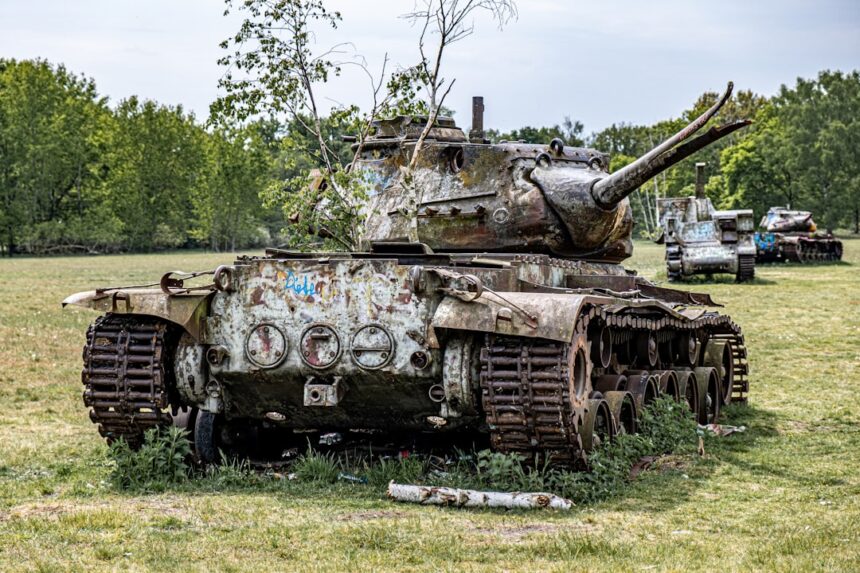
The Afghan mountains, a realm of stark beauty and historical layers, have once again yielded a remarkable discovery. Nestled within a remote and previously inaccessible ravine, a contingent of Soviet-era T-62 tanks has been uncovered, their hulking forms appearing as relics of a bygone conflict emerging from the earth. The find, confirmed by local authorities and independently verified by several independent researchers, presents a tantalizing glimpse into the logistical complexities and enduring presence of military hardware in the region.
The discovery was not the result of a systematic archaeological survey dedicated to military remnants. Instead, it emerged from the persistent efforts of nomadic herders who, during a period of unusual geological activity – perhaps a recent landslide or significant erosion – stumbled upon the metallic protrusions. Their initial reports, relayed through rudimentary communication channels, spoke of large, unidentifiable objects partially buried in the mountainside. The sheer scale of the finds necessitated a more thorough investigation, leading to the mobilization of a small team of local surveyors and historians.
Herder’s Accounts: A Whispered Revelation
The herders, accustomed to vast, often desolate landscapes, described noticing unusual shapes that did not conform to the natural topography. Their descriptions, though lacking technical detail, conveyed a sense of something artificial and immense. One elderly herder, who wished to remain anonymous, recounted following a weakened goat that had strayed towards a newly exposed section of the mountain. It was there, he stated, that he first saw the distinct silhouette of what appeared to be a large, iron beast encrusted with rock and earth. The arduous terrain and the inherent dangers of the region meant these early accounts were treated with a degree of skepticism, until more concrete evidence began to surface.
Geological Shifts: Unearthing the Past
Geologists studying the area noted that a recent series of minor seismic events, combined with increased seasonal rainfall, had likely contributed to significant erosion and sediment displacement. This natural process, over time, had gradually peeled back the layers of the mountain, revealing the buried tanks. The specific geological conditions of the ravine, characterized by steep slopes and a loose scree composition, would have facilitated this slow excavation by natural forces. The location itself, several kilometers from any known roads or settlements, underscores the challenges of access and the likelihood that these vehicles have remained undiscovered for decades.
The T-62 tanks, originally designed for conventional warfare, have found themselves in the rugged terrain of the Afghan mountains, where their capabilities and limitations are put to the test. For a deeper understanding of the operational challenges and historical context surrounding these tanks in Afghanistan, you can read the insightful article available at In The War Room. This resource provides a comprehensive analysis of the T-62’s performance in mountainous environments and its impact on military strategies in the region.
Identifying the Armored Relics
The identification of the unearthed vehicles as Soviet T-62 main battle tanks was made possible through a combination of visual characteristics and the remnants of identifying marks. While heavily weathered and partially obscured by debris, the distinctive turret shape, the placement of the main gun, and the overall hull design are all hallmarks of the T-62. Researchers, with further examination, were able to discern faded Cyrillic lettering and serial numbers on some of the more exposed sections.
The T-62: A Soviet Workhorse
The T-62, a Soviet main battle tank introduced in the early 1960s, was a significant development in Soviet armored warfare. It represented an improvement over its predecessor, the T-55, featuring a more powerful 115mm smoothbore gun. Its robust design, relative simplicity of maintenance, and widespread production made it a staple of many Warsaw Pact armies and export customers. Its presence in Afghanistan signifies a period of intense geopolitical activity and the Soviet Union’s commitment to supporting the Afghan People’s Democratic Party government.
Decoding Faded Markings: A Glimpse of Origin
The deciphering of faded Cyrillic markings and serial numbers proved to be a crucial step in confirming the origin and potentially the deployment history of the tanks. While many of these markings were obscured by rust and the natural patina of the mountains, meticulous cleaning and high-resolution photography allowed for their partial reconstruction. These remnants of stenciled numbers and letters provide a verifiable link to Soviet military production and supply chains. The consistent pattern of markings across the discovered tanks suggests they likely belonged to a single unit or a closely related deployment.
The Enigmatic Deployment: Why Here?
The discovery of an entire contingent of T-62 tanks in such a remote and seemingly unintended location raises numerous questions about their history. The generally accepted narrative of Soviet military involvement in Afghanistan during the 1980s typically focuses on established bases and operational routes. The presence of these tanks suggests a deviation from this pattern, pointing towards potential scenarios such as a convoy lost in adverse conditions, a hidden logistical cache, or perhaps even an element of strategic deception.
Lost Convoy Theories: Navigating Treacherous Terrain
One prominent theory posits that the tanks were part of a larger convoy that became disoriented or suffered mechanical failures in exceptionally difficult terrain. The Afghan mountains present formidable challenges to any motorized transport, with narrow passes, steep inclines, and unpredictable weather. A convoy encountering a severe sandstorm, a sudden rockslide, or a breakdown of multiple vehicles could have been forced to abandon its position or seek refuge in a secluded area. The sheer number of tanks found together might indicate the abandonment of an entire section of a column that was attempting to find a sheltered location to await assistance that never arrived.
Hidden Stash or Forward Operating Base: Strategic Implications
Another possibility is that this was a deliberately concealed supply depot or a rudimentary forward operating base established in a location deemed strategically advantageous due to its inaccessibility to enemy forces. Soviet forces often employed dispersal tactics to protect valuable assets and to project power along less conventional routes. The ravine, with its natural concealment provided by the surrounding rock formations, could have served as an ideal location to park and maintain a reserve of armor, away from the direct observation of insurgent groups or rival intelligence agencies.
Operational Missions Gone Awry: Beyond the Known Routes
It is also conceivable that these tanks were engaged in a specific operational mission that deviated significantly from standard patrols or established supply lines. Such missions might have involved reconnaissance deep into contested territory, the pursuit of elusive enemy elements, or the establishment of temporary checkpoints in areas where conventional forces could not easily operate. An unforeseen escalation of combat, severe logistical constraints, or the need for rapid redeployment could have led to the strategic shelving of these vehicles in this isolated location.
The State of Preservation and Potential for Recovery
The condition of the T-62 tanks, while weathered, offers a compelling case for their potential recovery and study. The arid mountain climate, while harsh, has in some ways acted as a preservative, shielding the metal from the extreme rust and corrosion typically associated with more temperate environments. The partial burial has further protected key components from direct environmental exposure.
Environmental Factors: A Double-Edged Sword
The arid climate of the Afghan mountains can be seen as a double-edged sword concerning preservation. On one hand, the lack of humidity and abundant rainfall, which accelerate degradation in many environments, has likely slowed the deterioration of the tanks. The dryness of the air and soil has helped to mitigate extensive rust formation that would otherwise have compromised the structural integrity of the steel. On the other hand, extreme temperature fluctuations, from scorching summers to freezing winters, combined with relentless wind-blown sand and dust, have certainly contributed to surface abrasion and wear on exposed components.
Salvage Challenges: Navigating the Remote Landscape
The primary challenge in recovering these tanks lies in their remote location and the rugged mountainous terrain. Transporting heavy lifting equipment and specialized vehicles capable of navigating such difficult inclines and narrow ravines would be a significant logistical undertaking. The cost and complexity of extracting armored vehicles, weighing many tons each, from a steep mountainside are considerable. Furthermore, the security situation in the broader region, while improving in some areas, remains a factor that necessitates careful planning and risk assessment for any large-scale operation.
Research Opportunities: Unlocking Historical Secrets
Despite the recovery challenges, the discovery presents an unparalleled research opportunity. The tanks, if carefully documented and potentially preserved in situ, could offer invaluable insights into Soviet military logistics, battlefield tactics, and the material culture of the Soviet-Afghan War. Studying the wear patterns, internal components, and any remaining equipment could shed light on the specific operational context of their deployment. For historians and military analysts, these metallic ghosts offer tangible evidence of a history often understood through written accounts and anecdotal reports.
The T-62 tanks, originally designed for conventional warfare, have found themselves in the rugged terrain of the Afghan mountains, where their capabilities are both challenged and showcased. The unique landscape poses significant obstacles for armored vehicles, yet these tanks have been adapted for use in this harsh environment. For a deeper understanding of the operational history and challenges faced by T-62 tanks in Afghanistan, you can read more in this insightful article here.
Future Prospects: A Monument to the Past?
| Metrics | Data |
|---|---|
| Tank Type | T-62 |
| Location | Afghan mountains |
| Number of Tanks | Unknown |
| Operational Status | Unknown |
| Deployment Date | Unknown |
The discovery of the T-62 tanks in the Afghan mountains is more than just the uncovering of lost hardware. It is a tangible reminder of the significant geopolitical shifts of the late 20th century and the enduring impact of conflict on landscapes and communities. The future of these armored relics remains uncertain, but their emergence from the earth compels contemplation and encourages further investigation.
Conservation vs. Collection: Divergent Paths
The prospect of what will happen to these tanks elicits divergent opinions. Some advocate for their conservation in situ, arguing that the ravine has become an unintended memorial. Others believe that careful excavation and preservation in a controlled museum environment would be more beneficial for wider study and public education. Considerations of cost, logistics, and the historical and cultural significance of the find will undoubtedly shape whichever path is ultimately chosen. The debate itself highlights the complex relationship between preserving the past and the practicalities of the present.
International Interest and Collaboration
News of the discovery has already sparked interest from international academic institutions and historical societies with a focus on Soviet military history and the Cold War. The possibility of collaborative efforts between Afghan authorities and international experts could facilitate a more comprehensive and objective assessment of the find. Such collaboration could provide the necessary expertise and resources for accurate documentation, analysis, and potentially, eventual recovery or preservation.
A Lasting Legacy: More Than Just Metal
Ultimately, the ‘62 Tanks Discovered in Afghan Mountains’ represent more than just a collection of abandoned military hardware. They are silent witnesses to a turbulent period, their rusting barrels and scarred hulls whispering tales of conflict, abandonment, and the relentless passage of time. Their emergence from the dust and stone of the Afghan peaks serves as a potent, if somber, reminder of history’s persistent presence and tendency to surface, demanding our attention and our understanding. The story of these tanks is still unfolding, a narrative etched in metal and stone, waiting for its full chapter to be written.
FAQs
What is the T-62 tank?
The T-62 is a Soviet main battle tank that was first produced in the early 1960s. It was widely used by the Soviet Union and its allies during the Cold War and has seen action in various conflicts around the world.
How are T-62 tanks used in the Afghan mountains?
T-62 tanks have been used in the rugged terrain of the Afghan mountains to provide fire support and mobility for ground forces. Their powerful armament and rugged design make them well-suited for operating in challenging environments.
What are the advantages of using T-62 tanks in mountainous terrain?
T-62 tanks are well-suited for mountainous terrain due to their relatively compact size, powerful engine, and robust suspension system. They are also equipped with a powerful 115mm smoothbore gun, making them effective in engaging targets at long ranges.
What are the challenges of using T-62 tanks in mountainous terrain?
While T-62 tanks are capable of operating in mountainous terrain, they still face challenges such as limited maneuverability in narrow and steep pathways, as well as the risk of becoming exposed to ambushes and improvised explosive devices (IEDs).
How have T-62 tanks been used in past conflicts in mountainous regions?
T-62 tanks have been used in past conflicts in mountainous regions, such as the Soviet invasion of Afghanistan in the 1980s and the ongoing conflict in Syria. They have been utilized for providing fire support, conducting reconnaissance, and engaging enemy forces in rugged and challenging terrain.