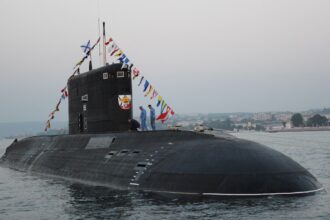
The deep, cold silence of the Pacific Ocean holds many secrets. Among the most compelling and enduring is the fate of the Soviet Project 629 diesel-electric submarine, K-129. Lost with all hands in March 1968, K-129’s disappearance was the first of the Soviet Navy’s major submarine tragedies in the Cold War. The circumstances surrounding its sinking, and the subsequent, highly clandestine American recovery operation, have woven a tapestry of speculation, rumor, and undeniable historical significance. This is the story of K-129, a ghost from the ocean’s abyss.
K-129 was a product of the Soviet Union’s submarine building program, a crucial component of its burgeoning naval power during the Cold War. As tensions between the superpowers escalated, submarines, especially those capable of launching ballistic missiles, became instruments of strategic deterrence. K-129 belonged to the Project 629 class, also known as the Golf class by NATO, which were designed to carry three R-13 (SS-N-4 Sark) ballistic missiles with nuclear warheads. These submarines were the silent sentinels of the Soviet arsenal, lurking beneath the waves, ready to respond to any perceived threat.
A Glimpse into the Golf Class
The Golf-class submarines were a significant development for the Soviet Navy. They marked a transition towards a more mobile and capable submarine force. While not as advanced as later nuclear-powered submarines, their diesel-electric propulsion allowed for extended submerged periods, albeit with limitations.
The Strategic Imperative
The rationale behind deploying submarines like K-129 was rooted in the concept of Mutually Assured Destruction (MAD). By possessing a credible sea-based nuclear deterrent, the Soviet Union aimed to ensure that even a preemptive strike against its land-based forces would not negate its ability to retaliate. The ballistic missile submarines were the ultimate insurance policy against aggression.
Key Features of Project 629
- Propulsion: Diesel-electric, allowing for relatively quiet operation on batteries for extended periods.
- Armament: Typically carried three ballistic missiles in external launch tubes, giving them a significant offensive capability.
- Crew Size: A standard complement of approximately 100 officers and sailors.
- Operational Range: Capable of intercontinental patrols, making them a global threat.
K-129’s Final Patrol
In early 1968, K-129 was on a deployment in the Pacific Ocean, a vast expanse that served as a strategic battleground for the Cold War naval presence of both the United States and the Soviet Union. The submarine’s mission likely involved reconnaissance or the positioning of its missile armament, a vital role in demonstrating Soviet resolve. The exact details of its operational orders remain shrouded in secrecy, a characteristic that would come to define the entire narrative surrounding its loss.
The Shadow of Secrecy
The Soviet Union, like the United States, operated its most sensitive military activities under a blanket of intense secrecy. Information about submarine deployments, capabilities, and losses was rarely, if ever, publicly disclosed. This opacity fostered an environment where speculation could flourish, and the true nature of events remained hidden from the world.
The Unanswered Questions
What was K-129 doing in the days leading up to its disappearance? Was it engaged in a routine patrol, a covert mission, or something else entirely? These questions have fueled much of the intrigue surrounding the submarine’s fate.
The mysterious disappearance of the Soviet submarine K-129 in 1968 has long captivated historians and enthusiasts alike, leading to numerous theories and investigations. For those interested in exploring this intriguing event further, a related article can be found at In The War Room, which delves into the circumstances surrounding the submarine’s loss and the subsequent covert operations undertaken to recover its remains. This article provides valuable insights into the Cold War era and the complexities of naval warfare during that time.
The Vanishing Act: Loss in the Pacific Depths
On March 8, 1968, K-129 ceased all communication. Its scheduled radio check-ins were missed, and its ultimate fate became a chilling enigma. The vastness of the Pacific, a seemingly infinite and indifferent ocean, had swallowed the submarine and its 98-man crew whole. The Soviet Navy initiated search efforts, but the immense scale of the ocean and the lack of precise information made finding a lost submarine an almost impossible task.
The Initial Search and Soviet Concern
The Soviet Navy, accustomed to maintaining operational silence, would have been acutely aware of K-129’s prolonged radio silence. The loss of a ballistic missile submarine, even a diesel-electric one, was a significant event. Ensuring its recovery or at least understanding the cause of its loss would have been a high priority, even if the efforts were not publicly advertised.
The Silent Alarm
The absence of signals from K-129 would have sent a silent alarm through the Soviet naval command. Every moment of silence, every missed communication, amplified the growing concern for the submarine and its crew.
The Search Zones
Without a precise location, the search for K-129 would have been a daunting logistical challenge. Soviet vessels likely scoured vast areas of the Pacific, a maritime desert where a lost submarine could disappear without a trace.
The American Connection: A Whispered Discovery
Unbeknownst to the Soviets for a period, the United States Navy had also detected unusual activity around K-129’s last known general area. Through sonar and other surveillance methods, American forces noted the submarine’s presence and subsequent disappearance. This discovery positioned the U.S. as a potential, albeit unwitting, witness to the tragedy.
Project JEWEL
The detailed operational intelligence gathering during the Cold War was known as constant surveillance. The U.S. Navy, through its advanced listening posts and submarine hunting capabilities, was meticulously charting the movements of Soviet naval assets. The disappearance of K-129 did not go unnoticed by these sophisticated eyes and ears.
The Faint Echoes
The signals picked up by American surveillance were like faint echoes in the deep. They offered clues but not definitive answers, igniting a fervent curiosity within intelligence circles.
The Great Recovery: Project AZORIAN

The true drama surrounding K-129 began to unfold not with its sinking, but with the subsequent realization, by the United States, that the submarine lay at the bottom of the ocean in an area accessible to American deep-sea recovery capabilities. Intelligence suggests that the U.S. Navy, through advanced signal analysis and tracking, had a remarkably precise estimate of K-129’s resting place. This led to the initiation of one of the most ambitious and clandestine deep-sea recovery operations in history: Project AZORIAN.
The Ultimate Prize: Intelligence Worthy of an Ocean’s Depths
The potential intelligence haul from recovering a sunken Soviet submarine, particularly one carrying ballistic missiles, was immense. The United States would have been eager to examine the submarine’s technology, its weapons systems, and any sensitive documents or equipment that might have survived the descent.
A Technological Arms Race
Each side in the Cold War was engaged in a continuous technological arms race. Understanding the enemy’s capabilities, their offensive and defensive strategies, was paramount. K-129 represented a treasure trove of such information.
The Secrets of the Deep
Inside the hull of K-129 lay the blueprints of Soviet military technology, the operational protocols of a Cold War submarine, and potentially, the personal effects of its crew. The U.S. saw an opportunity to pry open a vault of secrets.
The CIA and the Hughes Tool Company: An Unlikely Alliance
The logistical and technological challenges of recovering a submarine from a depth of approximately 16,000 feet were staggering. The U.S. government, primarily the CIA, contracted with the reclusive billionaire Howard Hughes and his Hughes Tool Company for the construction of a specialized vessel and equipment. This partnership, born out of necessity and secrecy, became the bedrock of Project AZORIAN.
The Glomar Explorer: A Ship of Intrigue
The Hughes Glomar Explorer, a massive ship designed specifically for deep-sea mining and salvage, was the centerpiece of Project AZORIAN. Its innovative design and advanced technical capabilities were essential for the audacious mission. The ship itself was a marvel of engineering, capable of lifting immense weights from extreme depths.
The Shadowy Network
The operation involved a complex network of intelligence agencies, private contractors, and anonymous operatives, all working under the cloak of extreme secrecy. The true extent of their involvement and the precise nature of their contributions remain largely classified.
The Delicate Operation: A Tightrope Walk Over the Abyss
The recovery itself was a feat of unparalleled engineering and sheer audacity. The Glomar Explorer deployed a colossal capture vehicle, known as the “Clementine,” equipped with a giant claw mechanism. This vehicle, lowered for miles through the water, had to precisely grip the hull of K-129, a challenging task in the unforgiving deep-sea environment.
Precision in the Pressure
Operating at such extreme depths presented immense challenges. The pressure is crushing, the darkness absolute, and visibility virtually non-existent. The engineers and technicians aboard the Glomar Explorer had to execute their task with millimeter precision.
The Gentle Giant’s Grip
The “Clementine” was designed to cradle the submarine without further damaging its hull or its contents. It was like a surgeon operating at the bottom of the ocean. The success of the operation hinged on this delicate touch.
The Unveiling and the Lingering Questions

Project AZORIAN, despite its incredible success in recovering a significant portion of K-129, did not bring an end to the mystery. While the U.S. gained invaluable intelligence, the operation’s secrecy meant that the true extent of what was recovered remained a closely guarded secret. The Soviet Union, aware of the recovery, had to contend with the reality of their lost submarine being in American hands.
What Was Recovered?
The exact extent of the recovered K-129 remains one of the most debated aspects of Project AZORIAN. It is understood that a substantial portion of the submarine’s hull, including sections containing missile launch tubes and potentially other sensitive equipment, was brought to the surface.
The Intelligence Bonanza
The recovered materials provided the United States with an unprecedented look into Soviet naval technology and strategic capabilities. This intelligence likely influenced naval development and strategic planning for years to come.
The Fate of the Crew
A somber aspect of the recovery is the fate of the 98 Soviet sailors. While parts of K-129 were recovered, it is understood that the entire crew perished, and their remains were not recovered in a way that would allow for individual identification. A portion of the submarine, believed to be the forward section containing the crew’s living quarters, broke off during the recovery and sank back to the ocean floor.
Soviet Awareness and Compliance
While the Soviets initially searched for K-129, their efforts were likely less sophisticated and ultimately unsuccessful. It is believed that they became aware of the American recovery, possibly through signals intelligence or other covert means. The fact that they did not publicly protest the retrieval, despite losing a ballistic missile submarine, suggests a complex geopolitical calculation.
The Silent Acknowledgment
The Soviet Union never officially acknowledged the loss of K-129 as a catastrophic event or the American recovery operation. This silence, however, speaks volumes about the delicate balance of power and the unspoken rules of engagement during the Cold War.
A Strategic Compromise
By not vocally objecting, the Soviets may have implicitly accepted that the potential damage of a public outcry or confrontation outweighed the perceived benefit. This could have been a strategic compromise, a tacit understanding that certain actions, while provocative, were best left unaddressed publicly.
The Legacy of Secrecy
Project AZORIAN remains a testament to the lengths to which intelligence agencies will go to gain an advantage. The operation’s success is undeniable, but its secrecy has also perpetuated a cloud of unanswered questions, leaving the story of K-129 as a haunting reminder of the Cold War’s hidden battles.
More Questions Than Answers
Despite the recovery, the exact cause of K-129’s sinking remains officially unconfirmed. Various theories range from a mechanical failure, such as a battery explosion, to a collision with an American anti-submarine warfare patrol.
The Unseen Ripples
The ripples of Project AZORIAN continue to be felt in discussions about military history, intelligence operations, and the ethical considerations of deep-sea salvage. The enduring mystery of K-129 serves as a potent symbol of the Cold War’s hidden depths.
The mysterious disappearance of the Soviet submarine K-129 in 1968 has captivated historians and enthusiasts alike, leading to numerous investigations and theories about its fate. For those interested in exploring this intriguing topic further, a related article offers insights into the events surrounding the submarine’s last mission and the subsequent search efforts. You can read more about it in this detailed analysis, which delves into the geopolitical implications of the incident and its impact on Cold War dynamics.
Lingering Mysteries and Enduring Intrigue
| Metric | Details |
|---|---|
| Submarine Name | K-129 |
| Type | Golf II-class ballistic missile submarine |
| Disappearance Date | March 8, 1968 |
| Last Known Location | North Pacific Ocean, approximately 1,560 nautical miles northwest of Hawaii |
| Number of Crew | 98 |
| Mission | Routine patrol carrying ballistic missiles |
| Cause of Disappearance | Unknown; suspected accidental sinking |
| Recovery Operation | Project Azorian (1974), CIA-led secret recovery attempt |
| Recovered Items | Partial section of the submarine, cryptographic materials, and two nuclear torpedoes |
| Significance | Cold War espionage and intelligence gathering |
The story of K-129 is far from over. Despite the significant efforts of Project AZORIAN, numerous questions continue to surround the submarine’s demise and recovery. The veil of secrecy, while providing strategic advantage, has also prevented a complete and transparent understanding of the events. This enduring mystery ensures that K-129 will continue to capture the imagination and fuel debate for generations to come.
The Cause of Sinking: A Puzzle Yet to Be Solved
The most significant lingering question is the precise cause of K-129’s sinking. With the bulk of the submarine still at the bottom of the Pacific, definitive evidence is scarce. Theories abound, each with its own proponents and detractors.
Mechanical Malfunction as a Suspect
One prominent theory suggests a catastrophic mechanical failure. Diesel-electric submarines of that era were known to be susceptible to the dangers of hydrogen gas buildup from battery charging. An accidental ignition could have led to a devastating explosion.
The Possibility of Collision
Another line of speculation suggests a collision with another vessel. Given the operational areas of Soviet submarines and American anti-submarine warfare patrols, a chance encounter, though unlikely to be officially acknowledged, cannot be entirely discounted.
The “What Ifs” of the Deep
The “what ifs” surrounding K-129’s sinking are as deep as the ocean itself. Without direct access to the complete wreck or irrefutable Soviet documentation, these questions are likely to remain open to interpretation.
The Moral and Ethical Dimensions
Beyond the strategic and technical aspects, the K-129 incident raises profound moral and ethical questions. The loss of 98 lives is a tragedy, and the secret recovery operation, while driven by national security imperatives, also raises concerns about the handling of human remains.
The Fate of the 98 Souls
The memory of the 98 Soviet sailors, lost in the cold embrace of the Pacific, serves as a poignant reminder of the human cost of geopolitical conflict. Their sacrifice, though largely unacknowledged by their own government, is an integral part of K-129’s story.
The Ethics of Salvage
The recovery operation, while a remarkable feat of engineering, also prompts discussions about the ethics of disturbing the resting places of fallen servicemen, even in the context of intelligence gathering. This is a complex issue with no easy answers.
K-129’s Place in History
The story of K-129 is more than just a maritime mystery; it is a microcosm of the Cold War itself. It embodies the era’s pervasive secrecy, the high-stakes technological competition, and the constant dance of strategic maneuvering. K-129, the silent ghost of Project 629, continues to serve as a potent symbol of those frozen years.
A Symbol of the Cold War’s Hidden World
The submarine’s story is a powerful illustration of the clandestine world that existed behind the Iron Curtain and the vast, unseen battles fought in the depths of the ocean. It is a narrative woven from threads of espionage, technological prowess, and unimaginable sacrifice.
The Enduring Narrative
As long as secrets lie buried in the ocean’s depths, and as long as the legacy of the Cold War continues to fascinate, the story of Soviet submarine K-129 will endure, a perpetual enigma waiting to be fully understood.

WATCH NOW ▶️ SHOCKING: How The CIA Stole A Nuclear Submarine
FAQs
What was the Soviet submarine K-129?
The Soviet submarine K-129 was a Golf II-class ballistic missile submarine of the Soviet Navy, commissioned in the early 1960s and equipped with nuclear missiles.
When and where did the K-129 disappear?
K-129 disappeared in March 1968 in the Pacific Ocean, northwest of Hawaii, during a routine patrol mission.
What caused the disappearance of K-129?
The exact cause of K-129’s disappearance remains unknown, but theories include a possible onboard explosion, mechanical failure, or collision.
What efforts were made to locate and recover K-129?
The United States conducted a secret recovery operation called Project Azorian in 1974, using the specially designed ship Hughes Glomar Explorer to attempt to recover parts of the submarine from the ocean floor.
What is the significance of the K-129 disappearance in Cold War history?
The disappearance of K-129 heightened Cold War tensions and led to significant intelligence and recovery efforts by the U.S., highlighting the risks of nuclear submarine operations during that era.