Nuclear submarines represent a pinnacle of modern naval engineering, primarily valued for their unparalleled stealth capabilities. These underwater vessels are not merely ships that travel beneath the waves; they are sophisticated instruments of power, designed to operate undetected in an environment that is inherently challenging for observation. Their ability to remain hidden is a strategic advantage of immense consequence, influencing global security dynamics and the nature of naval warfare. Understanding the mechanics and implications of this stealth is key to appreciating their role in contemporary defense.
The core of a nuclear submarine’s stealth lies in its ability to minimize all detectable signatures. This involves a multifaceted approach, addressing acoustic, magnetic, thermal, and visual aspects of its presence. The ocean, vast and deep, offers a natural cloak, but the submarine must actively work to avoid betraying its location to an array of sophisticated sensors employed by potential adversaries.
Acoustic Signature Reduction
Sound travels effectively through water, making acoustic detection the primary method by which submarines are located. Nuclear submarines employ a holistic strategy to become acoustically “quiet.”
Hull Design and Hydrodynamics
The shape of a submarine’s hull is crucial. Modern designs prioritize hydrodynamic efficiency, minimizing the turbulence that generates noise. Rounded, smooth surfaces and the absence of sharp angles reduce the water flow’s tendency to break into chaotic eddies. The sail, or conning tower, is also meticulously shaped to reduce drag and the associated noise. Think of it as a perfectly streamlined fish, designed to glide through the water with minimal disturbance. The goal is to make the submarine as unobtrusive as a falling feather in a still room.
Propulsion Systems
The nuclear reactor, while providing virtually limitless power, is a significant source of potential noise. Advanced reactor designs and shielding are employed to dampen vibrations and heat transfer. Beyond the reactor, the propeller is a major acoustic offender. Early submarines relied on relatively crude propellers that churned water loudly. Modern submarines utilize pump-jet propulsors or exceptionally advanced, slow-turning, seven-bladed propellers designed to minimize cavitation – the formation and collapse of bubbles that create a distinctive crackling sound. Even the machinery within the submarine is mounted on shock-absorbing mounts, isolating it from the hull and reducing the transmission of vibrations into the water. This is akin to carefully placing a delicate instrument on a padded surface to prevent any rattling.
Decoy and Countermeasure Systems
While the primary focus is on reducing emissions, submarines also possess systems to confuse or overwhelm pursuers if stealth is compromised. These can include noisemakers designed to mimic the submarine’s acoustic signature and distract sonar operators, or even active countermeasures that can attempt to jam or spoof incoming signals.
Magnetic Signature Reduction
Every object with mass generates a magnetic field. Submarines, with their large metal hulls and powerful electrical systems, possess a natural magnetic signature.
Hull Material and Magnetization Control
Advanced hull materials, often high-strength steels, are chosen for their lower magnetic permeability where possible, though structural integrity remains paramount. More significantly, submarines employ systems to counteract their own magnetic fields. This is achieved through a process called degaussing, where electrical coils are used to generate opposing magnetic fields that cancel out the submarine’s natural magnetism. Imagine wearing a magnetic bracelet that negates the magnetic pull of a metal bracelet you’re also wearing.
Machinery and Electrical Systems
The operation of electrical machinery, from pumps to generators, can create localized magnetic fields. Careful shielding and design of these systems help to minimize their magnetic footprint.
Recent advancements in nuclear submarine stealth capabilities have been a topic of significant interest in military technology discussions. For a deeper understanding of these developments, you can explore the article on stealth technologies and their implications for naval warfare at In the War Room. This resource provides valuable insights into how modern submarines are evolving to maintain a strategic advantage in underwater operations.
The Illusion of Absence: Visual and Thermal Stealth
While operating submerged significantly reduces the likelihood of visual detection, submarines can still be vulnerable when at periscope depth or if surfaced. Minimizing these signatures is an integral part of their stealth.
Visual Signature Reduction
When a submarine is at periscope depth, only the periscope and possibly the sail may break the surface.
Camouflage and Coatings
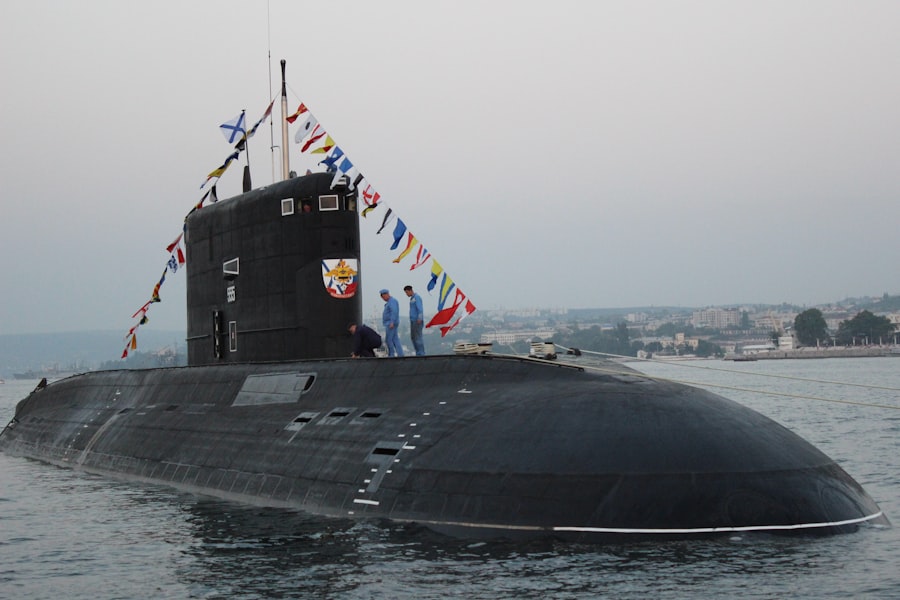
The exterior paint and coatings on submarines are designed not only for corrosion resistance but also to reduce their visual reflectivity and blend with the underwater environment. Dark, non-reflective surfaces are the norm.
Periscope Design and Operation
Modern periscopes are highly sophisticated and can be retracted completely below the waterline. When in use, they are slim and designed to offer a minimal profile. The time spent at periscope depth is carefully managed to minimize exposure.
Thermal Signature Management
Heat generated by the nuclear reactor and the internal workings of the submarine can create a thermal plume that might be detectable to infrared sensors, particularly if the submarine is operating at shallow depths.
Heat Dissipation Systems
Submarines employ advanced systems to dissipate waste heat into the surrounding ocean in a way that minimizes its detectability. This might involve spreading the heat over a larger area or mixing it with colder water before discharge.
Reactor Control and Operational Procedures
The operational tempo and power output of the reactor are managed to reduce its thermal output when stealth is paramount. This means avoiding high-speed sprints or full-power operations when trying to remain undetected.
The Deeper Than Expected: Operating in the Third Dimension
The ocean is a three-dimensional space, and this dimensionality is a submarine’s greatest ally in remaining hidden. The sheer volume of water provides an immense canvas upon which to disappear.
Sonar: The Eyes and Ears of the Underwater World
Sonar (SOund Navigation And Ranging) is the primary technology used to detect submarines. It works by emitting sound pulses and listening for echoes, or by passively listening for sounds generated by the submarine itself.
Active vs. Passive Sonar
Active sonar, employed by surface ships and other submarines, is like shouting into the darkness and listening for the echo. It’s effective but also reveals the locator’s own position. Passive sonar, on the other hand, is like being a silent observer, listening for the sounds emitted by the target. Nuclear submarines are masters of passive operations, relying on their quietness to avoid detection by active sonar and using their own advanced passive sonar arrays to detect others.
Sonar Propagation in Water
The way sound travels through water is complex, influenced by temperature, salinity, and pressure. These factors create “sound channels” and “shadow zones” that submarines can exploit to their advantage, using them to hide or travel undetected. Imagine a perfectly crafted acoustic hiding spot within the ocean’s layers.
The Arms Race in Sonar Technology
The development of submarine stealth and sonar detection is a continuous arms race. As submarines become quieter, sonar systems become more sensitive and sophisticated, employing advanced signal processing to discern faint sounds from background noise.
The Strategic Payoff: Why Stealth Matters
The stealth capabilities of nuclear submarines are not merely a technical curiosity; they are fundamental to their strategic importance. Their ability to operate unseen opens up a range of mission profiles that are impossible for conventionally detectable vessels.
Deterrence and First Strike Capability
The undetectable nature of nuclear submarines armed with ballistic missiles (SSBNs) forms the cornerstone of many nations’ nuclear deterrence strategies. Their survivability means they can act as a second-strike force, capable of retaliating even after a devastating first strike against land-based targets. This “assured retaliation” capability deters potential aggressors.
Intelligence, Surveillance, and Reconnaissance (ISR)
Stealthy submarines are ideal platforms for clandestine ISR missions. They can infiltrate denied waters, collect intelligence on enemy naval movements, or monitor sensitive areas without raising alarm. Their presence can be known only to themselves and their pursuers, if any. This is like a spy with an invisibility cloak, gathering vital information.
Special Operations and Power Projection
Submarines can transport and deploy special forces for covert operations, such as reconnaissance, sabotage, or the insertion and extraction of personnel. They can also project power by appearing in regions where a visible naval presence might be politically sensitive or provocative.
Recent advancements in nuclear submarine stealth capabilities have significantly enhanced their operational effectiveness, allowing them to evade detection by enemy forces. For a deeper understanding of these developments, you can explore a related article that discusses the latest technologies and strategies employed in modern submarine warfare. This insightful piece can be found at this link, where you will discover how stealth features are evolving in response to emerging threats.
The Future of Submarine Stealth
| Metric | Description | Typical Values / Range | Impact on Stealth |
|---|---|---|---|
| Acoustic Signature (Noise Level) | Measure of sound emitted by the submarine, usually in decibels (dB) | Below 120 dB (modern subs) | Lower noise reduces detectability by sonar |
| Propeller Cavitation | Formation of vapor bubbles caused by propeller movement, generating noise | Minimized by advanced blade design and speed control | Reduces noise spikes, enhancing stealth |
| Hull Coating | Special anechoic tiles or coatings that absorb sonar waves | Thickness: 10-30 mm; Material: rubber composites | Reduces sonar reflection, lowering detection probability |
| Magnetic Signature | Magnetic field emitted by the submarine’s metal hull | Reduced by degaussing systems | Minimizes detection by magnetic anomaly detectors |
| Thermal Signature | Heat emitted from the submarine, especially from the reactor and machinery | Managed by heat exchangers and cooling systems | Reduces detection by infrared sensors |
| Speed | Operational speed affects noise generation | Silent cruising speed: 5-10 knots; Max speed: 25-30+ knots | Lower speeds reduce noise, improving stealth |
| Depth | Operating depth affects sonar detection ranges | Typical operating depth: 200-600 meters; Test depth: 800+ meters | Greater depth can reduce sonar effectiveness |
The pursuit of ultimate stealth is a continuous endeavor. Research and development are constantly pushing the boundaries of what is technically achievable.
Advanced Materials and Coatings
The exploration of new hull materials that further reduce magnetic signatures and the development of advanced acoustic coatings that absorb or scatter sonar waves are ongoing.
Quieter Reactor and Propulsion Technologies
Improvements in nuclear reactor design to further reduce noise and vibration, as well as innovations in propulsion systems that are even more silent and efficient, are key areas of focus.
Cyber Warfare and Electronic Countermeasures
As naval warfare increasingly incorporates electronic and cyber dimensions, future stealth strategies will likely involve sophisticated electronic countermeasures and cyber defenses to protect against detection and disruption.
In conclusion, the stealth capabilities of nuclear submarines are a complex interplay of physics, engineering, and operational strategy. They are designed to be the ultimate silent hunters, disappearing into the vastness of the ocean, their presence only a ghost in the sonar readings. This ability to operate unobserved is their most potent weapon, shaping global security, providing strategic deterrence, and enabling a host of critical military missions. The ongoing evolution of these underwater platforms ensures that they will remain a formidable and enigmatic force for decades to come.
FAQs
What makes nuclear submarines stealthy compared to other submarines?
Nuclear submarines are stealthy primarily due to their quiet nuclear reactors, which produce minimal noise compared to diesel engines. Additionally, advanced sound-dampening technologies, streamlined hull designs, and specialized coatings reduce their acoustic signature, making them harder to detect by sonar.
How do nuclear submarines minimize noise to avoid detection?
They use vibration isolation systems to reduce machinery noise, pump-jet propulsors instead of traditional propellers to lower cavitation noise, and sound-absorbing anechoic tiles on their hulls. These measures collectively help nuclear submarines operate quietly underwater.
Can nuclear submarines remain submerged indefinitely?
While nuclear submarines can generate power and air indefinitely using their reactors, their endurance underwater is limited by food supplies and crew endurance. Typically, they can stay submerged for several months without surfacing.
What role does sonar play in the stealth capabilities of nuclear submarines?
Nuclear submarines use advanced passive and active sonar systems to detect other vessels while minimizing their own acoustic emissions. Passive sonar allows them to listen without revealing their position, enhancing stealth during operations.
Are there any countermeasures to detect nuclear submarines despite their stealth features?
Yes, anti-submarine warfare technologies such as low-frequency active sonar, magnetic anomaly detectors, and underwater drones are continually developed to detect stealthy nuclear submarines. However, the submarines’ advanced stealth features make detection challenging.