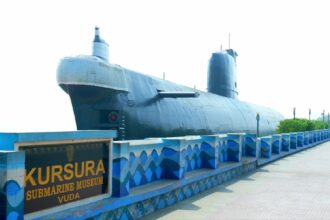
In March 1968, the Soviet submarine K-129 vanished without a trace in the vast expanse of the Pacific Ocean. This submarine, a part of the Soviet Navy’s fleet, was a Golf-class ballistic missile submarine, designed to carry nuclear missiles and serve as a deterrent during the height of the Cold War. The disappearance of K-129 was not just a loss of a military asset; it represented a significant gap in the Soviet Union’s naval capabilities and raised alarms within the Kremlin.
The submarine was last reported to be operating in the waters near the Hawaiian Islands, and its sudden silence sent shockwaves through Soviet military intelligence. The mystery surrounding K-129’s disappearance deepened as days turned into weeks without any sign of the vessel. The Soviet Union launched an extensive search operation, deploying ships and aircraft to scour the ocean for any trace of the submarine.
However, despite their efforts, no evidence was found, leading to speculation about what could have happened. Was it a mechanical failure, an accident, or something more sinister? The unanswered questions surrounding K-129’s fate would linger for decades, fueling intrigue and conspiracy theories that would capture the imagination of historians and enthusiasts alike.
Key Takeaways
- Soviet submarine K-129 mysteriously disappeared in 1968 during the Cold War.
- The CIA launched a covert mission, Project Azorian, to locate and recover the submarine.
- The recovery operation was partially successful, retrieving some parts of K-129 from the ocean floor.
- The incident fueled numerous conspiracy theories and heightened tensions between the US and the Soviet Union.
- K-129’s story remains a significant and unresolved chapter in Cold War history.
The Search for the Submarine
The search for K-129 was a monumental undertaking that showcased the lengths to which the Soviet Union would go to recover its lost submarine. The initial response involved mobilizing a fleet of ships and aircraft, all equipped with advanced sonar technology and underwater detection systems. The Soviet Navy scoured thousands of square miles of ocean, but as time passed, hope began to wane.
The vastness of the Pacific Ocean posed significant challenges, and the search efforts were hampered by unpredictable weather conditions and the sheer depth of the waters. As weeks turned into months, the Soviet leadership faced mounting pressure to explain the disappearance of K-129. The lack of concrete information led to speculation about potential espionage or sabotage.
The search operation became a matter of national pride, with officials determined to recover the submarine and restore confidence in their naval capabilities. Despite their best efforts, however, K-129 remained elusive, and the mystery surrounding its fate only deepened.
The CIA’s Secret Mission
Unbeknownst to the Soviet Union, the United States was closely monitoring the situation surrounding K-129. The CIA had been aware of the submarine’s disappearance and recognized an opportunity to gather intelligence on Soviet naval operations. In a highly classified operation known as Project Azorian, the CIA devised a plan to locate and recover K-129 from its resting place on the ocean floor.
This ambitious mission involved not only advanced technology but also significant financial resources. The CIA’s strategy included using a specially designed ship called Hughes Glomar Explorer, which was equipped with cutting-edge recovery technology. The operation was shrouded in secrecy, with many details kept hidden from even high-ranking officials within the U.S.
government. The goal was not only to retrieve valuable intelligence from K-129 but also to demonstrate American technological superiority during a time of intense Cold War rivalry. As preparations for Project Azorian progressed, the stakes grew higher, and the world remained unaware of the covert activities taking place beneath the surface.
The Recovery of K-129
| Metric | Details |
|---|---|
| Submarine Name | K-129 |
| Type | Golf II-class ballistic missile submarine |
| Incident Date | March 8, 1968 |
| Location of Sinking | North Pacific Ocean, approximately 1,560 nautical miles northwest of Hawaii |
| Depth of Wreck | Approximately 16,500 feet (5,030 meters) |
| Recovery Operation Name | Project Azorian (also known as Project Jennifer) |
| Recovery Vessel | Glomar Explorer |
| Recovery Year | 1974 |
| Recovered Items | Partial section of the submarine, including cryptographic materials and nuclear missiles |
| Operation Cost | Estimated at over 800 million (in 1970s USD) |
| Significance | Provided valuable intelligence on Soviet missile technology and cryptography |
In 1974, after years of planning and preparation, Project Azorian reached its critical phase: the recovery of K-129. The Hughes Glomar Explorer set sail into the Pacific Ocean with a crew trained for this unique mission. Utilizing advanced underwater technology, they aimed to locate and retrieve parts of the submarine from depths exceeding 16,000 feet.
The operation was fraught with challenges, including unpredictable ocean currents and technical malfunctions that threatened to derail their efforts. After several attempts, the crew successfully located K-129 on the ocean floor. The recovery process was painstakingly slow and required precision engineering to avoid damaging the submarine or losing valuable evidence.
Ultimately, they managed to raise a portion of K-129 to the surface, revealing critical information about its design and capabilities. However, not all aspects of the submarine were recovered; some sections remained submerged, leaving questions about what secrets they might still hold.
The Conspiracy Theories Surrounding K-129
The story of K-129 did not end with its recovery; instead, it gave rise to numerous conspiracy theories that continue to captivate those interested in Cold War history. Some theorists speculated that K-129 had been sabotaged by American forces before its disappearance, suggesting that it had been infiltrated by spies or that it had encountered an American submarine during its final mission. Others proposed that it had been lost due to mechanical failure or navigational errors, but these explanations did little to quell public curiosity.
The secrecy surrounding Project Azorian only fueled speculation about what truly happened to K-129. Some believed that the U.S. government had recovered classified documents or technology that could shift the balance of power in favor of America.
Others posited that there were hidden motives behind the operation, suggesting that it was part of a larger strategy to undermine Soviet naval capabilities. As new information emerged over time, conspiracy theories continued to evolve, creating an enduring narrative that blurred the lines between fact and fiction.
The Soviet Union’s Reaction

The Soviet Union’s reaction to the disappearance of K-129 was one of shock and concern. Initially, they believed that their search efforts would yield results; however, as time passed without any sign of recovery, anxiety grew within military circles.
High-ranking officials were tasked with investigating potential causes for the loss while simultaneously managing public perception. When news eventually surfaced about American involvement in recovering parts of K-129 through Project Azorian, it sent shockwaves through Soviet leadership. They were acutely aware that their adversaries had gained access to sensitive information about their naval capabilities.
This revelation prompted a reevaluation of their security protocols and intelligence-gathering methods. The incident underscored vulnerabilities within their military infrastructure and led to increased efforts to enhance submarine technology and operational security.
The Salvage Operation
The salvage operation conducted by the Hughes Glomar Explorer was one of unprecedented complexity and ambition. Engineers and technicians worked tirelessly to develop specialized equipment capable of retrieving sections of K-129 from extreme depths while minimizing damage to both the submarine and its contents. This endeavor required innovative thinking and collaboration among experts from various fields, including engineering, marine biology, and military strategy.
As sections of K-129 were brought to the surface, they were carefully examined for intelligence value. The recovered materials provided insights into Soviet submarine technology during a critical period in history. However, much of what was discovered remained classified for years, leaving historians and analysts speculating about what secrets lay hidden within those sunken depths.
The salvage operation not only demonstrated American ingenuity but also highlighted the lengths both superpowers would go to secure an advantage in an increasingly competitive global landscape.
The Submarine’s Final Resting Place
K-129’s final resting place remains shrouded in mystery even decades after its recovery. While portions of the submarine were salvaged and brought back to America for analysis, much of it still lies on the ocean floor at a depth where few have ventured since its sinking. This underwater grave serves as a reminder of both technological ambition and human fallibility during one of history’s most tense periods.
The location where K-129 sank has become a point of interest for researchers and explorers alike.
However, these efforts are fraught with challenges due to extreme depths and unpredictable ocean conditions.
As such, K-129 continues to be an enigmatic symbol of Cold War tensions—a relic from an era defined by secrecy and competition between two superpowers.
The Legacy of K-129
The legacy of K-129 extends far beyond its disappearance and eventual recovery; it serves as a pivotal moment in Cold War history that highlights both technological advancements and geopolitical rivalries. The incident underscored how critical naval capabilities were viewed by both superpowers during this period—each striving for dominance on land, air, and sea alike. Moreover, K-129’s story has inspired countless books, documentaries, and films exploring themes such as espionage, military strategy, and human resilience in times of crisis.
Its legacy continues to resonate today as historians analyze its implications for modern naval warfare and international relations. As new information emerges over time regarding Cold War events like this one, K-129 remains an enduring symbol—a testament to both ambition and caution in an era defined by uncertainty.
The Impact on Cold War History
The impact of K-129 on Cold War history cannot be overstated; it represented not only a significant loss for the Soviet Union but also an opportunity for American intelligence agencies to gain valuable insights into their adversary’s capabilities. Project Azorian demonstrated how technological innovation could be harnessed for strategic advantage while simultaneously highlighting vulnerabilities within both superpowers’ military infrastructures. Furthermore, this incident contributed to an ongoing cycle of mistrust between East and West during this tumultuous period—each side wary of potential espionage or sabotage at every turn.
As tensions escalated throughout subsequent decades leading up until 1991 when communism collapsed in Eastern Europe—the legacy left behind by events like those surrounding K-129 would shape diplomatic relations for years to come.
The Unanswered Questions
Despite extensive research into K-129’s disappearance and recovery efforts over time—many questions remain unanswered regarding this enigmatic submarine’s fate. What exactly caused its sinking? Were there any classified documents or technologies aboard that could have shifted power dynamics between superpowers?
And what other secrets lie hidden beneath those waves? As historians continue delving into this captivating narrative—new theories may emerge shedding light on previously unexplored aspects surrounding K-129’s story—ensuring that it remains an enduring subject within discussions about Cold War history for generations yet unborn. Ultimately—K-129 serves as both a cautionary tale about ambition gone awry while simultaneously reminding us all how fragile peace can be amidst competition between nations striving for dominance on every front imaginable.
The mysterious fate of the K-129 submarine has intrigued historians and military enthusiasts alike, shedding light on Cold War naval operations. For a deeper understanding of the geopolitical implications surrounding this incident, you can explore a related article on the topic at In The War Room. This resource provides valuable insights into the strategic significance of submarine warfare during that era and the subsequent impact on U.S.-Soviet relations.
WATCH THIS! The CIA’s Secret Mission to Recover a Nuclear Submarine: Project Azorian
FAQs
What was the K-129 submarine?
The K-129 was a Soviet Golf II-class ballistic missile submarine that sank in the Pacific Ocean in 1968.
When did the K-129 submarine sink?
The K-129 sank on March 8, 1968, under mysterious circumstances.
What caused the sinking of the K-129 submarine?
The exact cause of the sinking remains uncertain, but theories include an internal explosion, collision, or mechanical failure.
Where did the K-129 submarine sink?
The submarine sank in the northwest Pacific Ocean, approximately 1,560 nautical miles northwest of Hawaii.
Was there any attempt to recover the K-129 submarine?
Yes, the United States launched a secret operation called Project Azorian in 1974 to recover parts of the submarine from the ocean floor.
What was the purpose of Project Azorian?
Project Azorian aimed to recover the K-129 to gather intelligence on Soviet missile technology and cryptographic materials.
Was the recovery operation successful?
The operation partially succeeded in recovering a section of the submarine, but much of the wreckage remained on the ocean floor.
Were there any survivors from the K-129 submarine?
No, all 98 crew members aboard the K-129 perished when the submarine sank.
Has the Soviet or Russian government provided official information about the K-129?
The Soviet government initially kept details classified, and only limited information has been released over time.
Why is the K-129 submarine historically significant?
The K-129 incident is significant due to Cold War tensions, the secretive recovery operation by the U.S., and its impact on naval intelligence and submarine safety protocols.