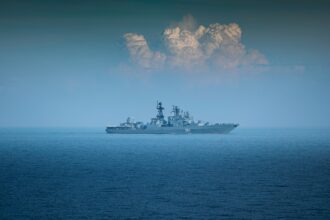
The disappearance of the Soviet submarine K-129, a Golf II-class ballistic missile submarine, in March 1968, ignited a clandestine operation that would become one of the most ambitious and audacious intelligence missions of the Cold War. This incident, shrouded in secrecy for decades, pulled the United States into a high-stakes game of cat and mouse, culminating in the extraordinary Project Azorian. The K-129’s fate remained a mystery for years, a ghost traversing the ocean floor, until an improbable discovery set in motion an elaborate plan to retrieve its secrets.
The K-129, a diesel-electric submarine carrying three R-13 nuclear ballistic missiles, departed its base in Petropavlovsk-Kamchatsky in February 1968 for a routine patrol in the Pacific. Its mission was boilerplate: patrol the designated area, remain silent, and be prepared to launch its deadly payload if ordered. However, the submarine failed to report in on March 8, 1968, sparking immediate concern within the Soviet Pacific Fleet. Initial attempts to contact the vessel were unsuccessful. As days turned into weeks, the grim realization settled in: the K-129 was lost.
Soviet Search Efforts
The Soviet Union launched a major aerial and naval search operation in the North Pacific. Naval vessels crisscrossed the patrol areas, while aircraft conducted extensive visual searches. This monumental effort, however, yielded no trace of the submarine. The vastness of the Pacific Ocean swallowed the K-129 whole, an iron leviathan vanishing beneath the waves, leaving behind only speculation and grief. The Soviets eventually abandoned their search, classifying the incident as a tragic loss at sea.
The United States Listens
Unknown to the Soviets, the United States Naval Security Group was, as always, keenly listening. Their network of hydrophones, part of the extensive SOSUS (Sound Surveillance System) network, was designed to detect and track Soviet submarines. On March 8, the SOSUS network picked up an anomalous sound event in the North Pacific, a brief, powerful acoustic signature consistent with an implosion. This faint whisper from the abyssal depths, captured by a silent, interconnected web of hydrophones, was the first concrete piece of evidence regarding the K-129’s demise. It was a needle in a haystack, but one the Americans intended to find.
The search for the USS Halibut’s involvement in the recovery of the K-129 submarine has intrigued historians and military enthusiasts alike. A related article that delves into the complexities of this operation can be found on In The War Room, which provides a comprehensive analysis of the Cold War’s underwater espionage efforts. For more insights, you can read the article here: In The War Room.
The Hunt Begins: A Covert Quest for Information
The SOSUS data provided a tantalizing but imprecise lead. The estimated location spread across hundreds of square miles, a vast underwater desert stretching thousands of meters deep. The task of finding a relatively small object in such an expanse was akin to finding a lost grain of sand on a sprawling beach, yet the intelligence prize was immeasurable. The K-129 carried not only nuclear missiles but also a wealth of Soviet cryptographic materials, torpedoes, and other sensitive technologies – a veritable treasure trove for Cold War intelligence.
The USS Halibut’s Role
Enter the USS Halibut (SSN-587), a unique nuclear submarine specially modified for clandestine photography and ocean bottom mapping. Stripped of its ballistic missile tubes, the Halibut was equipped with advanced sonar, cameras, and manipulators, transforming it from a weapon of war into a sophisticated deep-sea reconnaissance platform. In the summer of 1968, the Halibut embarked on its secret mission: Operation Sand Dollar. Its objective was to systematically search the vast target area, meticulously surveying the ocean floor for any sign of the K-129.
Advanced Deep-Sea Technology
The Halibut utilized a unique “Fish” towed array, a drone equipped with powerful strobe lights and cameras, to photograph the seabed. This innovative technology allowed the Halibut to effectively “see” in the inky blackness of the deep ocean. Days turned into weeks, and then months, as the Halibut methodically scanned the ocean floor. The crew, sworn to secrecy, endured the tedium and isolation, knowing that their work was of monumental importance. Imagine the immense pressure on these individuals, operating at the frontier of technological capability, searching for a ghost in the deep.
The Discovery: A Ghost in the Deep
After months of painstaking searching, scanning an area the size of several states, the USS Halibut finally made contact. On August 20, 1968, the “Fish” transmitted images back to the Halibut. The images were faint, blurry, but unmistakable: the shattered remains of a submarine, lying at a depth of approximately 4,900 meters (about 16,000 feet). The K-129 had been found, nearly 1,500 miles northwest of Hawaii. The discovery was a triumph of persistence and advanced technology.
An Unlikely Wreckage Site
The wreckage indicated a catastrophic implosion, suggesting the submarine was crushed by the immense pressure of the deep sea. The K-129 lay in several large pieces, scattered over a wide area. Critically, one section contained the sail and, potentially, the highly sought-after missile compartments and cryptographic equipment. The specific location and depth of the K-129’s resting place presented an unprecedented challenge for any salvage operation. It was far beyond the conventional capabilities of any nation at the time.
Intelligence Assessment
The discovery provided invaluable intelligence to the United States. Analysis of the wreckage could reveal details about Soviet submarine construction, missile technology, and operational procedures. But the truly coveted prize was inside: the nuclear missiles and the cryptographic systems, which would provide an unprecedented window into Soviet military communications. The decision was made to attempt a recovery.
Project Azorian: The Audacious Plan
The recovery of the K-129 became the focus of Project Azorian, an operation of staggering ambition and immense technical complexity. The scale of the undertaking was unprecedented. Retrieving a large submarine from nearly 5 kilometers beneath the surface required inventing new technologies and pushing existing ones to their absolute limits. This was not merely an engineering challenge; it was a diplomatic tightrope walk, a delicate dance of deception and geopolitical maneuvering.
The Glomar Explorer: A Ship Built for Secrecy
To execute Project Azorian, the CIA commissioned the construction of a revolutionary vessel: the Hughes Glomar Explorer. This ship was a marvel of engineering, appearing outwardly as a deep-sea mining vessel. In reality, it was a colossal floating platform equipped with a massive “moon pool” in its center, designed to house a gigantic underwater claw – the “Clementine” – capable of grappling and lifting large sections of the K-129. The Glomar Explorer was a masterstroke of Cold War subterfuge, a Trojan horse disguised as an industrial undertaking. Its deep-sea mining facade was a plausible cover story for its unusual design and capabilities.
Technical Challenges and Innovations
The engineering challenges were formidable. The enormous weight of the recovery vehicle and the submarine sections, combined with the immense pressure at such depths, demanded innovative solutions. The Glomar Explorer featured an advanced heave-compensating system to counteract the motion of the ocean, ensuring stability during the delicate lifting operation. Specialized grapples and attachment mechanisms had to be designed to secure the fragile wreckage without causing further damage. This was a testament to American ingenuity and its commitment to Cold War intelligence.
The search for the USS Halibut’s involvement in the K-129 incident has intrigued many historians and military enthusiasts alike. This covert operation not only highlights the complexities of Cold War naval warfare but also sheds light on the technological advancements of the time. For those interested in exploring more about this fascinating topic, you can read a related article that delves deeper into the intricacies of the mission and its implications. Check it out here for a comprehensive overview.
The Attempted Retrieval and Its Aftermath
| Metric | Details |
|---|---|
| Vessel Name | USS Halibut (SSGN-587) |
| Type | Submarine |
| Mission | Search and recovery of Soviet submarine K-129 |
| Operation Name | Project Azorian (also known as Project Jennifer) |
| Year of Search | 1974 |
| Location of K-129 Sinking | North Pacific Ocean, approximately 1,560 nautical miles northwest of Hawaii |
| Depth of Wreck | Approximately 16,500 feet (5,000 meters) |
| Recovery Vessel | Glomar Explorer |
| Recovery Outcome | Partial recovery of K-129’s wreckage |
| Significance | One of the deepest salvage operations in history; Cold War intelligence operation |
In the summer of 1974, the Hughes Glomar Explorer sailed to the K-129’s resting place. The world was told it was engaged in manganese nodule mining, a cover story that, remarkably, held for several years. The Glomar Explorer spent weeks over the site, carefully lowering the massive Clementine claw to retrieve sections of the K-129. The operation was fraught with peril.
Partial Recovery and Unexpected Setbacks
The recovery attempt was partially successful. While lifting a large section of the submarine, the colossal claw fractured, resulting in a significant portion of the K-129 breaking away and falling back to the seabed. Approximately one-third of the submarine was recovered, including the bow section. This recovered section contained two nuclear-tipped torpedoes, some cryptographic machines, and the bodies of six Soviet sailors. The recovery was a bittersweet victory. While not a complete success, it still yielded invaluable intelligence.
The Leak and Soviet Response
The secrecy surrounding Project Azorian was eventually breached in 1975, thanks to a leak to the press. Jack Anderson, a prominent investigative journalist, published an article revealing the true purpose of the Glomar Explorer. The revelation sent shockwaves through the intelligence community and exposed the scale of the CIA’s audacious operation. The Soviets, while publicly downplaying the incident, were undoubtedly dismayed by the loss of their secrets and the audacity of the American undertaking. The global political landscape, however, had shifted. With the Cold War easing, and the details already public, further recovery attempts were deemed too risky and politically damaging.
Project Azorian stands as a monumental testament to the lengths nations would go to gain an advantage during the Cold War. The hunt for the K-129 encapsulates the technological prowess, the unwavering determination, and the deep-seated paranoia that defined that era. The silence of the deep ocean held its secrets, but through unparalleled engineering and daring, a portion of the K-129’s story was brought to light, offering a unique glimpse into the submerged battlefield of intelligence and espionage. The K-129 remains, in large part, a solemn monument to the ultimate cost of technological failure and the unrelenting pursuit of strategic advantage.
WATCH NOW ▶️ SHOCKING: How The CIA Stole A Nuclear Submarine
FAQs
What was the USS Halibut K-129?
The USS Halibut (SSGN-587) was a United States Navy nuclear-powered guided missile submarine. K-129 was a Soviet Golf II-class ballistic missile submarine that sank in the Pacific Ocean in 1968.
Why was the USS Halibut involved in the search for K-129?
The USS Halibut was specially equipped for covert operations and was tasked with locating and investigating the sunken Soviet submarine K-129 as part of a secret U.S. Navy mission during the Cold War.
When did the search for K-129 take place?
The search for the Soviet submarine K-129 occurred shortly after it sank in March 1968, with the USS Halibut conducting underwater reconnaissance and recovery operations in the months following the incident.
What was the outcome of the USS Halibut’s search for K-129?
The USS Halibut successfully located the wreck of K-129 on the ocean floor and helped facilitate a covert U.S. operation, known as Project Azorian, to recover parts of the submarine using the specially designed ship Hughes Glomar Explorer.
Why is the USS Halibut K-129 search historically significant?
The search and recovery operation marked one of the most ambitious and secretive Cold War underwater missions, showcasing advanced naval technology and intelligence efforts to gain insights into Soviet submarine capabilities.