The nuclear arms race originated in the early 20th century during a period of significant scientific and technological progress. James Chadwick’s discovery of the neutron in 1932 and subsequent research demonstrating that nuclear fission could release enormous amounts of energy established the foundation for nuclear weapons development. As governments recognized the military potential of atomic energy, international competition to develop nuclear capabilities intensified.
The post-World War I geopolitical environment, characterized by instability and competing national interests, particularly in Europe, created conditions that encouraged nations to pursue nuclear weapons as instruments of security and power projection. The emergence of totalitarian governments in the 1930s and 1940s accelerated nuclear weapons development efforts. Concerns that Nazi Germany and Imperial Japan might acquire nuclear weapons prompted the United States and its allies to prioritize atomic research.
These security concerns led to the creation of the Manhattan Project, a classified program designed to develop atomic weapons before Axis powers could achieve similar capabilities. This initiative represented a significant shift in international relations and military doctrine, establishing nuclear weapons as a central element of national security strategy.
Key Takeaways
- The nuclear arms race began with the Manhattan Project and the creation of the first atomic bomb.
- The Cold War intensified nuclear tensions, especially after the Soviet Union developed its own nuclear arsenal.
- Key crises like the Cuban Missile Crisis brought the world to the brink of nuclear war.
- Arms control agreements have aimed to limit nuclear weapons, but proliferation to other countries remains a challenge.
- Despite reductions after the Cold War, the future of nuclear disarmament remains uncertain amid ongoing global tensions.
The Manhattan Project and the Development of the Atomic Bomb
The Manhattan Project, initiated in 1942, was a monumental undertaking that brought together some of the greatest scientific minds of the time. Led by figures such as J. Robert Oppenheimer and General Leslie Groves, this project sought to develop an atomic bomb capable of ending World War
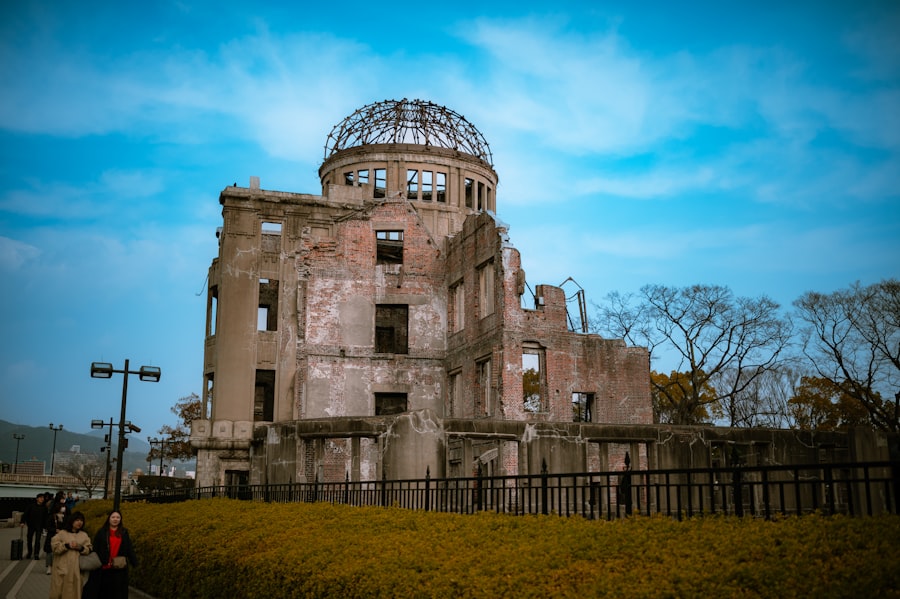
By July 1945, the culmination of years of research and development resulted in the successful detonation of the first atomic bomb during the Trinity Test in New Mexico. This event marked a turning point in human history, demonstrating the destructive power that could be unleashed through nuclear fission. Shortly thereafter, the United States dropped atomic bombs on Hiroshima and Nagasaki in August 1945, leading to Japan’s surrender and effectively ending World War
The Cold War and the Escalation of Tensions
The end of World War II did not bring about lasting peace; instead, it marked the beginning of the Cold War, a period defined by ideological conflict between the United States and the Soviet Union. As both superpowers emerged from the war with significant military capabilities, they found themselves in a precarious position where mutual distrust and competition for global influence became paramount. The development of nuclear weapons added a new dimension to this rivalry, as both nations sought to establish their dominance through military might.
The arms race escalated rapidly, with each side striving to outpace the other in terms of nuclear capabilities. During this time, propaganda played a crucial role in shaping public perception and justifying military expenditures. Both superpowers portrayed themselves as defenders of freedom and democracy against an existential threat posed by their adversary.
This narrative fueled an atmosphere of paranoia and fear, leading to increased military spending and an ever-growing stockpile of nuclear weapons. The doctrine of mutually assured destruction (MAD) emerged as a guiding principle, suggesting that neither side would initiate a conflict knowing it could lead to total annihilation. This precarious balance created a tense stalemate that defined international relations for decades.
The Soviet Union’s Entry into the Nuclear Arms Race
The Soviet Union’s entry into the nuclear arms race marked a significant turning point in global politics. Initially lagging behind the United States in nuclear capabilities, Soviet scientists worked diligently to catch up.
This event signaled that the Soviet Union had achieved parity with its rival, leading to heightened tensions and an escalation in arms development on both sides. In response to this new reality, the United States intensified its efforts to expand its own nuclear arsenal. The competition became increasingly aggressive, with both nations engaging in espionage and intelligence-gathering operations to gain insights into each other’s capabilities.
The arms race was no longer just about developing weapons; it became a matter of national pride and ideological supremacy. As both superpowers continued to amass nuclear stockpiles, concerns about global security grew, prompting calls for arms control measures that would eventually emerge in later decades.
The Cuban Missile Crisis and the Height of Nuclear Tensions
| Year | Event | Country | Number of Nuclear Warheads | Significance |
|---|---|---|---|---|
| 1945 | First nuclear test (Trinity) | USA | 1 | First-ever detonation of a nuclear device |
| 1949 | First Soviet nuclear test | USSR | 1 | Start of the nuclear arms race between USA and USSR |
| 1952 | First hydrogen bomb test | USA | 1 | Introduction of thermonuclear weapons |
| 1953 | First Soviet hydrogen bomb test | USSR | 1 | Escalation of nuclear arms race |
| 1962 | Cuban Missile Crisis | USA/USSR | USA: ~27,000 USSR: ~3,000 |
Closest point to nuclear war during Cold War |
| 1986 | Peak nuclear warheads | USA/USSR | USA: ~23,000 USSR: ~40,000 |
Highest number of nuclear warheads globally |
| 1991 | START I Treaty signed | USA/USSR | USA: ~12,000 USSR: ~12,000 |
First major arms reduction treaty |
| 2023 | Estimated nuclear warheads | Global | ~13,000 total | Current estimated global nuclear arsenal |
The Cuban Missile Crisis of October 1962 represented one of the most perilous moments in human history, bringing the world closer to nuclear war than ever before. When U.S. intelligence discovered Soviet missile installations in Cuba, President John F.
Kennedy faced an unprecedented challenge that required careful navigation between military action and diplomatic resolution. The crisis highlighted the dangers inherent in the arms race, as both nations stood on the brink of catastrophe with their nuclear arsenals at their disposal. In response to this threat, Kennedy implemented a naval blockade around Cuba while engaging in intense negotiations with Soviet Premier Nikita Khrushchev.
The world held its breath as tensions escalated, with both leaders aware that any miscalculation could lead to devastating consequences. Ultimately, diplomacy prevailed when Khrushchev agreed to dismantle the missile sites in exchange for a U.S. commitment not to invade Cuba and a secret agreement to remove American missiles from Turkey.
This resolution not only defused an immediate crisis but also underscored the importance of communication and negotiation in preventing nuclear conflict.
The Arms Control Agreements and Attempts at Disarmament
In the aftermath of the Cuban Missile Crisis, both superpowers recognized the need for arms control agreements to mitigate the risks associated with their burgeoning arsenals.
This treaty reflected a growing awareness that unchecked nuclear proliferation posed a threat not only to national security but also to global stability.
Subsequent agreements followed, including the Strategic Arms Limitation Talks (SALT) in the 1970s, which aimed to limit the number of strategic ballistic missile launchers and nuclear warheads held by both nations. These negotiations represented a shift from competition to cooperation, as both sides began to acknowledge that disarmament was essential for long-term peace. However, progress was often slow and fraught with challenges, as political dynamics shifted and new threats emerged on the global stage.
The Development of Hydrogen Bombs and Intercontinental Ballistic Missiles
As both superpowers sought to enhance their nuclear capabilities, the development of hydrogen bombs (thermonuclear weapons) introduced an even more destructive element into the arms race. Unlike atomic bombs that relied solely on fission reactions, hydrogen bombs utilized fusion processes that could yield exponentially greater explosive power. The United States successfully tested its first hydrogen bomb in 1952, followed by the Soviet Union’s successful test in 1955.
This escalation raised concerns about an arms race that could spiral out of control. In tandem with advancements in bomb technology came significant developments in delivery systems, particularly intercontinental ballistic missiles (ICBMs). These missiles allowed for rapid deployment of nuclear warheads over vast distances, fundamentally changing military strategy and deterrence theory.
The ability to strike targets across continents within minutes heightened fears of accidental launches or miscalculations during times of crisis. As both nations invested heavily in missile technology, they created an environment where any conflict could potentially escalate into full-scale nuclear war.
The Proliferation of Nuclear Weapons to Other Countries
As the Cold War progressed, concerns about nuclear proliferation extended beyond just the United States and Soviet Union. Other nations began pursuing their own nuclear capabilities, driven by regional conflicts or aspirations for greater geopolitical influence. Countries such as China conducted their first successful nuclear test in 1964, while India followed suit in 1974 with its own nuclear program.
This proliferation raised alarms among global leaders who feared that an increasing number of states possessing nuclear weapons could lead to instability and conflict. Efforts to curb proliferation led to international initiatives such as the Treaty on the Non-Proliferation of Nuclear Weapons (NPT), which aimed to prevent further spread while promoting disarmament among existing nuclear states. However, compliance proved challenging as some nations pursued clandestine programs despite international scrutiny.
The emergence of rogue states seeking nuclear capabilities added another layer of complexity to global security dynamics, prompting calls for more robust enforcement mechanisms and diplomatic engagement.
The End of the Cold War and the Reduction of Nuclear Stockpiles
The end of the Cold War in the late 1980s brought about significant changes in international relations and attitudes toward nuclear weapons. With the dissolution of the Soviet Union in 1991, both superpowers recognized an opportunity for reducing their nuclear arsenals as part of broader efforts toward peace and stability. Treaties such as START I (Strategic Arms Reduction Treaty) laid out frameworks for substantial reductions in deployed strategic warheads and delivery systems.
This period marked a shift from confrontation to cooperation as former adversaries engaged in dialogue aimed at reducing tensions and fostering trust. The dismantling of thousands of warheads signaled a commitment to disarmament that resonated globally. However, challenges remained as new geopolitical tensions emerged post-Cold War, raising questions about whether these reductions would be sustained or reversed amid evolving security threats.
The Current State of the Nuclear Arms Race
As of October 2023, the landscape surrounding nuclear weapons remains complex and fraught with challenges. While significant strides have been made toward disarmament since the Cold War’s conclusion, several nations continue to modernize their arsenals or pursue new capabilities amid rising geopolitical tensions. Countries like North Korea have drawn international condemnation for their aggressive pursuit of nuclear weapons despite widespread calls for denuclearization.
Moreover, emerging technologies such as cyber warfare and artificial intelligence have introduced new dimensions into strategic calculations regarding deterrence and defense systems. As states grapple with these evolving threats, concerns about accidental launches or miscalculations persist—underscoring an urgent need for renewed dialogue on arms control measures that can adapt to contemporary realities while addressing longstanding issues related to proliferation.
The Future of Nuclear Weapons and the Possibility of Disarmament
Looking ahead, the future of nuclear weapons remains uncertain as global dynamics continue to evolve rapidly. While there is widespread recognition among many leaders regarding the catastrophic consequences associated with nuclear warfare, achieving meaningful disarmament poses significant challenges amid competing national interests and security concerns. Efforts toward multilateral negotiations must navigate complex geopolitical landscapes while addressing issues such as verification mechanisms and compliance enforcement.
Ultimately, fostering a culture that prioritizes diplomacy over militarization will be essential for reducing reliance on nuclear weapons as instruments of national security policy. Engaging emerging powers within frameworks designed for dialogue can help build trust while addressing legitimate security concerns without resorting to arms races or confrontational postures. As history has shown time and again, collaboration rather than competition may hold key solutions toward achieving lasting peace in an increasingly interconnected world where humanity’s survival hinges on collective responsibility for safeguarding against existential threats posed by nuclear weapons.
The history of the nuclear arms race is a complex and pivotal aspect of 20th-century geopolitics, marked by intense rivalry and the quest for military supremacy. For a deeper understanding of this critical period, you can explore the article on nuclear strategy and its implications in modern warfare at In The War Room. This resource provides valuable insights into the strategies employed by nations during the arms race and the lasting effects on international relations.
WATCH THIS 🎬 DEAD HAND: The Soviet Doomsday Machine That’s Still Listening
FAQs
What is the nuclear arms race?
The nuclear arms race refers to the competition between countries, primarily the United States and the Soviet Union during the Cold War, to develop and accumulate more powerful and numerous nuclear weapons.
When did the nuclear arms race begin?
The nuclear arms race began shortly after World War II, around 1945, when the United States first used atomic bombs and the Soviet Union started developing its own nuclear weapons.
Which countries were the main participants in the nuclear arms race?
The main participants were the United States and the Soviet Union. Later, other countries such as the United Kingdom, France, and China also developed nuclear arsenals.
What were some key events in the history of the nuclear arms race?
Key events include the U.S. atomic bombings of Hiroshima and Nagasaki in 1945, the Soviet Union’s first atomic bomb test in 1949, the development of hydrogen bombs in the 1950s, and various arms control treaties like the Nuclear Non-Proliferation Treaty (NPT) in 1968.
How did the nuclear arms race impact global politics?
The arms race heightened tensions during the Cold War, leading to a policy of deterrence known as Mutually Assured Destruction (MAD), which aimed to prevent nuclear war by ensuring that both sides could retaliate with devastating force.
What efforts have been made to control or end the nuclear arms race?
Efforts include arms control agreements such as the Strategic Arms Limitation Talks (SALT), the Intermediate-Range Nuclear Forces Treaty (INF), and ongoing negotiations under the Treaty on the Non-Proliferation of Nuclear Weapons (NPT).
Is the nuclear arms race still ongoing today?
While the Cold War nuclear arms race ended with the dissolution of the Soviet Union, concerns remain about nuclear proliferation and modernization of arsenals by nuclear-armed states, making arms control an ongoing global issue.