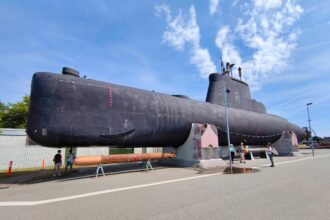
The Akula-class submarine, a formidable presence in modern naval technology, carries with it a distinct acoustic signature, a sonic fingerprint that speaks volumes to those trained to listen. This signature is not an arbitrary byproduct of its design; rather, it is the nuanced symphony of moving parts, hydrodynamic forces, and the very essence of its submerged existence. For those who study the silent depths, the Akula class is not merely a hull of steel but a complex acoustic organism, whose every hum, click, and groan tells a story.
The Akula class, like all submarines, is a masterclass in hydrodynamics, and its hull shape is a primary determinant of its acoustic behavior. The smooth, streamlined contours are engineered to minimize turbulent flow, a significant source of underwater noise. Yet, even the most elegant design cannot entirely eliminate the subtle whispers of water rushing over its surface.
Hydrodynamic Drag and Flow Noise
As the submarine moves through the water, the interaction between the hull and the surrounding fluid generates friction and pressure differentials. This creates what is known as flow noise, a broadband acoustic emission that varies in intensity with the submarine’s speed. Think of it as the rustling of leaves in a gentle breeze versus the roar of a gale; the fundamental phenomenon is the same, but the intensity is dictated by the force of the interaction. For the Akula, this flow noise, while a constant companion at speed, has been meticulously engineered to be as unobtrusive as possible, aiming for a whisper rather than a shout.
Cavitation and its Acoustic Signature
A more significant contributor to hydrodynamic noise is cavitation. This occurs when the water pressure around rotating components, such as propellers, drops below its vapor pressure, causing tiny bubbles to form and then collapse violently. The implosion of these bubbles generates a characteristic crackling or popping sound. The Akula class, with its advanced propeller designs and often sophisticated noise reduction measures, aims to mitigate cavitational noise. However, under certain operational conditions, such as high speeds or maneuverability, the onset of cavitation remains a potent acoustic signal, a tell-tale sign of increased activity.
The Akula-class submarine, known for its advanced stealth capabilities, has garnered significant attention due to its unique acoustic signature, which plays a crucial role in naval warfare. For a deeper understanding of the implications of submarine acoustics and the strategic advantages they provide, you can read a related article on this topic at In The War Room. This resource delves into the technological advancements in submarine design and how they affect underwater operations.
The Heart of the Noise: Machinery and Its Sonic Spectrum
Beneath the tranquil facade of the submerged hull lies a complex ecosystem of machinery, each component contributing its unique voice to the Akula’s acoustic signature. The power plant, cooling systems, and various operational systems all produce distinct sound frequencies and patterns. Understanding these internal sounds is crucial to deciphering the submarine’s operational state.
The Nuclear Reactor’s Hum
The Akula class is nuclear-powered, and the primary coolant pumps are a significant source of low-frequency noise. The continuous circulation of coolant through the reactor core and heat exchangers generates a steady, powerful hum. This is not a single, pure tone but a blend of frequencies, with harmonics that can extend into the audible range for sensitive hydrophones. Imagine the deep, resonant thrum of a distant industrial complex; the reactor’s output is of a similar foundational nature, a constant background presence.
Pump Vibrations and Noise Transmission
The mechanical components of the pumps themselves, including the turbines and impellers, are sources of vibration. These vibrations can be transmitted through the submarine’s structure and radiate into the surrounding water. The effectiveness of the Akula’s acoustic isolation and damping techniques plays a critical role in minimizing the transmission of this machinery noise.
Auxiliary Machinery and Its Harmonic Contributions
Beyond the main power plant, a host of auxiliary machinery contributes to the acoustic landscape. This includes pumps for ballast, hydraulics, and ventilation, as well as generators and air conditioning units. Each of these systems has its own distinct operational frequency and characteristic sound profile. Like an orchestra with various instruments, each plays its part, and a skilled acoustician can differentiate between the distinct timbres.
Electric Motor Noise and Gearbox Whines
Electric motors, used for various onboard systems, can produce higher-frequency tones. Gearboxes, employed to transmit power, often contribute with characteristic whines and grinding sounds, especially if lubrication or alignment is suboptimal. These sounds, while individually less imposing than the reactor’s hum, add layers to the Akula’s overall acoustic complexity.
The Symphony of Propulsion: Propeller Acoustics
The propeller is arguably the most significant external acoustic contributor to a submarine’s signature. Its design, number of blades, and rotational speed all directly impact the sound field generated. The Akula class has evolved its propeller technology to minimize noise, but it remains a focal point for acoustic detection.
Propeller Blade Rate and Harmonics
The fundamental frequency of the propeller’s noise is determined by the number of blades and its rotational speed – the propeller blade rate. Each time a blade passes a specific point, it generates a pressure pulse. The series of these pulses creates a distinct tonal component. Furthermore, harmonics of this fundamental frequency can also be prominent. The Akula class’s advanced propeller designs aim to create a “cleaner” wake, diffusing these pressure pulses and reducing their acoustic intensity.
The “Seven-Bladed Wonder” and Noise Reduction
While specific details of the Akula’s propeller designs are classified, naval architects continuously strive for propeller designs that minimize tip vortex cavitation and reduce overall radiated noise. Modern designs often feature more blades (sometimes seven or more) with carefully sculpted shapes to optimize hydrodynamic efficiency and acoustic performance. This is akin to designing a musical instrument to produce a pure, resonant tone rather than a discordant clang.
Propeller Cavitation’s Distinctive Crackle
As mentioned earlier, propeller cavitation is a major source of noise. The Akula class, like other advanced submarines, employs sophisticated propeller designs and operational procedures to delay or suppress cavitation. However, during high-speed maneuvers or in turbulent water, cavitation can become unavoidable, generating a characteristic broadband, crackling sound that is a strong indicator of the submarine’s activity.
The Invisible Hand: External Noise Sources and Acoustic Signatures
Beyond its internal machinery and propulsion, the Akula class interacts with its environment in ways that generate acoustic signatures. These external factors, while often less controllable, are equally important for acoustic analysis.
Sonar Arrays and Active Acoustics
While primarily known for their passive sonar capabilities, submarines can also employ active sonar. Active sonar involves emitting sound pulses and analyzing the returning echoes. The Akula class, when using active sonar, becomes a deliberate emitter of sound. The characteristics of these active sonar pings – their frequency, duration, and repetition rate – form a distinct and readily identifiable acoustic signature. This is the submarine “calling out” to its environment, and its voice is unmistakable.
The “Ping” and its Echoes: Information Exchange
The active sonar ping is a powerful tool for navigation and target detection. However, it also betrays the submarine’s presence. The way the sound interacts with the ocean floor, water layers, and any potential targets creates complex echo patterns that can be analyzed. For the detecting platform, these echoes are like Morse code, revealing spatial information and the nature of the environment.
Ballast Tank Operation and Water Movement
The manipulation of ballast tanks, essential for submerging, surfacing, and controlling buoyancy, generates distinct acoustic events. The rapid influx or expulsion of water, the operation of high-pressure air systems used for blowing tanks, and the movement of water through valves all create transient noises. These are often brief but noticeable sounds, akin to the sudden gurgle of a drain or the hiss of escaping air.
Valve Operations and Water Hammer Effects
The opening and closing of large valves, particularly those associated with ballast and trim systems, can create significant acoustic disturbances. In some instances, if not managed properly, rapid valve closure can lead to water hammer effects, a sharp, percussive sound.
The Akula class submarines are known for their advanced stealth capabilities, particularly their acoustic signature, which plays a crucial role in their operational effectiveness. For a deeper understanding of how these submarines manage to minimize their detectability, you can explore a related article that discusses various factors influencing submarine acoustics. This insightful piece can be found at this link, where you will discover more about the technologies and strategies employed to enhance the stealth of underwater vessels.
The Art of Deception: Noise Reduction and Acoustic Countermeasures
| Metric | Value | Unit | Notes |
|---|---|---|---|
| Acoustic Signature Level | 110 | dB re 1 μPa @ 1m | Estimated noise level at low speed |
| Speed at Silent Running | 5 | knots | Speed at which noise is minimized |
| Hull Coating | Rubber Anechoic Tiles | N/A | Reduces sonar reflection and noise |
| Propeller Type | Seven-blade skewed | N/A | Designed to reduce cavitation noise |
| Machinery Isolation | Double isolation mounts | N/A | Reduces vibration transmission to hull |
| Operational Depth | 600 | meters | Depth at which acoustic signature is measured |
Given the critical importance of stealth in submarine warfare, the Akula class has been the subject of extensive research and development in noise reduction. These efforts are not about eliminating sound entirely, but about shaping and masking the acoustic signature to render the submarine less detectable.
Anechoic and Damping Materials
The exterior of the Akula’s hull is often coated with anechoic tiles. These specialized materials are designed to absorb sonar energy, preventing reflections that would reveal the submarine’s location. Internally, significant effort is invested in vibration isolation and damping to prevent machinery noise from radiating outwards. This is like wrapping the submarine in a thick blanket of silence, dampening its internal clamor.
The Role of Decoupling and Shock Mounts
Vibration-sensitive equipment is mounted on shock mounts and decoupling systems. This separates the machinery from the hull structure, significantly reducing the transmission of vibrations. Think of placing a delicate object on a spring-loaded platform to protect it from shock; the principle is similar, but applied to mechanical systems.
Quieting Techniques for Machinery
Beyond damping, internal machinery is also designed with quiet operation in mind. This includes using low-noise pumps, employing variable speed drives to optimize operational speeds, and carefully balancing rotating components. These are like tuning an instrument to its most harmonious pitch.
Variable Speed Drives and Optimized Operation
By allowing machinery to operate at optimal, often reduced, speeds, variable speed drives can significantly reduce noise output. This flexibility in operation is a key component of modern acoustic quieting.
Operational Tactics and Signature Management
The psychological element of acoustic warfare is as important as the physical. The Akula’s operators are trained to employ tactics that minimize their acoustic signature. This includes avoiding high speeds in acoustically sensitive areas, carefully managing machinery operations, and employing sophisticated acoustic masking techniques. This is the art of the predator moving unseen and unheard, a master of its domain.
Speed Management and “Silent Running”
The most effective way to reduce noise is to slow down. The Akula class can operate at very low speeds, known as “silent running,” which dramatically reduces hydrodynamic and machinery noise.
In conclusion, the acoustic signature of the Akula-class submarine is a complex and multifaceted phenomenon. It is the sum total of its hydrodynamic interactions, the inherent noise of its machinery, and the deliberate efforts made to minimize its detectability. To those who possess the knowledge and the technology, listening to the Akula is akin to reading a detailed report, revealing its speed, its operational state, and its very intentions. The silent service, as submarines are often called, is anything but silent to the trained ear; it is a constant, evolving conversation conducted in the language of sound.

WATCH NOW ▶️ WARNING: The $17M Deal That Blinded The US Navy
FAQs
What is the acoustic signature of an Akula class submarine?
The acoustic signature of an Akula class submarine refers to the unique sound profile it produces underwater, which includes noises from its engines, propellers, and onboard machinery. This signature is used to detect and identify the submarine by sonar systems.
How does the Akula class submarine minimize its acoustic signature?
The Akula class submarine employs advanced noise-reduction technologies such as anechoic tiles on its hull, isolated machinery mounts, and specially designed propellers to reduce cavitation and mechanical noise, making it quieter and harder to detect.
Why is a low acoustic signature important for submarines like the Akula class?
A low acoustic signature is crucial because it enhances the submarine’s stealth capabilities, allowing it to operate undetected by enemy sonar systems, which is vital for reconnaissance, strategic deterrence, and combat missions.
How does the Akula class compare to other submarines in terms of acoustic signature?
The Akula class is considered one of the quieter Soviet/Russian nuclear-powered attack submarines, with acoustic signatures comparable to or better than earlier Soviet designs, though generally noisier than some Western counterparts like the U.S. Los Angeles or Virginia class submarines.
Can the acoustic signature of an Akula class submarine be detected by modern sonar systems?
Yes, modern sonar systems, especially passive sonar arrays and advanced signal processing techniques, can detect the acoustic signature of an Akula class submarine, although its noise reduction measures make detection more challenging compared to older submarine models.