The deep, churning waters of the Pacific Ocean served as the stage for a silent, high-stakes drama in the late 1970s, a clandestine dance between the United States and the Soviet Union. At the heart of this unfolding narrative was the Glomar Explorer, a vessel of unprecedented engineering, tasked with a mission shrouded in secrecy. Yet, the mission of the Glomar Explorer was not conducted in a vacuum. Throughout its operational periods, the watchful eyes of Soviet trawlers, seemingly anodyne fixtures of international waters, became an unavoidable presence, a constant reminder of the geopolitical currents flowing beneath the surface. This article will delve into the operational context of the Glomar Explorer, the nature of its secretive mission, the presence and likely functions of the Soviet trawlers, and the broader implications of this underwater chess match.
The Glomar Explorer was not merely a ship; it was a testament to audacious engineering ambition. Its creation was a direct response to a singular, extraordinary challenge, a project so complex and politically sensitive that its very existence was initially denied.
A Need Born of Disaster
Project Azorian: The Genesis of Secrecy
In the early 1970s, a catastrophic event occurred that would necessitate the development of a vessel unlike any other. The Soviet submarine K-129, a Golf-class ballistic missile submarine, met a calamitous end in the Pacific Ocean in March 1968. The exact cause of its sinking remains a subject of speculation, but the loss represented a significant intelligence coup for the United States if its secrets could be recovered. The wreck lay in exceptionally deep waters, a depth that rendered conventional salvage operations utterly impossible. The Pentagon, through the Central Intelligence Agency (CIA), initiated Project Azorian, a covert operation to retrieve the K-129. This monumental undertaking demanded a vessel capable of operating at depths previously thought to be beyond human reach for salvage purposes.
The Hughes Tool Company’s Ingenuity
The task of designing and building this specialized ship fell to the Howard Hughes’ Summa Corporation, specifically its shipbuilding subsidiary, the Hughes Tool Company. This choice was strategic, offering a civilian front for what was undeniably a military operation. The resulting vessel, the Glomar Explorer, was a marvel. It was essentially a colossal catamaran, its two hulks connected by a massive platform housing a central moonpool – an opening in the hull through which equipment could be lowered to the seabed. This design was crucial for its unique lifting capability. The ship was equipped with a massive, gimbal-mounted lifting system, designed to stabilize a colossal cage-like structure, the “capture vehicle,” in the turbulent ocean. This entire assembly was capable of being lowered to extreme depths with astonishing precision.
Capabilities and Design Innovations
The Glomar Explorer was not built for speed or comfort; its purpose was singular: deep-sea recovery. Its immense size, over 50,000 tons, provided a stable platform in the vast expanse of the ocean. The key innovation was its Dynamic Positioning System (DPS), a precursor to modern systems, which allowed the ship to maintain its exact position over the target, irrespective of wind and wave. This was critical for the delicate maneuvering required to attach the capture vehicle to the wreck. The capture vehicle itself was a colossal ironclad behemoth, designed to engulf and secure sections of the K-129. The ship’s interior was a complex network of machinery, housing powerful winches, cranes, and laboratories for immediate analysis of recovered materials. Its disguise as a deep-sea mining research vessel, the “Hughes Glomar Explorer,” was a vital component of Project Azorian’s deception.
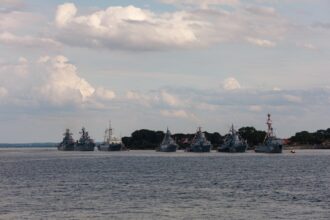
In the context of Cold War maritime operations, the activities of Soviet trawlers shadowing the Glomar Explorer have been a topic of significant interest among historians and military analysts. These trawlers were not merely fishing vessels; they played a crucial role in intelligence gathering and surveillance. For a deeper understanding of the strategic implications of these operations, you can read a related article that explores the intricate dynamics of naval espionage during this period. For more information, visit this article.
The Shadowy Ballet: Soviet Trawlers in the Vicinity
The presence of Soviet trawlers in the operational area of the Glomar Explorer was an undeniable, albeit often unacknowledged, aspect of the mission. These vessels, seemingly ordinary fishing boats, played a far more complex role in the Cold War maritime landscape.
The Nature of Soviet Trawlers
Soviet fishing fleets operated on a global scale, a significant component of the Soviet economy and a pervasive presence on the world’s oceans. These were not your average small-scale fishing boats. Soviet trawlers were often large, factory ships equipped with sophisticated sonar and processing facilities, capable of extended voyages and operating in distant waters. Their sheer numbers meant their presence in international shipping lanes and fishing grounds was a common occurrence. However, in the context of Project Azorian, their proximity to the Glomar Explorer was far from coincidental.
The Intelligence-Gathering Function
It is widely understood that many Soviet trawlers served a dual purpose. Beyond their stated fishing activities, they were equipped with extensive electronic intelligence (ELINT) and signals intelligence (SIGINT) gathering equipment. These vessels were effectively mobile listening posts, capable of monitoring radio communications, radar signals, and other electromagnetic emissions from passing ships and aircraft. Their innocuous civilian guise made them ideal for covert surveillance. In the vicinity of the Glomar Explorer, these trawlers would have been keenly interested in the ship’s activities, its communications, and any unusual movements.
Intercepting Communications
Surveillance and Reconnaissance
The presence of Soviet trawlers provided the USSR with an invaluable opportunity for direct, real-time observation. They could track the movements of the Glomar Explorer, observe the deployment of its specialized equipment, and potentially even gauge the scale and nature of the operation. This close proximity allowed for detailed photographic and visual intelligence gathering. The Soviet Union, locked in a technological and ideological arms race with the United States, would have spared no effort in understanding the capabilities and objectives of such a unique American vessel. The trawlers acted as the eyes and ears of the Soviet Union, observing the intricate choreography of Project Azorian from a seemingly detached distance.
Documenting Deployment Sequences
A Constant Undercurrent of Suspicion
For the crew of the Glomar Explorer, the constant presence of these Soviet vessels would have been a palpable reminder of the high-stakes environment in which they operated. Although direct confrontation was unlikely and would have been politically disastrous, the knowledge that they were being watched would have cast a long shadow over the proceedings. It underscored the broader Cold War context, where every significant technological advancement or strategic maneuver by one superpower was met with intense scrutiny and counter-intelligence by the other. The trawlers were the silent sentinels, a constant, low-frequency hum of awareness in the background of the deep-sea operation.
The Mission Deeper Than the Mariana Trench: Project Azorian’s Goal
The Glomar Explorer‘s primary mission was not about oil exploration or deep-sea research, as its cover story suggested. Its true objective was far more clandestine and strategically significant: the recovery of the Soviet submarine K-129.
The Loss of the K-129
In March 1968, the K-129, a Project 629 (Golf-class) diesel-electric submarine, sank in the Pacific Ocean, approximately 1,500 nautical miles northwest of Hawaii. The submarine was reportedly on a mission to test a new Soviet intercontinental ballistic missile. The exact circumstances of its demise remain uncertain, with theories ranging from an internal explosion to a collision with a US naval vessel (though the latter is highly disputed and unlikely). What is certain is that the wreck lay on the seabed at a depth of approximately 16,000 feet (nearly 5,000 meters). This depth presented an unprecedented challenge for recovery.
Retrieving Soviet Secrets
The strategic importance of recovering the K-129 was immense. The submarine carried three nuclear ballistic missiles, as well as advanced Soviet cryptographic equipment and weaponry. If successfully recovered, the United States would gain invaluable intelligence regarding Soviet missile technology, operational procedures, and code-breaking capabilities. The potential to understand Soviet nuclear strategy and develop countermeasures was a powerful motivator for the enormous investment in Project Azorian. The recovery was, in essence, an attempt to pluck a vital organ from the Soviet military machine and examine it at leisure in the laboratories of the West.
Understanding Ballistic Missile Technology
Deciphering Soviet Cryptography
The Magnitude of the Undertaking
The technical hurdles involved in retrieving a submarine from such extreme depths were staggering. Conventional dredging and lifting methods were wholly inadequate. The pressure at 16,000 feet is immense, capable of crushing even the strongest vessels. The Glomar Explorer‘s innovative design, with its large moonpool and sophisticated lifting system, was specifically engineered to overcome these obstacles. The operation required pinpoint accuracy in maneuvering the salvage equipment, the ability to withstand immense pressure, and the strength to lift thousands of tons of steel from the ocean floor. It was a feat of engineering that pushed the boundaries of what was thought possible.
Overcoming Extreme Pressure
Precision Maneuvering in the Abyss
The Role of Other Vessels in the Operation
While the Glomar Explorer was the star of the show, its performance relied on a supporting cast of other vessels and a carefully orchestrated logistical effort. The vastness of the Pacific Ocean required a coordinated response to ensure the mission’s success and security.
Support Ships and Logistics
Beyond the Glomar Explorer, Project Azorian involved a fleet of support vessels. These ships played crucial roles in maintaining the operational continuity of the primary salvage vessel and in facilitating the complex logistics of such an ambitious undertaking.
Supply and Provisions
Medical and Personnel Support
Auxiliary Naval Presence
While not directly involved in the salvage operation itself, the tacit presence of the U.S. Navy would have been a significant deterrent and a safeguarding measure. The Navy’s role was likely to provide a discreet but present “umbrella” of protection, ensuring that no hostile naval forces interfered with the Glomar Explorer‘s operations. This might have involved naval patrols in the wider area, though direct escort of the civilian-disguised ship would have compromised the secrecy of the operation. The Navy’s silent vigilance acted as a bodyguard, ensuring the mission could proceed without external disruption.
Deterrence of Interference
The Intelligence Network
The success of Project Azorian was not solely dependent on the physical recovery of the submarine. A sophisticated intelligence network was crucial for identifying the K-129’s location, tracking Soviet naval movements, and assessing the risk of detection. This network likely involved signals intelligence, reconnaissance aircraft, and U.S. intelligence assets operating in the region. The intelligence gathered on the Soviet trawlers themselves would have been a critical component of this network, providing insights into their capabilities and intentions.
Locating the Wreckage
Monitoring Soviet Activity
In the midst of Cold War tensions, the Soviet trawlers that shadowed the Glomar Explorer played a crucial role in the intricate game of espionage and intelligence gathering at sea. These vessels, often disguised as fishing boats, were tasked with monitoring the activities of the Glomar Explorer, which was engaged in the secretive recovery of a sunken Soviet submarine. For a deeper understanding of the geopolitical implications of these maritime maneuvers, you can read more in this insightful article on the subject at In the War Room. The cat-and-mouse dynamic between the two nations in international waters highlights the lengths to which they would go to protect their secrets.
The Broader Implications of the Underwater Chess Match
| Metric | Details |
|---|---|
| Event | Soviet trawlers shadowing Glomar Explorer |
| Time Period | 1970s |
| Location | Pacific Ocean, near Hawaii |
| Number of Soviet Trawlers | Approximately 3-5 vessels |
| Purpose of Glomar Explorer | Secret CIA project to recover sunken Soviet submarine |
| Duration of Shadowing | Several weeks during recovery operations |
| Outcome | Glomar Explorer successfully recovered submarine sections despite surveillance |
The operation of the Glomar Explorer and the shadowing by Soviet trawlers were microcosms of the larger Cold War struggle, a silent battle waged not with missiles and bombs, but with technology, intelligence, and strategic maneuvering.
The Arms Race in the Deep
The Glomar Explorer represented a significant leap in deep-sea recovery technology, a direct response to the evolving capabilities of the Soviet Union. Its success, or even its attempt, spurred further innovation on both sides of the Iron Curtain. This was an arms race that extended beyond the skies and the battlefield, reaching into the unexplored depths of the ocean. Projects like Azorian highlighted the growing importance of the maritime domain in the Cold War, not just for traditional naval power projection, but for intelligence gathering and advanced technological competition.
The Game of Deception
The entire operation was a masterclass in deception. The Glomar Explorer‘s elaborate cover story, the use of a civilian corporation, and the careful management of information were all designed to mask the true nature of the mission from the Soviet Union and the wider world. The Soviets, in turn, used their apparent fishing vessels for their own intelligence gathering, participating in their own game of deception by presenting an innocuous front for their surveillance activities. This constant interplay of masks and hidden intentions was a hallmark of Cold War espionage.
The Unseen Frontier of Conflict
The depths of the ocean became an unseen frontier of conflict. While the surface world was aware of the overt military build-ups and political tensions, the silent competition in the deep was largely unknown. The Glomar Explorer and the Soviet trawlers were players in this hidden arena, their actions having potential strategic implications that echoed far beyond the immediate operational area. The recovery of the K-129, while partially successful, provided the U.S. with a significant intelligence windfall, demonstrating the ongoing importance of adapting to new technological frontiers in the face of a formidable adversary. The waters where the Glomar Explorer sailed were, and remain, a silent testament to the enduring complexities of international relations and the unceasing quest for strategic advantage.
WARNING: The $800 Million Mechanical Failure That Almost Started WWIII
FAQs
What was the Glomar Explorer?
The Glomar Explorer was a deep-sea drilling ship built by the United States in the early 1970s. It was designed for a secret CIA mission called Project Azorian, which aimed to recover a sunken Soviet submarine from the ocean floor.
Why were Soviet trawlers shadowing the Glomar Explorer?
Soviet trawlers were shadowing the Glomar Explorer to monitor its activities and gather intelligence. The Soviets suspected that the ship was involved in espionage or military operations near their territorial waters.
Where did the Glomar Explorer operate when it was shadowed by Soviet trawlers?
The Glomar Explorer operated primarily in the Pacific Ocean, near the location where the Soviet submarine K-129 sank in 1968. This area was of strategic interest to both the United States and the Soviet Union during the Cold War.
How did the presence of Soviet trawlers affect the Glomar Explorer’s mission?
The presence of Soviet trawlers complicated the Glomar Explorer’s mission by increasing the risk of detection and confrontation. The ship had to take measures to avoid direct contact and maintain secrecy while conducting its deep-sea recovery operations.
What was the outcome of the Glomar Explorer’s mission despite Soviet surveillance?
Despite Soviet surveillance, the Glomar Explorer successfully recovered a portion of the sunken Soviet submarine K-129 in 1974. However, much of the operation remained classified for many years, and the full details of the mission were not publicly disclosed until decades later.