Project Azorian, a clandestine operation spearheaded by the Central Intelligence Agency (CIA) in the 1970s, stands as one of the most ambitious and audacious salvage missions ever attempted. Its objective was to recover a sunken Soviet submarine, the K-129, from the crushing depths of the Pacific Ocean. This undertaking was not merely a technical marvel; it was a high-stakes poker game played in the unforgiving arena of international espionage, with the fate of vital intelligence hanging in the balance. The story of Project Azorian is a testament to human ingenuity, resolve, and the intricate and often morally ambiguous nature of intelligence gathering.
The Catastrophic Loss
The tale of Project Azorian begins with a tragedy at sea. On March 11, 1968, the Soviet Golf II-class ballistic missile submarine K-129, a vessel bristling with nuclear potential and operational secrets, vanished without a trace. Her last known position was approximately 1,560 nautical miles northwest of Hawaii. The silence that followed her disappearance was deafening, a void that suggested a catastrophic event rather than a simple loss of contact. The Soviet Union launched an extensive search, but their efforts, hampered by technological limitations and the sheer vastness of the ocean, proved fruitless. The K-129 and her 98 crew members were swallowed by the abyss, becoming a silent, spectral sentinel in the Pacific’s unyielding embrace.
The Intelligence Imperative
For the United States, the loss of the K-129 represented a monumental intelligence opportunity. This submarine was equipped with nuclear missiles, and its intact recovery could provide invaluable insights into Soviet naval capabilities, missile technology, and operational doctrines. The potential for reverse-engineering Soviet technology or understanding their strategic thinking was immense. The CIA, ever the keen observer of global power dynamics, recognized that the K-129’s wreckage was a treasure trove of classified information, a digital time capsule frozen in the moment of its demise. To leave it undisturbed would be akin to leaving a loaded gun unguarded.
The CIA’s Project Azorian, which aimed to recover a sunken Soviet submarine from the depths of the Pacific Ocean, is a fascinating chapter in Cold War history. For those interested in exploring more about the intricacies of this covert operation and the technology behind the capture vehicle, a related article can be found at this link. This resource delves into the engineering challenges and the strategic implications of the project, providing a comprehensive overview of one of the most ambitious underwater recovery missions ever undertaken.
The Genesis of a Bold Endeavor
The Birth of an Idea
The sheer audacity of the proposed mission was staggering. Recovering a submarine from nearly 16,000 feet of water was a feat that pushed the boundaries of what was considered technologically possible. The idea was born within the rarefied air of intelligence agencies, where the impossible is often merely a challenge to be overcome. The initial concept was audacious: to build a specialized vessel capable of not only locating the wreck but also lifting it to the surface. This was not a simple retrieval; it was an extraction from the very jaws of the Earth’s crust.
Securing the Resources
Translating an idea into reality required an immense commitment of resources, both financial and technological. The project, codenamed Azorian, was shrouded in the deepest secrecy, its existence known only to a select few within the highest echelons of government and intelligence. The budget for Azorian was astronomical, a veritable colossus of funding that would dwarf many conventional military operations. This level of investment underscored the perceived importance of the mission and the willingness of the US government to go to extraordinary lengths for intelligence advantage. The project became a black hole of expenditure, consuming vast sums with little public accounting.
The Technological Marvel: The Hughes Glomar Explorer
A Ship of Unprecedented Design
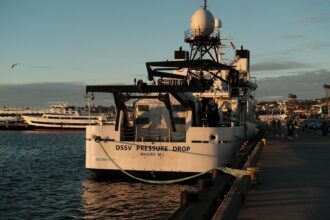
At the heart of Project Azorian lay a ship unlike any other: the Hughes Glomar Explorer. This colossal vessel, a technological marvel in its own right, was designed and built by Summa Corporation, a company owned by the eccentric billionaire Howard Hughes. The true purpose of the Glomar Explorer was concealed behind a legitimate-sounding guise: deep-sea mining. This provided the perfect cover, a plausible explanation for a ship equipped with highly specialized and powerful lifting equipment. The ship itself was a testament to American industrial prowess, a floating fortress of ingenuity.
The Capture Vehicle: The “Clementine”
The operational core of the Glomar Explorer was a sophisticated lifting system and a specialized submersible vehicle, unofficially nicknamed “Clementine.” This immense claw-like device was designed to descend thousands of feet, grapple the K-129, and then, with agonizing slowness, lift it to the surface. The engineering challenges were immense. The pressure at such depths is crushing, capable of reducing steel to mere filings. The currents were powerful, and the seabed itself was a treacherous, uneven landscape. Clementine was a testament to the precision engineering required to operate in such an unforgiving environment. It was a delicate instrument designed to perform a brutal surgery on the ocean floor.
The Shadowy Operation: Deception and Discovery
The Search Mission
Once operational, the Glomar Explorer embarked on its clandestine mission. For months, the vessel patrolled the predetermined area of the Pacific, its sophisticated sonar and other detection systems constantly scanning the abyss. The search itself was a delicate dance, a constant game of cat and mouse with Soviet vessels and aircraft that might be monitoring its activities. The intelligence community worked tirelessly to ensure the operation remained undetected, a ghostly presence in the ocean’s vast expanse. Every movement, every transmission was meticulously planned to maintain the illusion of a mining expedition.
The Moment of Truth
In July 1974, after years of planning and millions of dollars invested, the Glomar Explorer finally located the wreck of the K-129. The relief and excitement within the CIA must have been palpable, a surge of adrenaline after a long and arduous vigil. The target, a ghost from the deep, had been found. The challenge now shifted from finding to retrieving, a task that would test the limits of the Glomar Explorer‘s capabilities and the resolve of its crew. The recovered wreckage was a tantalizing prize, but the true extent of what could be salvaged remained uncertain.
The CIA’s Project Azorian, which aimed to recover a sunken Soviet submarine from the depths of the Pacific Ocean, is a fascinating example of Cold War ingenuity and secrecy. For those interested in learning more about the intricacies of this operation, a related article can be found at In The War Room, where the complexities of intelligence operations and their impact on global politics are explored in depth. This project not only showcased advanced engineering but also highlighted the lengths to which nations would go to gain an advantage over their adversaries.
The Retrieval and its Aftermath
| Metric | Details |
|---|---|
| Project Name | Azorian |
| Purpose | Recovery of Soviet submarine K-129 |
| Capture Vehicle Name | Hercules |
| Length of Capture Vehicle | Approximately 98 feet (30 meters) |
| Weight of Capture Vehicle | Estimated 2,000 tons |
| Operating Depth | Approximately 16,500 feet (5,000 meters) |
| Recovery Method | Hydraulic claw to grasp submarine section |
| Mother Ship | Glomar Explorer |
| Year of Operation | 1974 |
| Outcome | Partial recovery of submarine section |
The Partial Success
The retrieval operation was a complex and nerve-wracking affair. The Glomar Explorer successfully lifted a significant portion of the K-129’s hull to the surface. However, the operation was not without its setbacks. The extreme pressure and the passage of time had taken their toll on the submarine, and parts of the wreck, including some of the missile tubes and perhaps crucial technical components, were lost during the ascent. The recovered section was immense, a fragmented leviathan brought back from the crushing depths.
The Unveiling of Secrets
The contents of the recovered section of the K-129 provided the CIA with a wealth of intelligence. While not every secret was perfectly preserved, the salvaged materials offered invaluable insights into Soviet naval technology, including their ballistic missile systems and operational procedures. The cryptographic materials and technical manuals, even if damaged, provided critical puzzle pieces for intelligence analysts. Project Azorian, despite its partial success, was highly effective in achieving its primary intelligence objectives. It was a surgical strike into the heart of Soviet naval secrets.
The Lingering Mysteries and Deniability
Despite the operational success, much of Project Azorian remained shrouded in secrecy for decades. The true nature of the Glomar Explorer‘s mission was not officially acknowledged by the US government until 1998, a testament to the enduring need for deniability in such sensitive intelligence operations. The Soviet Union, while aware of the salvage attempt, never officially confirmed the extent of their knowledge or their own recovery efforts of any remaining debris. The operation left behind a trail of whispers and unanswered questions, a phantom of the Cold War that continued to fascinate and intrigue. The K-129, and thus Azorian, remains a powerful symbol of the hidden battles waged in the silent, unseen arenas of international espionage.
WARNING: The $800 Million Mechanical Failure That Almost Started WWIII
FAQs
What was the CIA Project Azorian capture vehicle?
Project Azorian was a secret CIA operation in the early 1970s aimed at recovering a sunken Soviet submarine from the Pacific Ocean floor. The capture vehicle was a specially designed underwater recovery system used to lift the submarine wreckage from a depth of about 16,500 feet.
Why was the capture vehicle important for Project Azorian?
The capture vehicle was crucial because it enabled the CIA to retrieve parts of the Soviet submarine intact from extreme ocean depths, which was previously considered nearly impossible. Its design allowed for the secure lifting and containment of the submarine sections during the recovery operation.
How was the capture vehicle deployed during the operation?
The capture vehicle was lowered from the specially modified ship, the Hughes Glomar Explorer, to the ocean floor. It used a claw-like mechanism to grasp the submarine wreckage and then lifted it back to the surface for analysis.
What challenges did the capture vehicle face during the recovery?
The main challenges included operating at great depths with high pressure, maintaining stability in rough ocean conditions, and securely gripping the fragile submarine wreckage without causing further damage.
What was the outcome of using the capture vehicle in Project Azorian?
The capture vehicle successfully recovered a significant portion of the Soviet submarine K-129, providing valuable intelligence to the United States. However, part of the submarine broke off during the lift and was lost back to the ocean floor. Despite this, the operation was considered a technical and intelligence success.