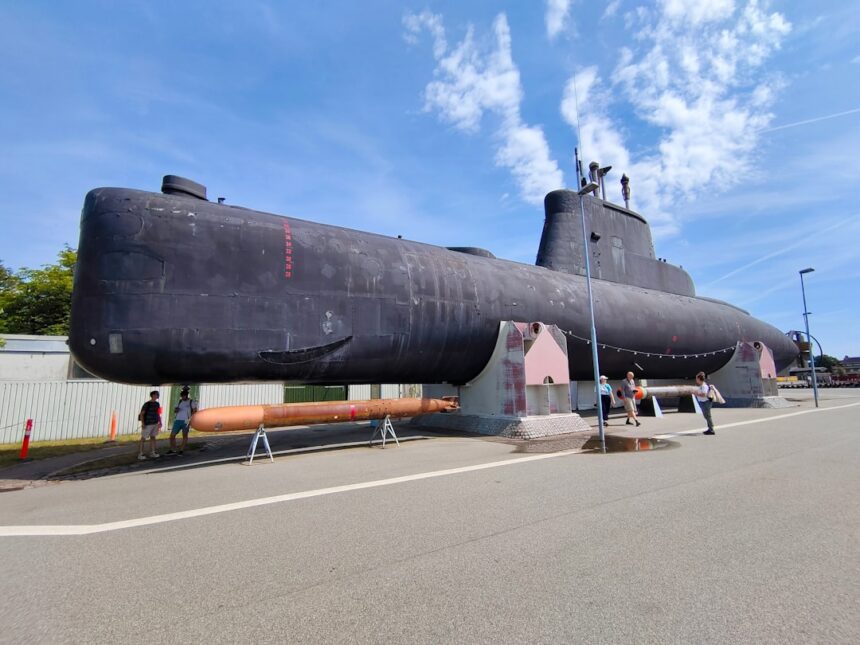
The Victor III submarine class represents a significant advancement in Soviet underwater warfare technology during the Cold War era. Designated Project 671RTM by the Soviet Union, these nuclear-powered attack submarines were developed in the 1970s and 1980s to enhance the Soviet Navy’s anti-submarine warfare capabilities and strategic deterrence posture. The class incorporated notable technological improvements over its predecessors, including reduced acoustic signatures through advanced hull design and sound-dampening materials, upgraded sonar systems for enhanced detection capabilities, and modernized weapon systems capable of deploying both torpedoes and anti-ship missiles.
The Victor III class submarines featured a double-hull construction with a length of approximately 107 meters and a submerged displacement of around 6,000 tons. Their nuclear propulsion systems enabled sustained underwater operations at speeds exceeding 30 knots submerged. The submarines were equipped with six 533mm torpedo tubes and could carry a variety of weapons including torpedoes, mines, and submarine-launched cruise missiles.
A total of 26 Victor III submarines were constructed between 1978 and 1991, serving as the backbone of the Soviet submarine fleet’s attack capabilities during the final decades of the Cold War.
Key Takeaways
- The Victor III submarine class represents a significant advancement in Soviet/Russian underwater warfare technology.
- It features enhanced stealth, improved sonar systems, and advanced weaponry compared to earlier Victor classes.
- The submarine is equipped with powerful torpedoes and missile systems, boosting its offensive capabilities.
- Propulsion improvements allow for greater speed and quieter operation, enhancing mission effectiveness.
- Ongoing modernization efforts aim to keep the Victor III relevant in contemporary naval conflicts.
History and Development of the Victor III Submarine
The development of the Victor III submarine class began in the late 1960s, as the Soviet Union sought to enhance its underwater fleet in response to emerging threats from NATO forces. The design process was influenced by lessons learned from previous classes, particularly the Victor I and II submarines, which had already established a foundation for advanced underwater capabilities. The first vessel of the Victor III class was commissioned in 1976, and it quickly became evident that this new class would play a crucial role in the Soviet Navy’s strategic posture.
Throughout its development, the Victor III class underwent several modifications to improve its performance and operational effectiveness. Engineers focused on enhancing stealth features, allowing these submarines to operate undetected in hostile waters. The incorporation of advanced sonar systems and improved hull designs contributed to their ability to evade enemy detection while maintaining a formidable presence beneath the waves.
As a result, the Victor III submarines became a symbol of Soviet naval power during a time of intense geopolitical rivalry.
Key Features and Capabilities of the Victor III Submarine
One of the standout features of the Victor III submarine class is its remarkable stealth capabilities. The design incorporates sound-dampening technologies and an innovative hull shape that minimizes noise production, allowing these submarines to operate covertly. This stealth advantage is crucial for conducting surveillance missions and engaging enemy vessels without being detected.
The ability to remain hidden beneath the surface enhances their effectiveness in both offensive and defensive operations.
These systems enable the submarines to detect and track enemy vessels at great distances, giving them a tactical edge in naval engagements.
Furthermore, their ability to operate at significant depths allows them to evade detection while gathering intelligence or preparing for an attack. The combination of stealth and advanced sensor technology positions the Victor III class as a formidable force in modern naval warfare.
Comparison with Previous Victor Class Submarines
When comparing the Victor III class to its predecessors, such as the Victor I and II submarines, several key differences emerge. While earlier models laid the groundwork for advanced submarine design, the Victor III class introduced significant enhancements in terms of stealth, speed, and weaponry. The improvements made in hull design and noise reduction technologies set the Victor III apart from earlier iterations, allowing it to operate more effectively in contested waters.
Moreover, the Victor III submarines feature upgraded weapon systems that reflect advancements in missile technology. This class is capable of launching a variety of torpedoes and cruise missiles, expanding its operational versatility beyond what was possible with earlier models. The integration of these advanced weapon systems not only increases their lethality but also enhances their role as multi-mission platforms capable of engaging various threats across different maritime environments.
Armament and Weapon Systems
| Metric | Specification |
|---|---|
| Class Name | Victor III |
| Type | Attack Submarine (SSN) |
| Country of Origin | Russia (Soviet Union) |
| Displacement (surfaced) | 4,600 tons |
| Displacement (submerged) | 6,000 tons |
| Length | 104 meters |
| Beam | 9.2 meters |
| Draft | 8.8 meters |
| Propulsion | 1 × pressurized water reactor, 1 shaft |
| Speed (submerged) | 35 knots |
| Test Depth | 400 meters |
| Endurance | 60 days |
| Crew | 78 personnel |
| Armament | 6 × 533 mm torpedo tubes, torpedoes, SS-N-15 anti-submarine missiles |
| Commissioned | 1979 – 1990 |
The armament of the Victor III submarine class is one of its most impressive attributes, designed to ensure dominance in underwater combat scenarios. These submarines are equipped with a range of torpedoes capable of engaging surface ships and other submarines effectively. The torpedo launchers are strategically positioned to allow for rapid engagement with minimal exposure, enhancing their survivability during combat operations.
In addition to torpedoes, the Victor III submarines can deploy cruise missiles that extend their strike capabilities beyond traditional underwater engagements. This versatility allows them to target land-based installations or enemy vessels from significant distances while remaining submerged. The combination of torpedoes and cruise missiles positions the Victor III class as a potent threat in any naval confrontation, capable of adapting to various mission requirements.
Propulsion and Performance
The propulsion system of the Victor III submarine class is another area where significant advancements have been made compared to earlier models. These submarines utilize a nuclear propulsion system that provides them with virtually unlimited range and endurance. This capability allows them to remain submerged for extended periods without the need for refueling, giving them a strategic advantage during long-term deployments.
In terms of performance, the Victor III submarines are designed for high-speed maneuvers while maintaining stealth. Their streamlined hull design reduces drag, enabling them to reach impressive speeds underwater. This combination of speed and endurance allows them to respond rapidly to emerging threats or reposition themselves strategically during operations.
The propulsion system’s efficiency further enhances their operational capabilities, making them a formidable presence in any naval theater.
Sensors and Communication Systems
The sensors and communication systems aboard the Victor III submarine class are integral to its operational effectiveness. Advanced sonar arrays provide comprehensive situational awareness, allowing these submarines to detect enemy vessels and gather intelligence on maritime activities. The integration of passive and active sonar systems enhances their ability to operate undetected while still maintaining awareness of their surroundings.
Communication systems on board are equally sophisticated, enabling secure data transmission between vessels and command centers. This capability is crucial for coordinating operations with other naval assets and ensuring that commanders have real-time information about the submarine’s status and mission objectives. The combination of advanced sensors and communication technologies positions the Victor III class as a highly capable platform for modern naval warfare.
Crew Accommodations and Living Conditions
The living conditions aboard the Victor III submarines reflect a balance between operational efficiency and crew comfort. Designed to accommodate a crew of approximately 100 personnel, these submarines feature living quarters that prioritize functionality while providing essential amenities. Crew members have access to sleeping quarters, dining areas, and recreational facilities that help maintain morale during extended deployments.
Despite the confined space typical of submarines, efforts have been made to ensure that crew members can perform their duties effectively while also having opportunities for rest and relaxation. The design includes areas for physical exercise and social interaction, which are vital for maintaining mental well-being during long missions beneath the waves. Overall, the accommodations aboard the Victor III submarines demonstrate a commitment to supporting crew welfare while maximizing operational readiness.
Operational Deployment and Missions
The operational deployment of Victor III submarines has varied throughout their service history, reflecting changing geopolitical dynamics and naval strategies. Initially designed for anti-submarine warfare during the Cold War, these submarines have since adapted to a broader range of missions, including intelligence gathering, surveillance, and strike operations against surface targets. Their versatility has allowed them to remain relevant in contemporary naval engagements.
Victor III submarines have participated in numerous exercises and operations across various theaters, showcasing their capabilities in joint exercises with other naval forces. Their ability to operate independently or as part of a larger task force enhances their strategic value in modern naval warfare. As global maritime security challenges evolve, these submarines continue to play a critical role in maintaining deterrence and ensuring maritime stability.
Future Upgrades and Modernization
As military technology advances at an unprecedented pace, plans for future upgrades and modernization of the Victor III submarine class are underway. These enhancements aim to incorporate cutting-edge technologies that will further improve stealth capabilities, sensor systems, and weaponry. By integrating new technologies into existing platforms, navies can extend the operational life of these submarines while ensuring they remain competitive against emerging threats.
Future upgrades may include advanced missile systems capable of engaging land targets with precision or enhanced electronic warfare capabilities that allow for better countermeasures against enemy detection systems. Additionally, improvements in automation and artificial intelligence could streamline operations aboard these submarines, reducing crew workload while enhancing overall mission effectiveness. Such modernization efforts will ensure that the Victor III class continues to be a vital asset in naval arsenals around the world.
The Role of the Victor III Submarine in Modern Naval Warfare
In conclusion, the Victor III submarine class stands as a testament to advancements in underwater warfare technology and strategic naval capabilities. Its development reflects a response to evolving threats during a critical period in global history, while its features ensure its relevance in contemporary military operations. With superior stealth capabilities, advanced weaponry, and versatile operational roles, these submarines play an essential part in modern naval warfare.
As nations continue to navigate complex maritime security challenges, understanding the capabilities and historical significance of the Victor III class provides valuable insights into future naval strategies. The ongoing modernization efforts will likely enhance its role further, ensuring that it remains a formidable presence beneath the waves for years to come. Ultimately, the Victor III submarine class exemplifies how technological innovation can shape military power dynamics on a global scale.
The Victor III submarine class, known for its advanced capabilities and stealth features, has been a significant part of naval warfare since its introduction. For a deeper understanding of its operational history and technological advancements, you can read more in this related article on the topic at In The War Room. This resource provides valuable insights into the strategic implications of the Victor III class in modern naval engagements.
FAQs
What is the Victor III submarine class?
The Victor III submarine class is a series of nuclear-powered attack submarines developed and operated by the Soviet Union and later by Russia. They are known for their improved stealth capabilities and advanced sonar systems compared to earlier Victor classes.
When was the Victor III submarine class introduced?
The Victor III class was introduced in the late 1970s and early 1980s as an upgrade to the earlier Victor I and Victor II classes, with the first vessel commissioned in 1979.
What are the primary roles of Victor III submarines?
Victor III submarines are primarily designed for anti-submarine warfare (ASW), anti-surface ship warfare, and intelligence gathering. They are capable of engaging enemy submarines and surface vessels using torpedoes and missiles.
What are the key features of the Victor III class?
Key features include improved acoustic stealth, a more hydrodynamic hull design, advanced sonar and electronic warfare systems, and the ability to launch torpedoes and cruise missiles. They also have enhanced noise reduction technologies compared to earlier Victor classes.
How many Victor III submarines were built?
A total of 14 Victor III submarines were constructed between 1979 and 1990.
What is the displacement and size of a Victor III submarine?
Victor III submarines typically have a submerged displacement of around 6,000 tons, with a length of approximately 100 meters (328 feet).
What type of propulsion system do Victor III submarines use?
They are powered by a nuclear reactor driving a steam turbine, which in turn powers a single propeller, allowing for high underwater speeds and extended operational range.
Are Victor III submarines still in service?
As of the early 2020s, most Victor III submarines have been retired or are in reserve status, with some possibly still in limited service or used for training purposes by the Russian Navy.
What countries operate Victor III submarines?
Victor III submarines were exclusively operated by the Soviet Union and later by the Russian Navy. No other countries have operated this class.
How do Victor III submarines compare to Western submarines?
Victor III submarines were considered competitive during their time, with significant improvements in stealth and sonar capabilities. However, Western submarines, such as the U.S. Los Angeles class, generally had advantages in noise reduction and sensor technology.