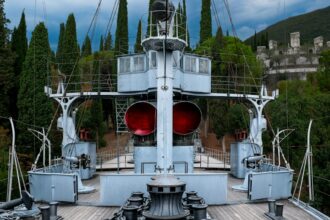
The Cold War, a period of pervasive geopolitical tension, fostered an environment ripe for audacious espionage. Amidst this climate, nations engaged in a constant struggle for intelligence supremacy, leading to operations of extraordinary complexity and secrecy. One such operation, known as Project Azorian, stands as a testament to the lengths to which intelligence agencies would go to acquire crucial information. This article delves into the intricacies of Project Azorian, focusing on the remarkable engineering feat of the Hughes Glomar Explorer and its enigmatic “moon pool,” a pivotal component in this high-stakes underwater retrieval.
The Genesis of a Grand Design
The seeds of Project Azorian were sown in 1968, a year marked by a significant maritime incident that would ultimately set in motion one of the most ambitious covert operations in history. The Soviet Union, a formidable naval power, experienced a devastating loss that year, a loss they were desperate to conceal.
The K-129 Incident: A Sunken Secret
On March 8, 1968, the Soviet Golf II-class ballistic missile submarine K-129, carrying three R-21 nuclear ballistic missiles, disappeared without a trace in the Pacific Ocean. The Soviet Navy conducted an extensive, albeit ultimately unsuccessful, search for its missing vessel. The K-129, a silent behemoth of the deep, had vanished into the abyss, leaving behind a lacuna in Soviet strategic capabilities and a tantalizing intelligence target for the United States.
US Intelligence Locates the Wreck
Unbeknownst to the Soviets, the United States, through its sophisticated underwater listening network known as SOSUS (Sound Surveillance System), had detected acoustic anomalies consistent with an implosion at a specific location in the Pacific. Further analysis and the deployment of specialized deep-sea reconnaissance vessels, notably the USS Halibut (SSN-587), confirmed the location of the K-129 wreck. Lying at an extraordinary depth of approximately 16,000 feet (4,900 meters) northwest of Hawaii, the submarine presented an unprecedented challenge and opportunity for intelligence gathering. The potential prize was immense: Soviet codebooks, cryptographic equipment, and, most significantly, a complete R-21 ballistic missile, offering invaluable insights into Soviet nuclear capabilities.
The Engineering Marvel: The Hughes Glomar Explorer
The decision to attempt retrieval of the K-129 was a momentous one, fraught with immense technical and political risks. No nation had ever attempted to recover an object of such size and weight from such extreme depths. To accomplish this, a vessel of unprecedented design and capability was required – a mobile platform capable of precise deep-sea operations, while simultaneously concealing its true purpose.
Concealing the True Mission: Project Azorian’s Elaborate Veil
To mask the audacious nature of the operation, the Central Intelligence Agency (CIA) orchestrated an elaborate cover story. The project was publicly presented as a legitimate deep-sea mining venture, a pioneering effort to extract manganese nodules from the ocean floor. Howard Hughes, the enigmatic billionaire industrialist, was recruited as the public face of this enterprise. His name lent credibility to the endeavor, as he was known for his ambitious and often unconventional projects. The vessel itself, the Hughes Glomar Explorer, was ostensibly designed for deep-sea mineral exploration, its unique features attributed to the demands of this novel industry. This elaborate deception, a carefully constructed façade, was essential to prevent Soviet interference or an international diplomatic incident.
The Revolutionary “Moon Pool” and Capture Vehicle
The heart of the Hughes Glomar Explorer‘s technological prowess lay in its revolutionary “moon pool” and the colossal mechanical claw designed to retrieve the K-129. The moon pool, a massive opening in the center of the ship’s hull, effectively created a protected, calm environment in the open ocean. This allowed for the deployment and recovery of large objects from the depths, shielded from the elements.
Below the moon pool was housed the “Clementine,” the massive capture vehicle – a specialized grapple built to withstand immense pressures and carefully designed to envelop and lift sections of the K-129. This gargantuan mechanical claw, a testament to Cold War ingenuity, was equipped with sophisticated sensors and cameras to guide its descent and ensure proper engagement with the wreck. Imagine, if you will, the ship as a kind of colossal ocean-going surgical theater, with the moon pool as the sterile, enclosed operating space, and the Clementine as the precision instrument delicately reaching into the unseen depths.
Dynamic Positioning System: Holding Steady in the Storm
Operating at such extreme depths required unparalleled stability. The Hughes Glomar Explorer was equipped with a state-of-the-art dynamic positioning system (DPS), a marvel of 1970s maritime technology. This system utilized a network of thrusters and sophisticated computer controls to maintain the ship’s position directly over the target, even in challenging sea conditions. This precision was paramount for the delicate dance of lowering and raising the capture vehicle, a process that could take days or even weeks. Without such a system, the operation would have been akin to trying to thread a needle in a hurricane.
The Retrieval Operation: A High-Stakes Deep-Sea Ballet
With the Hughes Glomar Explorer at sea, the retrieval operation commenced, a perilous and protracted undertaking that tested the limits of human endurance and technological capability. The entire operation was a delicate choreography, a high-stakes ballet performed thousands of feet beneath the surface.
Initial Attempts and Mechanical Failures
The initial attempts to recover the K-129 were fraught with difficulties. The sheer size and weight of the sunken submarine, combined with the immense pressures at such depths, presented formidable engineering challenges. The Clementine, despite its robust construction, encountered several mechanical failures. As the grapple slowly descended and attempted to engage with the submarine, sections of the K-129, severely weakened by years on the seabed and the initial implosion, proved fragile. The harsh reality of deep-sea salvage is that once disturbed, a structure can often disintegrate further. This vulnerability was a constant concern, a ticking clock against the relentless forces of the deep.
The Partial Recovery: A Glimmer of Success
Despite the setbacks, Project Azorian achieved a partial success. In the summer of 1974, after weeks of painstaking maneuvers, a significant portion of the K-129’s forward section, estimated to be about one-third of the submarine, was successfully lifted from the seabed. This section reportedly contained two nuclear torpedoes, codebooks, and various intelligence materials. The recovery of this “payload” was a monumental achievement, a tangible victory in the shadowy intelligence war. The moment of its arrival within the moon pool must have been one of profound relief and exhilaration for the crew and the intelligence operatives overseeing the project.
The Subsequent Loss: A Twist of Fate
However, the complete retrieval of the K-129 was not to be. During the final stage of lifting, a significant portion of the remaining submarine broke away from the Clementine. This catastrophic failure, occurring near the surface, sent a large section of the wreck plummeting back into the abyss. The precise reasons for this failure remain subject to speculation, but it was likely a combination of the submarine’s compromised structural integrity and the immense stresses of the lifting operation. This dramatic turn of events underscored the inherent risks of deep-sea salvage, a stark reminder of the unforgiving nature of the ocean.
The Unveiling: Leakage and Aftermath
Despite the extraordinary measures taken to maintain secrecy, Project Azorian was ultimately exposed, leading to significant political and public ramifications. The carefully constructed façade, a monument to deception, eventually crumbled under the weight of sustained inquiry and a crucial leak.
The “Greatest Covert Operation”: A Whispered Secret
For years, details of Project Azorian remained a closely guarded secret, known only to a select few within the intelligence community and government. The retrieved section of the K-129 was meticulously analyzed, yielding invaluable intelligence on Soviet submarine design, nuclear weapon systems, and cryptographic capabilities. This information provided a significant advantage to the United States in the ongoing Cold War intelligence battle, much like finding a competitor’s playbook before a major game. The project was hailed internally as a profound success, a testament to American ingenuity and clandestine capability.
The Public Disclosure and Its Ramifications
In 1975, the secrecy surrounding Project Azorian began to unravel. A series of leaks, initially emerging from classified documents stolen by former CIA employee Christopher Boyce (the subject of the book and film “The Falcon and the Snowman”), eventually led to public disclosure. The Los Angeles Times broke the story on February 7, 1975, revealing the true purpose of the Hughes Glomar Explorer and the audacious mission to recover the Soviet submarine.
The public disclosure sparked a flurry of international reactions. The Soviet Union, though publicly downplaying the significance of the event, was undoubtedly chagrined at the exposure of their lost submarine and the effective intelligence coup by the United States. Domestically, the revelation ignited a debate about the scope of CIA operations, the ethics of deep-sea salvage, and the limits of government secrecy. Project Azorian became a landmark case study in the challenges of maintaining secrecy in an increasingly interconnected world.
The “Glomar Response”: A Legacy of Secrecy
The public exposure of Project Azorian directly led to the development of what is now famously known as the “Glomar response.” When intelligence agencies are asked to confirm or deny the existence of classified information, they can respond by stating they can “neither confirm nor deny” the existence of such records. This response originated from a Freedom of Information Act (FOIA) request regarding the Hughes Glomar Explorer‘s true mission. The CIA’s refusal to confirm or deny its involvement effectively created a precedent for this type of evasive but legally permissible answer, leaving a lasting legacy on government transparency and access to information.
The Enduring Legacy of Project Azorian
Project Azorian stands as a singular achievement in the annals of intelligence operations, a story of technological prowess, audacious planning, and the relentless pursuit of information in the shadows of the Cold War. Its impact reverberated through various domains, from intelligence gathering to international law, leaving an indelible mark on how nations conduct covert operations and manage information.
An Intelligence Bonanza: Unmasking Soviet Capabilities
The intelligence gleaned from the retrieved section of the K-129 was invaluable. Analysis of the submarine’s design and internal systems provided critical insights into Soviet naval capabilities, particularly regarding their ballistic missile technology. This knowledge informed US strategic planning and technological development for years to come, offering a significant advantage in the nuclear arms race. The recovered codebooks and other sensitive documents were akin to holding a magnifying glass to the inner workings of a rival’s most protected thoughts.
International Law and Salvage Rights: A Precedent Set
Project Azorian also raised complex questions regarding international law and salvage rights. The K-129 was a sovereign vessel on the high seas, and its recovery by another nation without explicit permission was a contentious issue. While the UN Convention on the Law of the Sea (UNCLOS) was still in its formative stages during Project Azorian, the operation highlighted the need for clear international guidelines regarding deep-sea salvage, especially for military vessels. The incident remains a case study in the ambiguities of international maritime law when confronted with covert operations of national security importance.
A Testament to Human Ingenuity and Resolve
Beyond the political and legal ramifications, Project Azorian remains a profound testament to human ingenuity and the unwavering resolve to overcome seemingly insurmountable challenges. The conception, design, and execution of such a complex deep-sea retrieval operation required a combination of scientific brilliance, engineering excellence, and sheer determination. The Hughes Glomar Explorer, with its revolutionary moon pool, continues to inspire awe as a symbol of technological innovation driven by the imperatives of national security. It stands as a monument to the human capacity to reach into the deepest, darkest corners of the unknown, not just for scientific discovery, but for the elusive prize of information in a world perpetually defined by its secrets.
WARNING: The $800 Million Mechanical Failure That Almost Started WWIII
FAQs
What was the purpose of the CIA’s Project Azorian?
Project Azorian was a secret CIA operation during the early 1970s aimed at recovering a sunken Soviet submarine, K-129, from the Pacific Ocean floor.
What is a moon pool, and how was it used in Project Azorian?
A moon pool is an opening in the hull of a ship that allows access to the water below. In Project Azorian, the specially designed ship, the Hughes Glomar Explorer, used a moon pool to lower and raise equipment and the submarine wreckage from the ocean depths.
Why was the Hughes Glomar Explorer significant in Project Azorian?
The Hughes Glomar Explorer was a unique vessel built specifically for Project Azorian. It featured a large moon pool and advanced technology to secretly recover the submarine from nearly 16,000 feet underwater.
Was Project Azorian successful in recovering the submarine?
Project Azorian partially succeeded in recovering a section of the Soviet submarine K-129, but much of the wreckage was lost during the lift due to mechanical failure.
How did the use of a moon pool contribute to the secrecy of Project Azorian?
The moon pool allowed the Hughes Glomar Explorer to conduct underwater recovery operations within the ship’s hull, shielding the activities from external observation and helping maintain the mission’s secrecy.