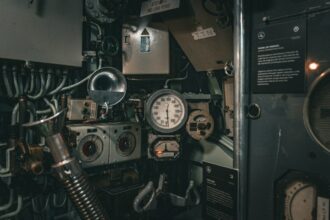
Project Azorian, a covert operation shrouded in secrecy and fueled by Cold War anxieties, stands as a stark reminder of how close the world has flirted with global conflict. While the immediate objective was the recovery of a sunken Soviet submarine, the underlying currents of espionage, technological daring, and geopolitical tension made this enterprise a veritable tightrope walk over the abyss of World War III. The narrative of Project Azorian is not just one of historical curiosity; it is a compelling case study in the high-stakes gamble inherent in superpower rivalries, a story where missteps sent ripples of dread across continents.
The story of Project Azorian begins not in a clandestine meeting room, but in the icy, unforgiving depths of the Pacific Ocean on March 11, 1968. On that fateful day, the Soviet Golf II-class ballistic missile submarine K-129, a vessel carrying its crew into the silent expanse, met its end. The exact cause of its demise remains a subject of speculation, a whispering ghost in the oceanic abyss. Theories range from a catastrophic battery malfunction to a collision with an American submarine, or even a retaliatory strike by a clandestine American weapon system, although the latter is highly improbable and has no supporting evidence.
The Silent Service’s Silent Loss
The K-129 was more than just steel and a payload of nuclear missiles; it was a symbol of Soviet naval power, a technological marvel of its era, and, crucially, a repository of sensitive intelligence. Its loss was a significant blow to the Soviet Union, not only in terms of materiel and human life but also in the potential intelligence advantage it represented for its adversaries. The Soviets, bound by the secrecy of their military operations, were unable to openly mourn or investigate the full extent of the disaster. The loss became a silent, heavy burden carried by the Soviet Navy.
The American Ear: A Whisper of Opportunity
However, the vastness of the ocean is no respecter of national borders in the realm of intelligence. American intelligence agencies, through their sophisticated listening posts and surveillance capabilities, detected the distress signals and the subsequent disappearance of the K-129. This was not merely a notification of a tragedy; it was a glimmer of opportunity. The potential intelligence contained within the sunken vessel – its advanced Soviet technology, its cryptographic materials, and its very operational secrets – was a prize beyond measure for the United States.
The Project Azorian mission, which aimed to recover a sunken Soviet submarine during the Cold War, has been analyzed for its potential risks and implications, including the possibility of escalating tensions that could lead to World War III. For a deeper understanding of these risks and the geopolitical climate of the time, you can read a related article that explores the intricacies of this covert operation and its impact on international relations. Check it out here: Project Azorian: A Risky Endeavor.
The Gambit: Project Azorian Takes Shape
With the location of the K-129 pinpointed, the stage was set for an audacious plan. The United States, driven by the imperative of intelligence advantage in the Cold War, embarked on what would become one of the most elaborate and ambitious covert operations in history: Project Azorian. This was not a simple salvage mission; it was a meticulously planned operation involving unprecedented technological innovation and a carefully constructed deception.
The Technological Tightrope: Building the Glomar Explorer
The core of Project Azorian lay in the development of the Glomar Explorer, a specialized ship designed to retrieve the K-129 from a depth of nearly 16,000 feet. This was a feat of engineering that pushed the boundaries of what was thought possible. The vessel was equipped with a massive, articulated arm nicknamed “Clementine,” capable of reaching the ocean floor and delicately lifting the submarine. This was akin to threading a needle with a battleship in the dark.
Engineering Miracles Under a Veil of Secrecy
The construction and operation of the Glomar Explorer were shrouded in layers of secrecy. To mask its true purpose, the operation was ostensibly presented as a deep-sea mining venture by Howard Hughes’s Summa Corporation. This subterfuge was crucial, as any overt acknowledgment of the salvage effort by the U.S. government would have immediately signaled the operation to the Soviet Union, likely triggering a severe response. The engineering challenges were immense, from the immense pressure at such depths to the precise maneuvering required to secure the submarine. The success of the project rested on the shoulders of brilliant minds working in the shadows, their achievements largely unrecognized for decades.
The Deception Doctrine: A Narrative of Plausible Deniability
The success of Project Azorian hinged on its ability to remain undetected by the Soviets. The cover story of deep-sea mining was central to this strategy. This narrative created a smokescreen of legitimate commercial activity, allowing the operation to proceed without raising immediate suspicion. The CIA, tasked with overseeing the project, understood that a naked display of intent would transform a salvage operation into a direct confrontation.
The Summa Corporation: A Civilian Front for a Shadow War
Howard Hughes, a recluse and a visionary in his own right, provided the perfect civilian facade. The Summa Corporation, his holding company, became the public face of the operation. This provided a degree of insulation for the U.S. government, allowing for plausible deniability should the Soviets discover the true nature of the Glomar Explorer’s activities. The intricate dance of secrecy and deception was a testament to the lengths to which both superpowers would go to gain an advantage, even if it meant employing the theatricalities of the private sector.
The Shadow of Escalation: Why Azorian Risked World War III
The audacious nature of Project Azorian, while driven by the allure of intelligence, carried with it a palpable risk of igniting a global conflagration. The Cold War was a period defined by a delicate balance of power, a precarious peace maintained by the threat of mutual annihilation. Any perceived transgression, especially one involving sensitive military assets, could easily tip the scales.
The Red Line: Soviet Military Assets in International Waters
The K-129, despite its watery grave, was still a sovereign asset of the Soviet Union. The act of attempting to recover it by a foreign power, particularly the United States, was a direct infringement of what the Soviets would have viewed as their territorial integrity, even in international waters. Imagine a burglar attempting to pick the lock on your neighbor’s safe in their living room – the perception of intrusion is immediate and deeply felt. For the Soviets, this was a far more significant invasion of their perceived security.
The Potential for Misinterpretation: From Salvage to Caper
The Soviets, already highly suspicious of American intentions and possessing a keen sense of their own strategic vulnerabilities, could have easily misinterpreted the salvage operation as something far more sinister. It was not a stretch of the imagination to envision them believing that the Americans were not merely recovering a lost submarine but attempting to steal advanced Soviet technology or even to gain access to classified information that could be used against them. This misinterpretation could have been the spark that ignited the powder keg.
The Escalation Ladder: A Step Towards Direct Confrontation
Had the Soviets detected the Glomar Explorer in the act of recovering the K-129, the immediate response could have been anything from diplomatic protests to aggressive military action. Consider the scenario: Soviet naval vessels shadowing the Glomar Explorer, perhaps deploying special forces or even submarines to intercept the operation. The American response, in turn, would have been to protect their asset, leading to a dangerous game of cat and mouse that could have easily escalated.
The Nuclear Shadow: The Ultimate Deterrent and the Ultimate Risk
The backdrop to Project Azorian was the ever-present specter of nuclear war. Both the United States and the Soviet Union possessed unimaginably destructive arsenals. A direct military confrontation, even if initially conventional, carried the inherent risk of spiraling into a nuclear exchange. The recovery of a ballistic missile submarine, an instrument of nuclear deterrence, would have been a particularly sensitive trigger. The possibility of the K-129’s nuclear warheads falling into American hands, or even being damaged and detonating, would have been a nightmare scenario for Soviet leadership, potentially leading to a preemptive strike. The decision to proceed with Project Azorian was, therefore, a calculated risk of stepping onto the precipice of global catastrophe.
The Unseen Success and the Lingering Questions
Despite the immense risks, Project Azorian, in its primary objective, was a success. The Glomar Explorer managed to lift a significant portion of the K-129 to the surface. However, the operation was not without its setbacks, and the full extent of what was recovered remains a subject of debate.
The Partial Victory: A Glimpse of Soviet Secrets
While the operation successfully retrieved a portion of the K-129, it did not manage to recover the entire submarine. The sheer weight and fragility of the vessel at such depths meant that parts of it broke apart during the ascent. Nevertheless, the recovered sections provided invaluable intelligence to the United States. They offered a tangible understanding of Soviet submarine technology, naval capabilities, and potentially even insights into their operational doctrines. It was like dismantling a complex lock and managing to extract a few vital tumblers.
The Intelligence Bonanza: What Was Gained?
The intelligence gleaned from the salvaged parts of the K-129 was reportedly immense. It allowed the U.S. to refine its understanding of Soviet sonar capabilities, missile technology, and communication systems. This knowledge directly informed American military strategy and defense development throughout the Cold War. The ability to anticipate Soviet technological advancements gave the United States a crucial edge in the ongoing arms race.
The Lingering Mysteries: What Remained Beneath?
The portions of the K-129 that were not recovered still lie on the ocean floor. Their ultimate fate and the secrets they still hold are unknown. Furthermore, the exact composition of the recovered materials and the full extent of the intelligence derived from them have never been fully disclosed by the U.S. government. This lack of transparency fuels continued speculation and contributes to the mystique surrounding Project Azorian.
The Unanswered Questions: A Legacy of the Unknown
The unanswered questions surrounding Project Azorian serve as a reminder of the inherent opacity of covert operations. What specific documents or technologies were recovered? What was the precise nature of the Soviet response during the operation, had they fully detected it? These questions, locked away in government archives, contribute to the enduring fascination with this daring and dangerous undertaking.
The Project Azorian mission, which aimed to recover a sunken Soviet submarine, has been analyzed for its potential risks, including the possibility of escalating tensions that could lead to World War III. A related article discusses the geopolitical implications of such covert operations and their impact on international relations. For more insights on this topic, you can read the full article here. Understanding the historical context of these missions is crucial for comprehending the delicate balance of power during the Cold War era.
The Azorian Legacy: A Cautionary Tale in the Game of Espionage
| Risk Factor | Description | Potential Impact | Mitigation Strategy | Risk Level |
|---|---|---|---|---|
| Detection by Soviet Forces | Possibility of Soviet detection of the recovery operation | Escalation to military confrontation, potential WWIII outbreak | Use of cover story, deep-sea secrecy, and timing during low Soviet surveillance | High |
| Technical Failure | Failure of the recovery vessel or equipment during operation | Loss of sensitive technology, mission failure, increased tensions | Extensive testing, redundant systems, and backup plans | Medium |
| Political Exposure | Leak or exposure of the mission to the public or foreign governments | Diplomatic fallout, increased Cold War tensions | Strict secrecy protocols, compartmentalization of information | Medium |
| Environmental Hazards | Adverse weather or ocean conditions impacting the operation | Delay or failure of mission, risk to crew safety | Careful timing, weather monitoring, and contingency planning | Low |
| Intelligence Misinterpretation | Incorrect assessment of Soviet capabilities or intentions | Misguided operational decisions, increased risk of conflict | Cross-checking intelligence, multiple sources, and expert analysis | Medium |
Project Azorian stands as a potent symbol of the high-stakes espionage that characterized the Cold War. It demonstrates the lengths to which nations would go to gain an intelligence advantage, even at the precipice of unimaginable destruction. The operation’s success was tempered by its inherent dangers, serving as a stark reminder of the fine line between strategic victory and catastrophic defeat.
The Price of Information: The Risks of the Shadow War
The relentless pursuit of intelligence during the Cold War often involved operations that were as perilous as they were ingenious. Project Azorian exemplifies this by pushing the boundaries of technology and daring. The potential rewards in terms of strategic advantage were immense, but the potential consequences of failure were existential. This project was a clear illustration of the immense pressures and risks inherent in the global game of espionage.
The Unseen Battles: The Ongoing Struggle for Supremacy
The efforts of Project Azorian were part of a broader, unseen struggle for technological and military supremacy between the United States and the Soviet Union. Each piece of intelligence gained, each technological advantage secured, was a victory in this protracted Cold War conflict. The successful recovery of the K-129, while shrouded in secrecy, undoubtedly played a part in shaping the strategic landscape for years to come.
Lessons for Today: The Enduring Relevance of Azorian
While the Cold War may be over, the lessons learned from Project Azorian remain relevant in the contemporary geopolitical landscape. The importance of intelligence gathering, the dangers of miscalculation, and the ever-present threat of escalation are all themes that continue to resonate in international relations. The ghosts of submarines and the echoes of Cold War anxieties serve as a perpetual reminder of the fragile nature of peace.
Navigating the Fog of Geopolitics: The Perils of Unchecked Ambition
Project Azorian serves as a cautionary tale for any nation pursuing ambitious covert operations. It highlights the critical need for careful planning, rigorous risk assessment, and a deep understanding of the potential for unintended consequences. The desire for knowledge and advantage, while powerful motivators, must be tempered by a respect for the delicate balance of global security. The shadow of Project Azorian reminds us that the pursuit of information can, indeed, be a dance with the devil, where a single misstep could plunge the world into an inferno.
WARNING: The $800 Million Mechanical Failure That Almost Started WWIII
FAQs
What was Project Azorian?
Project Azorian was a secret CIA mission in the early 1970s aimed at recovering a sunken Soviet submarine, K-129, from the Pacific Ocean floor using a specially designed ship called the Hughes Glomar Explorer.
Why was Project Azorian considered risky?
The mission was risky due to the technical challenges of deep-sea recovery, the potential for Soviet detection, and the geopolitical tensions of the Cold War, which could have escalated if the Soviets perceived the operation as an act of espionage or aggression.
Did Project Azorian have the potential to trigger World War III?
While Project Azorian was a high-stakes intelligence operation, there is no evidence that it directly risked triggering World War III. However, any covert operation involving the Soviet Union during the Cold War carried inherent risks of escalating tensions.
How did the United States try to keep Project Azorian secret?
The U.S. government maintained strict secrecy by using cover stories, such as claiming the Hughes Glomar Explorer was a commercial mining vessel, and by limiting information to a small group of officials to avoid leaks.
What was the outcome of Project Azorian?
Project Azorian partially succeeded in recovering a section of the K-129 submarine, but much of the submarine remained unrecovered. The mission provided valuable intelligence but remained classified for many years.