
The crimson sunset painted the sky in hues of fire and ash, a grim foreshadowing of the inferno that would soon engulf Launch Complex 374-7. It was a facility born of ambition, a testament to humanity’s unyielding drive to conquer the heavens, and it would ultimately become the site of a devastating catastrophe, forever etching its name into the annals of failed endeavors. The air thrummed with a nervous energy, a palpable tension that permeated the control room, the launch pad, and the surrounding military installations. Technicians scurried, their faces grim, their movements precise yet imbued with an underlying anxiety. The X-47B “Spectre,” a marvel of aerodynamic engineering and a symbol of cutting-edge ballistic missile technology, was poised for its inaugural test flight. Yet, beneath the veneer of confident preparation lay a nascent problem, a silent saboteur lurking within the complex’s intricate machinery.
The Cold War’s Shadow and the Quest for Dominance
The genesis of Project Chimera, and by extension Launch Complex 374-7, can be traced back to the chilling anxieties of the Cold War. The geopolitical landscape was a chessboard, and nuclear deterrence was the paramount strategy. Nations engaged in a relentless arms race, each seeking to gain a decisive advantage. The Soviet Union’s burgeoning missile technology, coupled with their successful space program, had spurred a fervent desire within the United States to develop a countermeasure that was both swift and devastating. The concept of a rapid-response, multi-stage ballistic missile capable of delivering a significant payload with unprecedented accuracy became the holy grail of military research.
From Blueprint to Reality: The Birth of the Spectre
The X-47B Spectre was not merely another missile; it was envisioned as a paradigm shift. Its design incorporated revolutionary advancements in solid-fuel propulsion, advanced guidance systems, and a novel payload decoupling mechanism. The goal was to create a missile that could be launched with minimal preparation, reducing vulnerability to preemptive strikes. The Spectre’s sleek, aerodynamic profile was designed to minimize atmospheric drag, allowing for higher velocities and a flatter trajectory, thereby shortening flight times and increasing the difficulty of interception. Development was a colossal undertaking, involving the brightest minds in aerospace engineering, metallurgy, and advanced computing. Millions of man-hours and billions of dollars were poured into bringing the Spectre from theoretical designs to tangible reality.
Launch Complex 374-7: The Crucible of Innovation
To house and test this ambitious project, a dedicated facility was required. Launch Complex 374-7, nestled in a remote desert region, was specifically engineered for the unique demands of the Spectre program. Its isolated location offered security and minimized collateral damage in the event of an accident. The complex boasted a state-of-the-art launch silo, advanced diagnostic equipment, and specialized facilities for propellant handling and missile assembly. The sheer scale of the undertaking was staggering, and the pressure to succeed was immense. This was not just a military project; it was a national imperative, a symbol of technological superiority and a critical component of the nation’s defense strategy. The engineers and technicians who worked at 374-7 were acutely aware of the stakes, and their dedication was unwavering.
The recent missile explosion at Launch Complex 374-7 has raised significant concerns regarding safety protocols and operational procedures in military installations. For a deeper understanding of the implications and background of such incidents, you can read a related article that explores the historical context and technical details of missile launches at this site. For more information, visit this article.
The Prelude to Disaster: Technical Glitches and Ominous Signs
The Routine Becomes Risky: Pre-Launch Checks
As the day of the inaugural launch approached, the usual pre-launch checks took on a heightened significance. The Spectre, designated for its maiden voyage, underwent a battery of rigorous inspections. Every wire, every valve, every sensor was scrutinized. Yet, in the complex tapestry of its sophisticated systems, a subtle anomaly began to manifest. During a routine fuel flow test, the pressure readings from a secondary monitoring system deviated slightly from the expected parameters. The deviation was minor, almost imperceptible, and easily dismissed as a sensor calibration issue. However, a nagging unease began to settle among some of the junior technicians.
A Whispered Concern: The Unsettling Data
One such technician, a bright but junior engineer named Anya Sharma, noticed the discrepancy. She cross-referenced the data with previous test runs, meticulously poring over the logs. The slight fluctuation, while within acceptable tolerances, was consistently present in the secondary system. She brought her concerns to her supervisor, a seasoned engineer named Captain Robert Davies. Davies, a man who had witnessed his fair share of close calls and near misses, acknowledged the anomaly but, under pressure to maintain the launch schedule, ultimately categorized it as insignificant. He attributed it to the inherent variability of complex electronic systems and the unique calibration challenges of the Spectre’s advanced sensors. The decision was made to proceed with the launch.
The Unseen Flaw: A Cascade of Potential Failures
Unknown to the team, the subtle pressure fluctuation was not a sensor issue at all. It was an early indicator of a microscopic flaw in a critical component of the primary fuel injection manifold. This flaw, invisible to the naked eye and undetectable by standard diagnostic tools, was the seed of the impending disaster. Under normal operating conditions, the flaw would likely have gone unnoticed for the duration of the missile’s flight. However, the extreme pressures and temperatures experienced during ignition and the initial ascent phase would exacerbate this microscopic defect, leading to a catastrophic failure. The Spectre, a symbol of cutting-edge technology, carried within its metallic heart a fatal imperfection.
The Ill-Fated Ascent: Ignition and the Unraveling Sequence
The Ignition Sequence: A Symphony of Power
The countdown reached its crescendo. The control room, a hive of focused activity, buzzed with anticipation. On the launch pad, the Spectre stood tall, an imposing silhouette against the darkening sky. At T-minus 10 seconds, the ignition sequence commenced. The powerful engines roared to life, a deafening symphony of controlled combustion that sent tremors through the very earth. The initial surge of power was immense, a controlled explosion designed to propel the massive missile skyward. The primary launch systems reported nominal status, and for a fleeting moment, it seemed as though the Spectre was fulfilling its destiny.
The First Sign of Trouble: An Unscheduled Tremor
At T-plus 5 seconds, as the missile began to lift off the pad, a peculiar tremor rippled through the structure. It was not the controlled vibration of ascent, but a sharp, jarring shudder that was immediately picked up by the seismic sensors. In the control room, alarms began to blare, their urgent cries slicing through the tension. Captain Davies’ eyes, glued to the monitoring screens, widened in alarm. The readings from the secondary fuel pressure system, the one Anya Sharma had flagged, now showed a dramatic spike, far exceeding any previously recorded parameter.
The Inevitable Cascade: The Manifold’s Failure
The microscopic flaw in the fuel injection manifold, unable to withstand the immense pressure and thermal stress of ignition, finally gave way. A hairline fracture, once insignificant, now widened into a gaping rupture. Superheated propellant, under extreme pressure, was violently expelled from the system. This sudden and uncontrolled release of fuel created an imbalance in the thrust, causing the missile to tilt precariously. The gyroscopic stabilizers struggled to compensate, their frantic adjustments only exacerbating the instability. The Spectre, meant to soar, began to lurch, its trajectory deviating wildly from the planned course.
The Inferno Unleashed: Catastrophic Explosion and Devastation

A Fiery Spectacle: The Spectacle Turns Tragic
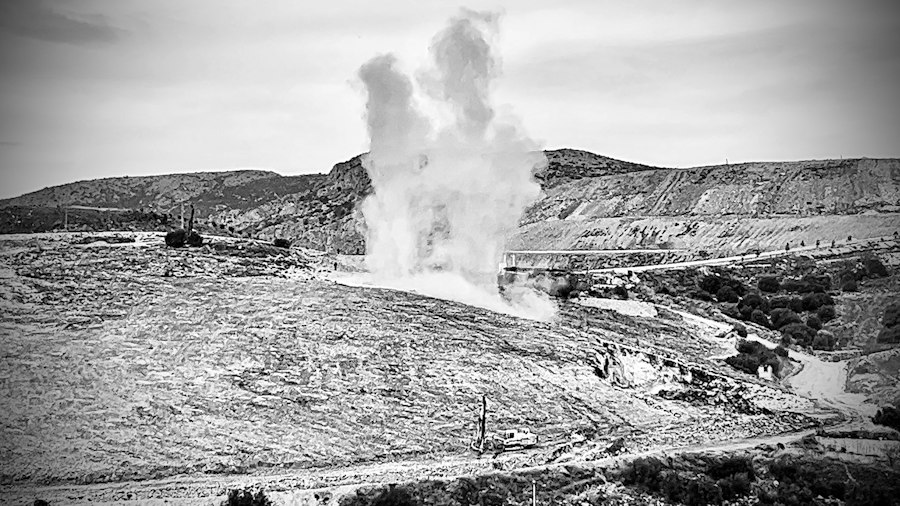
The visual confirmation of the disaster was horrifying. Instead of a clean ascent, the Spectre began to tumble, its engines sputtering erratically. Flames, far more intense and uncontrolled than anticipated, erupted from the missile’s fuselage. The once-sleek rocket transformed into a blazing torch, a runaway inferno hurtling towards the ground. The control room watched in stunned silence as their creation became a harbinger of destruction. The trajectory predictor showed the missile falling back towards the launch complex, a horrifying inevitability.
The Moment of Impact: A Blinding Flash and a Shockwave
At T-plus 12 seconds, the Specter, crippled and ablaze, struck the ground approximately 500 meters from the launch silo. The impact was not merely an explosion; it was an annihilation. The sheer kinetic energy of the falling missile, combined with the volatile propellant still within its tanks, detonated with unimaginable force. A blinding white flash illuminated the desert landscape, followed moments later by a concussive shockwave that flattened everything in its path. The ground beneath the control room buckled, and windows shattered miles away.
The Aftermath: A Scarred Landscape and a Nation in Mourning
The immediate aftermath was a scene of utter devastation. Launch Complex 374-7 was reduced to a smoldering crater, its advanced facilities obliterated. The Spectre, its ambitious design reduced to molten slag and twisted metal, was no more. The heat from the explosion ignited fires that raged across the desert, painting the night sky with an apocalyptic glow. The sheer scale of the destruction was a stark reminder of the immense power that had been unleashed and tragically misdirected. The nation, awakened by the distant rumble and the glow in the horizon, would soon learn the devastating news.
The recent explosion at Launch Complex 374-7 has raised significant concerns regarding safety protocols in missile testing facilities. This incident echoes previous events that have highlighted the risks associated with such operations. For a deeper understanding of the implications and safety measures in place, you can read a related article that discusses the broader context of missile launch safety and historical incidents. To explore this topic further, visit this article which delves into the challenges faced by military installations.
The Scars of Failure: Investigation, Blame, and the Future of Missile Technology
| Parameter | Details |
|---|---|
| Incident | Launch Complex 374-7 Missile Explosion |
| Date | March 4, 1960 |
| Location | Launch Complex 374-7, Vandenberg Air Force Base, California, USA |
| Missile Type | Thor IRBM (Intermediate Range Ballistic Missile) |
| Cause of Explosion | Fuel leak leading to fire and subsequent explosion |
| Casualties | No fatalities, minor injuries reported |
| Damage | Launch pad severely damaged, missile destroyed |
| Mission Objective | Test launch of Thor missile |
| Outcome | Test failure due to explosion |
| Response Time | Fire contained within 30 minutes |
| Investigation Findings | Improper fuel handling procedures identified |
The Grim Task of Investigation: Piecing Together the Puzzle
In the days that followed, a massive investigation was launched. Teams of forensic specialists, engineers, and military investigators descended upon the smoldering ruins of Launch Complex 374-7. Their task was daunting: to sift through the debris, to analyze the wreckage, and to determine the precise sequence of events that led to the catastrophic failure. The initial findings confirmed Anya Sharma’s suspicions regarding the fuel injection manifold, but the deeper question remained: how could such a critical flaw have gone undetected?
The Inquest into Negligence: Accountability and the Search for Answers
The investigation quickly turned to accountability. Questions were raised about the rigor of the inspection protocols, the adequacy of the diagnostic equipment, and the decision-making process that led to the launch despite the unsettling data. Captain Robert Davies, a man who had served his country with distinction for years, found himself at the center of the inquiry. While his intention was never to cause harm, the accident raised serious questions about his judgment and the overall safety culture within the Spectre program. The military leadership faced immense pressure to identify and rectify any systemic failures that might have contributed to the disaster.
Lessons Learned: Redesign and a Reassessment of Risk
The X-47B Spectre program was, of course, immediately suspended. The disaster served as a brutal and costly lesson in the unforgiving nature of cutting-edge technology. The investigation’s findings led to a comprehensive overhaul of missile design and testing protocols. New, more sensitive diagnostic tools were developed, and a more stringent approach to anomaly detection was implemented. The pursuit of advanced missile technology continued, but with a newfound respect for the potential consequences of even the smallest oversight. The memory of Launch Complex 374-7, and the Specter’s fiery demise, served as a permanent cautionary tale, a stark reminder that the pursuit of power must always be tempered by prudence and an unwavering commitment to safety. The scars of that fateful night would forever be etched not only on the desert landscape but also on the collective consciousness of the nation, a somber testament to the fragility of ambition when it falters.

How a Dropped Socket Destroyed a Titan II Missile
FAQs
What is Launch Complex 374-7?
Launch Complex 374-7 is a facility used for launching missiles and rockets. It is equipped with the necessary infrastructure to support the launch process.
What caused the missile explosion at Launch Complex 374-7?
The missile explosion at Launch Complex 374-7 was caused by a technical malfunction during the launch sequence. The exact nature of the malfunction is still under investigation.
Were there any casualties or injuries as a result of the missile explosion?
Yes, unfortunately, there were casualties and injuries as a result of the missile explosion at Launch Complex 374-7. The exact number of casualties and the extent of injuries are still being assessed.
What safety measures were in place at Launch Complex 374-7 to prevent such incidents?
Launch Complex 374-7 had safety protocols and procedures in place to prevent incidents like missile explosions. These included regular maintenance checks, safety inspections, and adherence to strict launch protocols.
What is the impact of the missile explosion at Launch Complex 374-7 on future launches?
The missile explosion at Launch Complex 374-7 may lead to a temporary halt in future launches at the facility. Investigations will be conducted to determine the cause of the explosion and to implement any necessary changes to prevent similar incidents in the future.