The declassified files paint a picture of a mission so audacious, so seemingly straightforward, yet so fraught with the potential for catastrophic escalation, that it’s almost difficult to believe it transpired. Operation Paul Bunyan, as it was codenamed, was not a clandestine raid or a complex intelligence gathering exercise. Instead, it was a brutal, precise, and remarkably swift arboreal assault, designed to reshape a geopolitical landscape and assert dominance through a stark, physical demonstration. The objective: to fell a specific cluster of trees on a hotly contested border, a seemingly minor act that belied the immense strategic anxieties it was intended to address. The entire operation, from the moment the first saw touched wood to the last stump being surveyed, took a mere 42 minutes.
The Genesis of a Timber Felling Operation: Border Tensions in the DMZ
The Korean Peninsula, a land divided by ideology and a heavily militarized border known as the Demilitarized Zone (DMZ), has been a tinderbox for decades. Following the Korean War (1950-1953), an armistice agreement was signed, creating a buffer zone that, in practice, became one of the most heavily fortified borders in the world. The DMZ, stretching approximately 250 kilometers across the peninsula, is a physical manifestation of the deep animosity and unresolved conflict between North and South Korea, as well as their respective international allies. Within this tense environment, even the most innocuous natural features could become points of contention and strategic calculation.
A Landscape of Unease: The Strategic Significance of Visibility
The dense foliage and towering trees within the DMZ, particularly on the southern side, presented a dual-edged sword. While offering natural camouflage and a degree of concealment, they also limited the line of sight for South Korean and United Nations Command (UNC) forces. This lack of clear visibility was a significant operational concern. Enemy infiltrators, the movement of military personnel, and even the potential for artillery observation could be obscured by the dense tree cover. In a region where every shadow could conceal a threat, the ability to observe and react swiftly was paramount.
The Pine Tree as a Tactical Obstacle
The specific target of Operation Paul Bunyan was a cluster of pine trees, notably a large, imposing specimen, situated within the Joint Security Area (JSA) of the DMZ. The JSA, located in the western part of the DMZ, is the only place where North and South Korean forces stand face-to-face. It is a place of perpetual tension, where diplomatic negotiations and military standoffs coexist precariously. The trees in question, while seemingly natural, had become a tactical impediment. Their height and density afforded North Korean soldiers improved vantage points and potential cover for covert activities. They also obstructed the clear observation capabilities of UN forces stationed at observation posts overlooking the area.
The “Axe Incident” of 1976: A Catalyst for Action
The immediate precursor to Operation Paul Bunyan was an incident that occurred on August 18, 1976, known as the “Axe Murder Incident” or the “Panmunjom Axe Incident.” A team of U.S. and South Korean soldiers were tasked with pruning a large poplar tree that had been planted by Kim Il-sung, the former North Korean leader, and his son Kim Jong-il, decades earlier. The tree had grown to a size that obstructed the view from a nearby UN guard post. As the team began their work, a group of North Korean soldiers, led by a Captain Pak, arrived and aggressively demanded they cease their activity.
Operation Paul Bunyan, a military operation conducted in 1976, involved the swift removal of a poplar tree in the Korean Demilitarized Zone, which had become a focal point of tension between U.S. and North Korean forces. This 42-minute tree-cutting mission was not only a demonstration of power but also a strategic response to the earlier killing of two U.S. soldiers. For a deeper understanding of the historical context and implications of this operation, you can read a related article that explores the broader significance of military actions in the region at this link.
The Escalation and the Decision to Act: A Calculated Response
The Axe Incident rapidly escalated into a violent confrontation. The North Koreans, claiming the tree was a sacred monument, attacked the U.S. and South Korean personnel with axes and clubs. The assault was brutal, resulting in the deaths of two U.S. Army officers, Captain Arthur Bonifas and Lieutenant Mark Barrett, and injuring several others. The incident sent shockwaves through the command structure and ignited a furious debate about how to respond. The North Koreans, by their violent actions, had not only challenged the authority of the UN Command but had also directly attacked allied forces on what was considered neutral ground.
The Dilemma of Retaliation: A Tightrope Walk
The pressure to retaliate was immense, both from within the military and from the U.S. government. However, the specter of full-scale war on the Korean Peninsula loomed large. Any direct military action carried the risk of being misinterpreted by North Korea, potentially leading to an uncontainable conflict. The response had to be decisive, impactful, and yet carefully calibrated to avoid further bloodshed and an uncontrolled escalation. The challenge was to demonstrate resolve without provoking an all-out war.
The Strategic Imperative: Reasserting Control
Beyond the immediate outrage over the killings, the incident highlighted a broader strategic concern. The North Koreans’ aggressive territorial claims and their willingness to use violence to enforce them within the JSA were unacceptable. The UN Command needed to demonstrate its unwavering control over the area and its ability to enforce its mandate. The presence of the obstructive trees, which had been used as a pretext for the North Koreans’ aggression, now became the focus of a very different kind of intervention.
The Genesis of “Operation Paul Bunyan”: A Symbolic and Practical Solution
The idea to remove the trees, specifically the offending poplar and its surrounding brethren, emerged as a solution that was both symbolic and practical. Felling the trees would remove the tactical advantage they provided to North Korea, improve visibility for UN forces, and, most importantly, serve as a stark and undeniable message of resolve. The operation was codenamed “Paul Bunyan,” a nod to the legendary American lumberjack, symbolizing immense strength and a willingness to tackle colossal tasks. The irony of an American folklore hero being invoked in a tense Korean border conflict was not lost on those involved.
The Planning and Preparation: Orchestrating a Swift and Decisive Assault
The planning for Operation Paul Bunyan was conducted with extreme haste and under the utmost secrecy. The gravity of the situation demanded a swift response, and the operational window was expected to be narrow. The objective was not just to cut down trees, but to do so in a manner that minimized the risk of a confrontation and demonstrated overwhelming force and capability. Every detail, from the tools to the personnel, was meticulously considered.
Assembling the Force: A Show of Military Might
The operation required a significant deployment of personnel and equipment, designed to both execute the task efficiently and deter any North Korean interference. A large contingent of U.S. and South Korean soldiers was assembled, including infantry, engineers, and specialized units. The presence of these forces was intended to be a clear signal of intent, a visible deterrent to any North Korean provocation.
The Tools of the Trade: Beyond the Humble Axe
While the “axe” was the symbol of the incident, the actual operation would utilize more modern and efficient tools for lumberjacking. Chainsaws, which were not readily available in the JSA at the time, were a key component. The U.S. Army procured two of these powerful machines specifically for the operation. Additionally, the operation involved engineers tasked with rigging and felling techniques to ensure the trees fell in a controlled manner.
The Intelligence Briefing: Anticipating North Korean Reactions
Extensive intelligence gathering and analysis were conducted to anticipate North Korean reactions. The hope was that the sheer scale and speed of the operation would catch them off guard, leaving them with little opportunity to mount an effective response. The timing of the operation was also crucial, aiming for a period when North Korean observation might be less vigilant, although in the JSA, vigilance was the norm.
The Rules of Engagement: Calculated Restraint
Despite the recent killings, the rules of engagement for Operation Paul Bunyan were designed to be primarily defensive. While lethal force was authorized if necessary to protect the operation and its personnel, the primary objective was to complete the task without further bloodshed. This represented a delicate balance between asserting authority and avoiding a full-blown conflict. The forces were prepared for the worst, but the hope was that overwhelming presence and efficiency would prevent it.
The Execution: 42 Minutes of Controlled Deforestation
The morning of August 21, 1976, dawned with a tense quiet over the JSA. The plan was set in motion with military precision. The operation, codenamed Paul Bunyan, was designed to be swift, decisive, and overwhelming. The goal was to cut down the offending trees in the shortest possible time, minimizing the window for any potential North Korean intervention.
The Initial Incursion: Establishing a Secure Perimeter
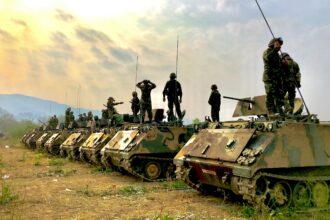
Under the watchful eyes of numerous UN observation posts, a substantial force of U.S. and South Korean soldiers began to move into the designated area. Their primary objective was to establish a secure perimeter around the target trees. This involved positioning troops to create a physical barrier, ready to respond to any immediate threats. The presence of hundreds of heavily armed soldiers, alongside armored personnel carriers and helicopters hovering overhead, was a clear and unambiguous message.
The Sound of Progress: Chainsaws Against the Silent Threat
The air, usually filled with the strained silence of the DMZ, was soon broken by the unmistakable roar of chainsaws. These were not the quaint tools of leisurely woodworking; these were powerful, industrial machines designed for rapid timber felling. Two chainsaws, specially brought in for the operation, were put to immediate use. Skilled engineers and lumberjacks, accustomed to rigorous training and demanding conditions, expertly guided the cutting, aiming to fell the trees efficiently and safely.
The Spectacle of Defiance: A Visual Declaration
As the trees began to fall, the operation became a highly visible spectacle for both sides of the DMZ. North Korean soldiers, observing from their positions, were undoubtedly witnessing a direct challenge to their authority and territorial claims. The falling trees were a potent visual declaration of the UN Command’s resolve. It was a tangible act of defiance, a physical reshaping of the disputed landscape. The sheer speed and scale of the operation were designed to leave no room for misinterpretation.
The Unseen Presence: Helicopters and Aerial Surveillance
Throughout the operation, helicopters patrolled the skies, providing aerial surveillance and an additional layer of deterrence. They were not just observers; they were a constant reminder of the UN Command’s aerial superiority and their ability to rapidly deploy assets. The presence of these noisy machines overhead would have further amplified the message of power and control.
The 42-Minute Timeline: A Masterclass in Efficiency
The entire operation, from the moment the first saw began to cut to the moment the last stump was surveyed, took an astonishingly brief 42 minutes. This remarkable efficiency was a testament to the meticulous planning, the skilled execution, and the overwhelming force deployed. The swiftness of the operation was a key strategic element, designed to prevent North Korea from formulating a meaningful or effective response. It was a lightning strike, leaving little time for deliberation or counter-aggression.
Operation Paul Bunyan, a remarkable 42-minute tree cutting mission, was a significant event during the Korean War that symbolized the tension between North and South Korea. For those interested in exploring the broader implications of this operation and its impact on military strategy, a related article can be found at In The War Room. This piece delves into the historical context and the strategic decisions that shaped this unique military endeavor, providing valuable insights into the complexities of warfare during that era.
The Aftermath and the Message: A Reshaped Landscape and a Stark Warning
Operation Paul Bunyan concluded as swiftly as it began, leaving behind a dramatically altered landscape and a clear, albeit unspoken, message to North Korea. The trees that had stood as symbols of obstruction and potential advantage were gone, replaced by a stark reminder of the UN Command’s determination.
The Visual Impact: A Clearer Line of Sight
The most immediate and obvious consequence of Operation Paul Bunyan was the physical alteration of the JSA. The towering trees were gone, leaving behind stumps and open ground. This immediately improved the line of sight for UN forces, enhancing their ability to monitor activity in the area. The tactical advantage that the North Koreans might have perceived in the dense foliage was effectively neutralized.
The Psychological Warfare: A Demonstration of Will
Beyond the tactical gains, the operation served as a potent form of psychological warfare. The swiftness and decisiveness of the operation sent a clear message to Pyongyang: the UN Command would not tolerate aggression or challenges to its authority. The felling of the trees was a symbolic act of reclaiming control and demonstrating the capacity for swift and impactful action. It was a powerful statement that the days of North Korean territorial encroachment, even through arboreal manipulation, were over.
The Absence of Escalation: A Carefully Orchestrated Outcome
Remarkably, despite the heightened tensions and the potential for reprisal, Operation Paul Bunyan did not lead to a wider military conflict. The North Koreans, though undoubtedly angered, did not launch a direct military counter-attack. Several factors likely contributed to this: the overwhelming show of force, the speed of the operation, and perhaps a realization that further aggression could have led to an even more significant and undesirable response from the UN Command. The operation was a gamble, but one that paid off in terms of achieving its objectives without triggering a catastrophic escalation.
The Lingering Legacy: A Symbol of Resolve
Operation Paul Bunyan remains a fascinating, if somewhat obscure, chapter in the history of the Korean Peninsula. It stands as a testament to the complex and often bizarre nature of geopolitical conflict, where even the act of felling trees can carry immense strategic weight. It illustrates how military planning can be as much about psychology and symbolism as it is about brute force. The story of the 42-minute tree-cutting mission serves as a stark reminder of the constant tension that has characterized the DMZ and the lengths to which nations will go to assert their dominance and protect their interests, even in the most unlikely of arenas.
The Enduring Significance of a 42-Minute Mission
Operation Paul Bunyan, though concluded in less than an hour, cast a long shadow. It was a critical moment in the ongoing, albeit frozen, conflict on the Korean Peninsula, demonstrating the UN Command’s resolve and its capacity for swift, decisive action. The operation was a carefully calculated response to a violent provocation, a demonstration of power designed to deter further aggression without igniting a full-blown war.
The JSA as a Microcosm of Conflict
The Joint Security Area, where Operation Paul Bunyan took place, has always been a focal point of tension. It is the only place where North and South Korean soldiers stand mere meters apart, a constant reminder of the division and the unresolved conflict. The trees, in their growth and their removal, became an integral part of this micro-conflict, a physical manifestation of territorial disputes and strategic maneuvering.
The Power of Symbolic Action
The operation underscored the power of symbolic action in international relations. The felling of the trees was not just about improving visibility; it was about sending a message. It was a declaration of control, a rejection of North Korean territorial claims, and a stark warning against future provocations. The efficiency and overwhelming nature of the operation ensured that the message was received and understood.
The Balancing Act of Deterrence
Operation Paul Bunyan epitomized the delicate balancing act of deterrence. The UN Command sought to deter future aggression by demonstrating its capability and its willingness to act decisively. However, it also had to ensure that its actions did not inadvertently provoke a wider conflict. The 42-minute timeline was a key element in achieving this balance, leaving North Korea with little opportunity to mount a significant, escalatory response.
A Legacy of Measured Force
In the annals of military history, Operation Paul Bunyan might not be as widely known as grand invasions or prolonged campaigns. Yet, its significance lies in its precise execution and its successful achievement of strategic objectives through a seemingly minor act. It stands as a case study in how measured force, coupled with meticulous planning and a clear understanding of psychological dynamics, can yield profound results. The story of Operation Paul Bunyan, the 42-minute tree-cutting mission, remains a compelling illustration of the complex realities of the Korean Peninsula and the enduring quest for stability in a divided world.

America Sent an Aircraft Carrier to Cut Down One Tree
FAQs

What was Operation Paul Bunyan?
Operation Paul Bunyan was a 42-minute tree-cutting mission carried out by the United States and South Korea in the Korean Demilitarized Zone in 1976.
Why was Operation Paul Bunyan conducted?
Operation Paul Bunyan was conducted in response to the killing of two U.S. Army officers by North Korean soldiers while attempting to trim a poplar tree in the DMZ.
How many trees were cut down during Operation Paul Bunyan?
During Operation Paul Bunyan, a total of 42 trees were cut down in the DMZ, including the infamous poplar tree that led to the deadly incident.
What was the significance of the name “Operation Paul Bunyan”?
The name “Operation Paul Bunyan” was chosen to symbolize the determination and strength of the U.S. and South Korean forces in carrying out the tree-cutting mission in the face of North Korean aggression.
Did Operation Paul Bunyan lead to further escalation of tensions between North and South Korea?
Despite the tense atmosphere surrounding Operation Paul Bunyan, the mission was successful in demonstrating the resolve of the U.S. and South Korea without leading to further escalation of tensions between North and South Korea.